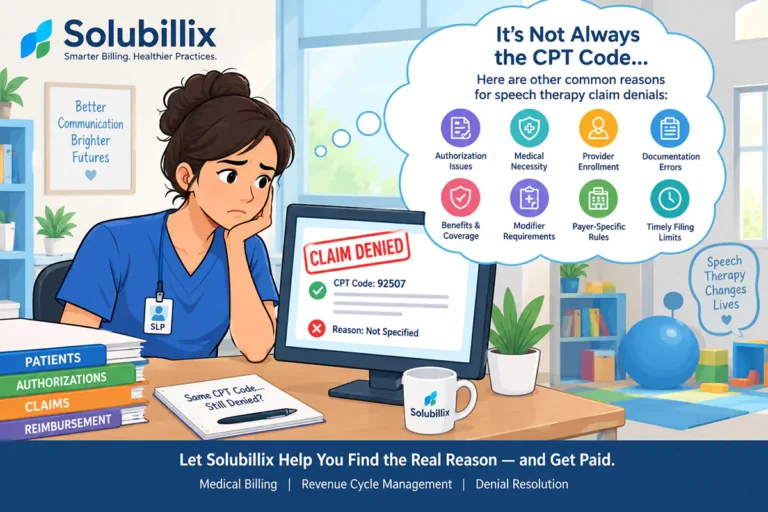

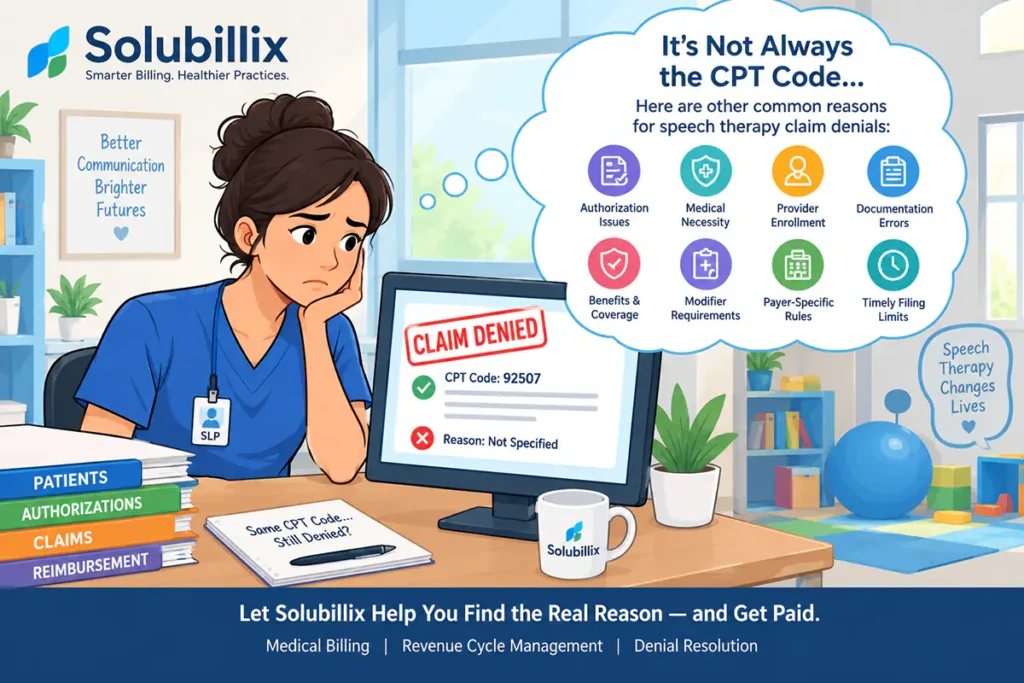
For many speech-language pathology practices, a denied claim can create the immediate assumption that something is wrong with the CPT code. When the claim includes 92507 and the service was correctly documented, however, the CPT code itself may not be the reason for the denial.
A speech therapy claim can be denied because of authorization, diagnosis, medical necessity, provider enrollment, modifiers, payer policy, benefit limitations, or information elsewhere on the claim.
For SLP practices, understanding the difference is important. Repeatedly correcting a claim that was already coded correctly can delay reimbursement without addressing the actual problem.
What Is CPT 92507?
CPT 92507 is used to report individual treatment of speech, language, voice, communication, and/or auditory processing disorders. CMS currently recognizes 92507 as an outpatient speech-language pathology treatment code.
For Medicare claims, the GN modifier is used to identify services furnished by a speech-language pathologist or under an outpatient speech-language pathology plan of care.
However, having the correct 92507 code does not automatically mean a claim will be payable. The rest of the claim still needs to satisfy the applicable payer’s coverage and billing requirements.
1. Authorization May Be the Real Problem
One of the most common situations is a claim being submitted with the correct CPT code but without a valid authorization for the date of service.
For example, an SLP practice may have an authorization for 12 visits, but the patient could have already exhausted those visits. An authorization may also have an effective date that does not cover the date being billed.
Before assuming the CPT code is incorrect, billing teams should verify:
- Authorization number
- Approved number of visits
- Authorization effective and expiration dates
- Authorized service
- Patient’s remaining visits
- Whether the payer requires a new authorization after a specific number of visits
An authorization problem generally requires a different solution from a coding correction.
2. The Diagnosis May Not Support Medical Necessity
A correctly reported 92507 does not eliminate the need for an appropriate diagnosis.
Medicare coverage policies identify diagnosis codes that may support medical necessity for speech-language pathology services, including 92507. CMS also states that the provider is responsible for selecting diagnosis codes to the highest level of specificity appropriate to the year of service.
This means a claim can contain a valid CPT code while still receiving a medical-necessity denial if the diagnosis, documentation, or payer coverage policy does not support the service.
Billing teams should compare:
Diagnosis → treatment plan → documented problem → treatment performed → payer coverage policy
If those elements do not tell the same story, changing 92507 may not resolve the denial.
3. The GN Modifier Can Matter
For Medicare outpatient speech-language pathology claims, modifier GN identifies services furnished personally by an SLP or under an outpatient SLP plan of care.
A missing or incorrect therapy modifier can therefore create a claim-processing problem even when 92507 itself is correct.
Modifier requirements should not be assumed to be identical across every payer. Commercial plans and Medicaid programs may have their own billing rules.
Before resubmitting a denied claim, verify the payer’s current requirements rather than automatically adding or changing a modifier.
4. Provider Enrollment and Credentialing Can Cause Denials
Sometimes the claim is correct but the payer does not recognize the provider in the way the claim was submitted.
Potential issues include:
- Rendering provider not enrolled with the payer
- Rendering provider not linked correctly to the billing entity
- Incorrect NPI or taxonomy
- Credentialing not effective for the date of service
- Location not associated with the provider
- Group enrollment mismatch
This is particularly important for practices that recently hired an SLP, opened a new location, changed their billing entity, or completed a credentialing update.
If the payer does not recognize the provider relationship correctly, changing 92507 will not solve the underlying issue.
5. The Patient’s Benefit May Not Cover the Service
A patient can have active insurance and still have limited or no coverage for a particular therapy service.
Eligibility verification should go beyond asking whether the policy is active.
For speech therapy, billing teams should verify applicable:
- Therapy benefits
- Visit limitations
- Deductible and coinsurance
- Prior authorization requirements
- Referral requirements
- Exclusions
- Benefit-year limitations
- Network restrictions
Active coverage does not necessarily mean unlimited coverage.
That distinction is one of the reasons a claim can be denied even when the CPT code is completely appropriate.
6. The Claim May Have a Payer-Specific Billing Requirement
Healthcare payers do not always process claims using identical rules.
A payer may require specific information relating to the provider, diagnosis, authorization, place of service, modifier, referral, or benefit category.
This is why an SLP practice should avoid assuming that a billing rule used successfully with one payer will automatically work with another.
A good denial-management process identifies the payer’s actual denial reason first, then determines whether the issue is:
coding, authorization, eligibility, credentialing, documentation, medical necessity, or payer processing.
7. Documentation May Not Support the Billed Service
A claim can contain the right CPT code while the medical record does not adequately support the service.
CMS states that medical records must support the medical necessity of therapy services and that the services must be appropriate for the patient’s condition and require the skills of a qualified clinician.
For an SLP claim, documentation should tell a consistent story about the patient’s condition, treatment goals, skilled intervention, progress, and plan of care.
If the documentation does not support the billed service, simply correcting the claim form may not be enough.
8. Same-Day Services Can Create Claim Conflicts
Another issue can arise when multiple therapy services are reported on the same date of service.
CMS’s 2026 NCCI Policy Manual includes specific guidance involving 92507/92508 and other therapy services. For example, a single practitioner should not report 92507 and/or 92508 on the same date as certain cognitive or sensory treatment codes such as 97129, 97130, or 97533. CMS also describes circumstances in which services performed by different practitioners may be separately reportable.
This is a good example of why looking only at the 92507 line can be misleading.
The entire claim and same-day services may need to be reviewed.
A Better Way to Investigate a 92507 Denial
When Solubillix reviews a denied speech therapy claim, the first question should not simply be:
“Is 92507 correct?”
Instead, the review should follow the entire claim pathway:
Patient eligibility → Authorization → Provider enrollment → Diagnosis → Plan of care → Documentation → CPT → Modifier → Place of service → Claim submission → Payer adjudication
This approach helps identify the actual source of the denial instead of repeatedly correcting the same claim line.
Before Resubmitting a Denied 92507 Claim, Check:
| Area | What to Verify |
| Eligibility | Was the patient’s coverage active on the DOS? |
| Benefits | Does the plan cover speech therapy? |
| Authorization | Was 92507 authorized for the DOS? |
| Diagnosis | Does the diagnosis support the service? |
| Provider | Is the rendering SLP properly enrolled? |
| Modifier | Does the payer require GN or another modifier? |
| Documentation | Does the record support skilled therapy? |
| Same-day services | Are there applicable claim edits? |
| Payer policy | Does the plan have additional requirements? |
| Denial reason | Does the EOB/ERA identify the actual issue? |
An Important 2027 Change for SLP Practices
Speech therapy billing teams should also be preparing for a significant CPT change.
CPT 92507 remains in effect through December 31, 2026. Beginning January 1, 2027, it will be replaced by a new family of 10 speech-language pathology treatment codes. The new codes use a time-based structure with base and add-on codes. CMS has proposed Medicare values for the new codes, with final Medicare payment values to be established through the CY 2027 Medicare Physician Fee Schedule final rule.
For SLP practices, this means 2026 claims should not simply be carried forward into 2027 without reviewing the new coding and payer requirements.
Practices should begin preparing their billing teams, EHR templates, fee schedules, payer contracts, authorization workflows, and claim edits for the transition.
The Bottom Line
A denied 92507 claim does not automatically mean 92507 was billed incorrectly.
The real problem may be authorization, medical necessity, diagnosis, provider enrollment, benefits, modifiers, documentation, payer policy, or another claim-level issue.
For speech therapy practices, effective denial management means looking beyond the CPT code and reviewing the complete revenue cycle surrounding the service.
At Solubillix, we help healthcare practices identify the underlying causes of claim denials—not simply resubmit the same claim and hope for a different result. Our medical billing and RCM team can help review eligibility, authorization, coding, claim submission, denials, appeals, and outstanding accounts receivable so providers can spend more time focusing on patient care and less time troubleshooting payer issues.
Frequently Asked Questions
Can a 92507 claim be denied even if the CPT code is correct?
Yes. A claim can be denied for reasons unrelated to the CPT code, including authorization, eligibility, medical necessity, provider enrollment, documentation, modifier requirements, or payer-specific policies.
Does 92507 require the GN modifier?
For applicable Medicare outpatient speech-language pathology claims, CMS uses the GN modifier to identify services furnished by an SLP or under an outpatient SLP plan of care. Other payers may have different requirements, so payer-specific guidance should be verified.
Is 92507 still valid in 2026?
Yes. CPT 92507 remains in effect through December 31, 2026. A new family of SLP treatment codes is scheduled to replace it beginning January 1, 2027.
What should an SLP practice check first after a 92507 denial?
Start with the payer’s specific denial reason, then verify eligibility, authorization, diagnosis, provider enrollment, modifier requirements, documentation, and any applicable claim edits before deciding whether to correct, resubmit, or appeal the claim.