
Therapy billing can look simple until a claim comes back because of a modifier.
For physical therapy and occupational therapy practices, GP, GO, CQ, and CO are four modifiers that can have a direct impact on how Medicare identifies the therapy discipline and, in certain circumstances, how the service is reimbursed.
The confusion usually starts when these modifiers are treated as interchangeable.
They are not.
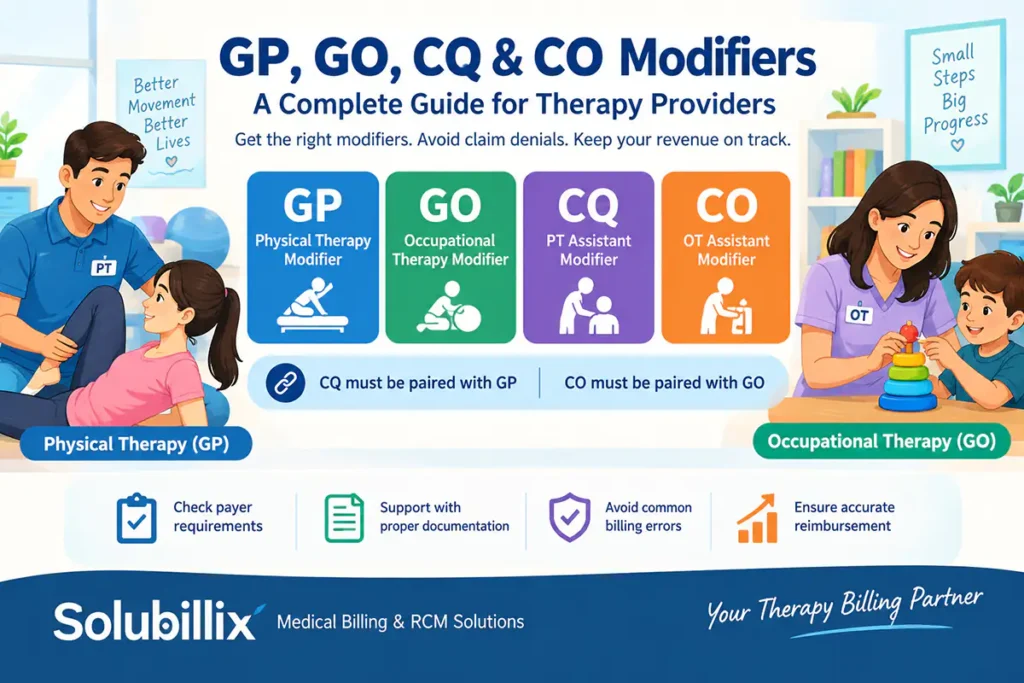
GP and GO identify the therapy discipline. CQ and CO identify services furnished by therapy assistants. CMS requires CQ and CO to be paired with the corresponding GP or GO modifier when applicable.
That distinction is important for both clinicians and billing teams.
A claim with the wrong modifier combination can be rejected, returned as unprocessable, or processed differently than the practice expected.
This guide explains what GP, GO, CQ, and CO mean, when they are used, how the Medicare 10% de minimis standard works, common billing mistakes, and what therapy practices should check before submitting claims.
2026 Medicare reminder: CMS continues to require the applicable therapy discipline modifier on outpatient therapy claims, while CQ and CO apply to qualifying services furnished in whole or in part by PTAs and OTAs.
What Do GP, GO, CQ & CO Mean?
The easiest way to understand these modifiers is to separate them into two groups.
Therapy discipline modifiers
| Modifier | Identifies | Therapy discipline |
| GP | Services delivered under a physical therapy plan of care | Physical Therapy |
| GO | Services delivered under an occupational therapy plan of care | Occupational Therapy |
Therapy assistant modifiers
| Modifier | Identifies | Assistant discipline |
| CQ | Outpatient physical therapy services furnished in whole or in part by a PTA | Physical Therapist Assistant |
| CO | Outpatient occupational therapy services furnished in whole or in part by an OTA | Occupational Therapy Assistant |
CMS defines GP and GO as discipline-specific outpatient rehabilitation modifiers and CQ/CO as modifiers identifying applicable services furnished by PTAs or OTAs.
The most important pairing to remember is:
Physical Therapy → GP
Physical Therapist Assistant → GP + CQ
Occupational Therapy → GO
Occupational Therapy Assistant → GO + CO
CMS specifically states that CQ must be reported with GP, while CO must be reported with GO when the assistant modifier applies. Claims using the wrong pairing can be rejected or returned as unprocessable.
GP Modifier: Physical Therapy
The GP modifier identifies services delivered under an outpatient physical therapy plan of care.
In practical billing terms, when an applicable Medicare therapy service is being reported under a physical therapy plan of care, GP is the discipline modifier used to identify the service as physical therapy.
Example
A physical therapist provides therapeutic exercises to a Medicare beneficiary under an established outpatient physical therapy plan of care.
The claim may contain:
CPT 97110 — GP
The CPT code identifies the service.
The GP modifier identifies the physical therapy discipline under which the service was furnished.
The modifier does not replace the CPT code, diagnosis, documentation, or medical necessity requirements.
GO Modifier: Occupational Therapy
The GO modifier identifies services delivered under an outpatient occupational therapy plan of care.
For applicable Medicare outpatient therapy services, GO distinguishes occupational therapy from physical therapy and speech-language pathology.
Example
An occupational therapist provides therapeutic activities under an occupational therapy plan of care.
The claim may contain:
CPT 97530 — GO
Again, the CPT code identifies the procedure, while GO identifies the occupational therapy discipline.
A common billing mistake is to think GO identifies the individual occupational therapist.
It does not.
GO is a therapy discipline modifier, not a provider-identification modifier.
CQ Modifier: Physical Therapist Assistant Services
The CQ modifier identifies applicable outpatient physical therapy services furnished in whole or in part by a physical therapist assistant (PTA).
This is where therapy billing becomes more complicated.
A PTA does not simply trigger CQ because the PTA was involved in the patient’s care.
CMS applies specific rules concerning how much of the service was furnished by the PTA independently of the physical therapist. The applicable standard generally looks at whether the PTA furnished all of the service independently or furnished more than 10% of the service separately from the PT.
When CQ applies, it is reported together with GP.
Example
A Medicare patient receives a physical therapy service.
The service is performed by the PTA independently, and the circumstances meet the CMS requirements for the assistant modifier.
The claim would generally identify the service with:
CPT code — GP + CQ
The CQ modifier tells Medicare that the qualifying service was furnished in whole or in part by the PTA.
The GP modifier remains necessary because the underlying service is being provided under a physical therapy plan of care.
CO Modifier: Occupational Therapy Assistant Services
The CO modifier serves the corresponding purpose for occupational therapy.
It identifies applicable occupational therapy services furnished in whole or in part by an occupational therapy assistant (OTA).
When CO applies, it must be paired with GO.
Example
An OTA provides a qualifying portion of an occupational therapy service under an occupational therapy plan of care.
The claim may contain:
CPT code — GO + CO
The combination communicates two separate pieces of information:
- GO = occupational therapy
- CO = qualifying OTA involvement
CMS requires this pairing when the assistant modifier applies.
GP vs. GO: What Is the Difference?
The simplest distinction is the therapy discipline.
| Scenario | Modifier |
| Physical therapy | GP |
| Occupational therapy | GO |
| Speech-language pathology | GN |
CMS identifies GN separately for speech-language pathology services. GP and GO should not be used simply because a service is considered “therapy.” The modifier needs to correspond to the applicable therapy discipline and code requirements.
Why this matters
Suppose a billing system automatically adds GP to every rehabilitation claim.
That may create a problem if the underlying service belongs to occupational therapy.
The billing workflow should therefore determine the discipline before applying the modifier.
CQ vs. CO: What Is the Difference?
This distinction is even easier:
CQ = PTA
CO = OTA
The modifier does not describe the patient’s condition or the type of exercise performed.
It identifies qualifying involvement by the therapy assistant.
| Provider involved | Modifier |
| Physical Therapist | GP |
| Physical Therapist Assistant | GP + CQ when applicable |
| Occupational Therapist | GO |
| Occupational Therapy Assistant | GO + CO when applicable |
CMS states that CQ and CO are required, when applicable, for services furnished in whole or in part by PTAs and OTAs under the corresponding physical or occupational therapy plan of care.
The Medicare 10% De Minimis Standard
This is one of the areas that creates the most confusion.
CMS uses a 10% de minimis standard in determining when the CQ or CO modifier applies to certain services.
In general, the assistant modifier applies when:
- the PTA or OTA furnishes all of the minutes of a service independently of the PT or OT; or
- the PTA or OTA furnishes a separate portion of the service and the assistant’s independent minutes exceed 10% of the total minutes for that service or unit.
CMS describes this as the de minimis standard.
A simple example
Suppose a timed therapy service involves:
30 total minutes
The PTA independently furnishes:
5 minutes
Five minutes is more than 10% of 30 minutes.
The billing team therefore needs to evaluate the service under CMS’s CQ requirements rather than assuming the assistant modifier can be omitted.
But this is where practices need to be careful:
The 10% calculation is not the only consideration.
CMS has specific exceptions and billing scenarios where the de minimis standard is not applied.
For that reason, a billing department should not use a simple spreadsheet formula as the only decision-making tool.
When CQ or CO May Not Be Required
Not every situation involving a PTA or OTA automatically results in CQ or CO.
CMS specifically identifies circumstances where the assistant modifiers do not apply.
For example, CMS states that the CQ/CO modifiers are not used when:
- the PT or OT wholly provides the service; or
- the PT and PTA, or OT and OTA, provide care to the patient at the same time in the circumstances described by CMS.
There are also specific rules for certain timed-service billing scenarios.
For example, CMS provides an exception involving the final 15-minute unit when the PT/OT independently meets the Medicare timed-service requirement without relying on the PTA/OTA minutes.
This is why the billing team should look at the actual treatment timeline rather than simply asking:
“Was a PTA or OTA involved?”
The better question is:
How was the service furnished, who provided the relevant portion, and does the CMS rule for the applicable service require CQ or CO?
CQ/CO and the 85% Medicare Payment Rule
The assistant modifiers are not merely informational.
For applicable Medicare Part B services, CMS pays services furnished in whole or in part by a PTA or OTA at 85% of the otherwise applicable Part B payment amount, effective for dates of service beginning January 1, 2022.
That makes correct modifier reporting particularly important.
A practice should not think of CQ or CO as simply another claim-edit field.
The modifier can affect Medicare reimbursement.
Billing example
Assume an applicable Medicare service has an otherwise applicable payment amount of:
$100
When the service is subject to the assistant payment reduction, the Medicare payment amount would be calculated at 85%:
$100 × 85% = $85
The actual payment depends on Medicare’s applicable payment rules, allowed amount, deductible, coinsurance, and other claim circumstances.
The example simply illustrates why assistant-modifier reporting matters financially.
Do CQ and CO Apply to Every Payer?
No—not automatically.
This is one of the most important points for a multi-payer therapy practice.
The CMS CQ/CO requirements discussed in this article are Medicare rules. Commercial insurers, Medicaid programs, Medicare Advantage plans, workers’ compensation programs, and other payers may have different requirements.
A commercial payer may:
- require a different modifier combination
- follow Medicare rules
- have its own assistant billing policy
- apply different reimbursement terms
- require additional documentation
- have contract-specific rules
Therefore, do not create a universal billing rule such as:
“Every PTA claim needs CQ.”
Instead, the billing system should identify the payer and then apply the applicable payer policy.
For Medicare, follow CMS requirements. For other payers, verify their current provider manual, contract, fee schedule, and claim instructions.
Do CQ and CO Apply to Speech Therapy?
No.
CQ is the physical therapy assistant modifier.
CO is the occupational therapy assistant modifier.
They are not speech-language pathology modifiers.
Speech-language pathology has its own therapy discipline modifier, GN, when applicable under Medicare’s therapy billing requirements.
This distinction is particularly important for billing companies that handle PT, OT, and SLP claims for the same organization.
A modifier matrix should identify the therapy discipline before the claim is generated.
Common GP, GO, CQ & CO Billing Errors
1. Using GP on an OT claim
If the underlying service is occupational therapy, GP is not the appropriate discipline modifier.
OT → GO
The claim should be reviewed before submission.
2. Using GO on a PT claim
The reverse problem can happen as well.
PT → GP
A billing system should not rely on manual modifier selection when the practice handles a large volume of therapy claims.
3. Reporting CQ without GP
This is a significant Medicare billing issue.
CMS requires CQ to be paired with GP.
Likewise, CO must be paired with GO. CMS states that claims with the wrong pairing can be rejected or returned as unprocessable.
4. Reporting CO without GO
The same principle applies to occupational therapy.
CO + GO
not simply:
CO
5. Adding CQ or CO Because a PTA/OTA Was in the Building
This is not the correct way to determine the modifier.
The question is not whether an assistant was physically present in the facility.
The question is how the service was actually furnished and whether the CMS requirements for the assistant modifier were met.
6. Applying the 10% Rule Without Reviewing the Actual Service
The 10% standard requires careful attention to the relevant service or unit.
A practice should not apply one blanket calculation to every therapy claim.
CMS has specific exceptions and examples that affect how the rule is applied.
7. Assuming Medicare Rules Apply to Every Payer
A modifier that is correct for Original Medicare may not automatically be required by a commercial payer.
Always check the payer’s current requirements.
8. Ignoring Documentation
Modifier reporting should be supported by the medical record.
CMS’s outpatient therapy documentation guidance emphasizes documenting treatment minutes and the information necessary to support the services and units billed.
If a payer questions assistant involvement, the documentation should make it possible to determine who furnished the service and how the reported units were calculated.
Documentation for CQ and CO
A therapy practice should have a workflow that allows the billing team to determine:
- who provided the service
- which portion of the service the assistant provided
- total treatment minutes
- therapist minutes
- assistant minutes
- whether services were provided independently or together
- which CPT code was reported
- whether the service was timed or untimed
- whether the applicable payer requires CQ or CO
For timed services, CMS instructs providers to document total minutes for the date of service and enough information to support the units and codes billed.
This is especially useful when a claim is later reviewed by the payer.
A clean claim is easier to defend when the underlying medical record clearly supports it.
GP, GO, CQ & CO: Quick Reference Table
| Modifier | Therapy | Who/what it identifies | Medicare pairing |
| GP | Physical Therapy | PT plan of care | GP alone when appropriate |
| GO | Occupational Therapy | OT plan of care | GO alone when appropriate |
| CQ | Physical Therapy | Qualifying PTA involvement | GP + CQ |
| CO | Occupational Therapy | Qualifying OTA involvement | GO + CO |
| GN | Speech Therapy | SLP plan of care | Used for applicable SLP services |
The key point is that CQ and CO do not replace GP and GO. When the assistant modifier applies, the assistant modifier is reported alongside the corresponding discipline modifier.
Example: Physical Therapy With a PTA
Consider a patient receiving outpatient physical therapy.
The treatment includes a timed therapeutic procedure.
The PT provides part of the service, and the PTA independently provides another portion.
The billing team reviews:
- Total treatment minutes
- PT minutes
- PTA minutes
- Whether the portions were furnished separately
- Whether the PTA’s independent portion exceeds the applicable de minimis standard
- Whether a CMS exception applies
If CQ is required, the claim should identify the service with:
CPT code + GP + CQ
The exact CPT code depends on the service actually performed.
Example: Occupational Therapy With an OTA
Now consider an occupational therapy visit.
The OT and OTA both participate in treatment, but the OTA independently furnishes a qualifying portion of a service.
The billing team should review the same basic questions:
- What service was performed?
- How many minutes were provided?
- Which minutes were furnished by the OT?
- Which were furnished independently by the OTA?
- Does the CMS de minimis rule apply?
- Is there an applicable exception?
If CO is required, the claim should identify the service with:
CPT code + GO + CO
Again, the modifier decision should be based on the actual service and payer requirements—not simply on the fact that an OTA participated in the patient’s care.
A Better Therapy Billing Workflow
For practices with multiple therapists and assistants, modifier accuracy should be built into the billing workflow rather than left to the final claim scrub.
A practical process is:
Step 1: Identify the discipline
Is the service:
- PT?
- OT?
- SLP?
Step 2: Identify the provider
Was the service furnished by:
- PT?
- PTA?
- OT?
- OTA?
- another qualified professional?
Step 3: Review the treatment record
Determine how the service was actually furnished.
Step 4: Calculate applicable treatment time
For timed services, compare the documented minutes with the units reported.
Step 5: Apply the payer rule
Do not assume Medicare’s modifier requirements apply to every insurer.
Step 6: Apply the appropriate modifier combination
For Medicare, when applicable:
PT → GP
PT + qualifying PTA involvement → GP + CQ
OT → GO
OT + qualifying OTA involvement → GO + CO
Step 7: Run claim edits
Check for:
- missing modifier
- incorrect modifier pairing
- incompatible CPT/modifier combination
- incorrect provider
- incorrect payer
- authorization issue
- diagnosis mismatch
- unit/minute issue
Step 8: Monitor the ERA/EOB
Modifier-related issues may not always appear as an obvious “modifier error.”
Review the payer’s explanation of payment and denial or adjustment codes.
What If a Claim Is Denied Because of CQ or CO?
Start with the payer’s exact explanation.
Do not immediately remove the modifier and rebill.
First determine whether the modifier was:
- missing
- incorrectly paired
- incorrectly applied
- required but omitted
- reported for the wrong service
- inconsistent with the documentation
Then compare the claim against the medical record and the payer’s billing requirements.
For Medicare claims, CMS guidance should be the starting point for determining whether the CQ/CO requirements were satisfied.
If the original claim was correct and the payer processed it incorrectly, the appropriate next step may be a claim reconsideration or appeal rather than simply changing the modifier.
Why Modifier Accuracy Matters to Therapy Practices
A modifier can look like a small two-character addition to a claim.
Operationally, it can affect much more.
Incorrect therapy modifiers can lead to:
- claim rejections
- payment delays
- incorrect reimbursement
- avoidable rework
- increased accounts receivable
- repeated claim corrections
- audit exposure when documentation does not support the claim
For practices billing a large number of therapy services, even a small recurring claim-edit problem can create significant administrative work.
That is why modifier management should be part of the practice’s overall revenue-cycle process.
How Solubillix Supports PT and OT Billing
Therapy billing requires coordination between clinical documentation, coding, payer rules, claim submission, payment posting, and denial follow-up.
At Solubillix, our medical billing and RCM support can help therapy practices manage that process from the front end through accounts receivable.
Our services can include:
- Insurance eligibility and benefits verification
- Authorization verification
- Claims submission
- Claim scrubbing and billing review
- Payment posting
- ERA/EOB analysis
- Denial management
- Corrected claims
- Appeals and reconsiderations
- Accounts receivable follow-up
- Underpayment review
- Payer follow-up
- Patient balance support
- Revenue-cycle reporting
For PT and OT practices, modifier review is one part of a larger billing workflow.
The goal is not simply to add GP, GO, CQ, or CO to a claim.
The goal is to make sure the provider, therapy discipline, treatment record, CPT code, units, modifiers, payer requirements, and reimbursement all align.
Final Takeaway
GP, GO, CQ, and CO serve different purposes.
GP identifies physical therapy.
GO identifies occupational therapy.
CQ identifies qualifying PTA involvement in applicable physical therapy services.
CO identifies qualifying OTA involvement in applicable occupational therapy services.
For Medicare, CQ must be paired with GP, and CO must be paired with GO when those assistant modifiers apply. CMS also uses a de minimis standard and specific exceptions that require the billing team to look at how the service was actually furnished.
The biggest billing mistake is treating these modifiers as interchangeable claim decorations.
They are not.
A reliable therapy billing process starts with the clinical documentation, identifies the discipline and rendering personnel, reviews treatment time, applies the appropriate payer rules, and then submits the claim with the correct modifier combination.
For practices working with multiple payers, keep one additional rule in mind:
Medicare’s modifier requirements should not automatically be copied into every commercial payer workflow.
Verify the payer’s current requirements before making a universal billing rule.
Solubillix — Maximize Collections. Minimize Denials. Partner with Solubillix.
Frequently Asked Questions
What does the GP modifier mean?
GP identifies services delivered under an outpatient physical therapy plan of care for applicable Medicare therapy services.
What does the GO modifier mean?
GO identifies services delivered under an outpatient occupational therapy plan of care for applicable Medicare therapy services.
What does CQ mean in therapy billing?
CQ identifies applicable outpatient physical therapy services furnished in whole or in part by a physical therapist assistant. When required, CQ is reported with GP.
What does CO mean in therapy billing?
CO identifies applicable outpatient occupational therapy services furnished in whole or in part by an occupational therapy assistant. When required, CO is reported with GO.
Can CQ be billed without GP?
For Medicare claims where CQ applies, CMS requires CQ to be paired with GP. Claims with incorrect pairings can be rejected or returned as unprocessable.
Can CO be billed without GO?
For Medicare claims where CO applies, CMS requires CO to be paired with GO.
Does CQ apply when a PTA helps the PT?
Not automatically. The practice must evaluate how the service was furnished and whether the CMS requirements for CQ are met, including the applicable de minimis rules and exceptions.
Does CO apply whenever an OTA participates in treatment?
Not automatically. The same principle applies to OT services: review how the service was furnished and whether CMS’s requirements for CO are met.
Do CQ and CO apply to speech therapy?
No. CQ is associated with physical therapy assistant services, while CO is associated with occupational therapy assistant services. Medicare uses GN for applicable speech-language pathology services.
Do commercial insurance companies require GP, GO, CQ, and CO?
Requirements vary by payer. Medicare rules should not automatically be assumed to apply to commercial insurance, Medicaid, or other programs. Verify the payer’s current billing instructions and contract requirements.
Does CQ or CO affect Medicare payment?
Yes. For applicable Medicare Part B services furnished in whole or in part by PTAs or OTAs, CMS pays 85% of the otherwise applicable Part B payment amount.