

Occupational therapy practices can lose revenue without realizing it.
A claim may be clinically appropriate, the patient may have valid insurance, and the therapist may have provided every service documented in the treatment plan—yet the practice can still experience a denial, underpayment, delayed reimbursement, or unnecessary accounts receivable work.
The problem is often not one major billing mistake. It is a series of small errors that repeat across dozens or hundreds of claims.
For occupational therapy providers, common trouble areas include incorrect units, missing modifiers, weak documentation, authorization problems, diagnosis mismatches, and failure to monitor Medicare requirements.
Here are seven occupational therapy billing errors that deserve a closer look.
1. Billing the Wrong Number of Timed Units
One of the most common therapy billing problems is incorrect unit calculation.
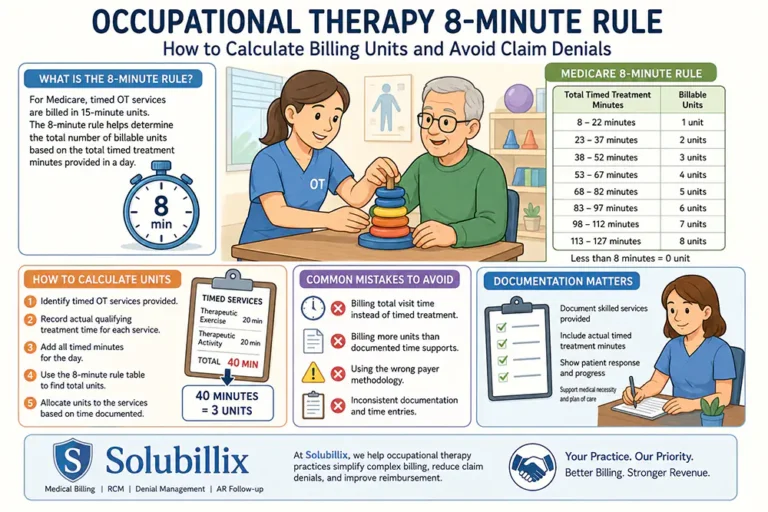
Many occupational therapy CPT codes are reported in 15-minute increments. For Medicare, the total timed treatment minutes for the discipline on that date of service are used to determine the number of units that may be billed.
For example:
- 8–22 minutes = 1 unit
- 23–37 minutes = 2 units
- 38–52 minutes = 3 units
- 53–67 minutes = 4 units
The problem occurs when a practice simply divides the appointment length by 15.
That approach can produce incorrect claims because not every minute spent in the facility is billable skilled treatment time.
CMS specifically cautions against counting activities such as waiting, changing, resting, toileting, or other unskilled time as treatment time.
Billing tip
Document the actual timed treatment minutes, not simply the patient’s arrival and departure times.
2. Using the GO, CO or Other Modifier Incorrectly
Modifiers can have a direct effect on how Medicare processes a therapy claim.
For occupational therapy, GO identifies services furnished under an outpatient occupational therapy plan of care.
When qualifying services are furnished in whole or in part by an occupational therapy assistant (OTA), CO may be required.
When CO applies, it is reported with GO. CMS’s CQ/CO rules also include specific exceptions and the 10% de minimis standard.
A common mistake is treating CO as an automatic modifier whenever an OTA participates in the patient’s care.
That is not the correct approach.
The billing team needs to review:
- Who provided the service?
- How many minutes did the OT provide?
- How many minutes did the OTA provide independently?
- Was the service provided together?
- Does the CMS de minimis rule apply?
- Does an exception apply?
Billing tip
Don’t let your billing software automatically add CO to every OTA claim without reviewing the actual service and Medicare requirements.
3. Poor or Incomplete Treatment-Time Documentation
A claim can have the correct CPT code and still create a problem if the medical record does not support the units billed.
CMS expects therapy documentation to support the treatment minutes and services reported on the claim.
For timed OT services, the record should make it possible to understand:
- What treatment was provided
- How much time was spent
- Which timed services were performed
- Total timed treatment minutes
- Total treatment time
- How the billed units were determined
For example, documenting only:
“OT provided for 60 minutes.”
may not be enough to support several different timed CPT codes.
A better record identifies the actual interventions and corresponding treatment time.
Billing tip
The clinical note and the claim should tell the same story.
If the claim reports four timed units but the documentation does not support the corresponding treatment time, the claim has a preventable vulnerability.
4. Ignoring the Medicare KX Threshold
Medicare outpatient therapy has an annual threshold that billing teams need to monitor.
For calendar year 2026, the KX modifier threshold for occupational therapy is $2,480.
Reaching the threshold does not mean that medically necessary therapy automatically stops.
Instead, when applicable, the KX modifier indicates that the services above the threshold remain medically necessary and reasonable and are supported by documentation. CMS is specifically reviewing therapy claims for appropriate KX use, medical necessity, and documentation.
Billing tip
Don’t wait until a claim denies to discover that the patient’s therapy spending has crossed the threshold.
Your billing workflow should monitor the patient’s cumulative Medicare therapy amount.
5. Diagnosis and Treatment Do Not Match
Another common problem is a disconnect between the diagnosis reported on the claim and the service documented in the medical record.
The diagnosis should accurately represent the patient’s condition and support the medical necessity of the occupational therapy being provided.
For example, if the clinical documentation consistently addresses functional limitations related to a specific condition, but the claim contains an unrelated or overly broad diagnosis, the payer may question whether the billed service is supported.
This does not mean a particular diagnosis automatically guarantees payment.
Coverage and medical necessity are payer-specific.
Billing tip
Before submission, compare:
Diagnosis → Plan of Care → Treatment → Progress → CPT Code
If those pieces do not make sense together, stop and review the claim.
6. Billing Without Checking Authorization and Benefits
A clinically appropriate OT service can still result in a patient-benefit or authorization denial.
Common problems include:
- Authorization was never obtained
- Authorization expired
- Authorized visits were exhausted
- CPT code was not included in the authorization
- Provider was not included in the authorization
- Patient’s insurance changed
- OT benefit was limited or excluded
- Referral requirements were not met
These are front-end problems that can become back-end revenue problems.
A claim submitted after benefits or authorization have been exhausted may require additional work to correct—and in some cases, the service may not be recoverable from the payer.
Billing tip
Verify eligibility and authorization before treatment whenever the payer requires it, and maintain a system for tracking remaining authorized visits.
7. Failing to Follow Up on Denials and Underpayments
Getting a claim paid is not the same as getting the correct amount paid.
Some practices focus heavily on claim submission but do not have a consistent process for reviewing:
- Denials
- Partial payments
- Contractual adjustments
- Missing payments
- Incorrect patient responsibility
- Unresolved claims
- Aging accounts receivable
For example, an OT claim can process successfully but still pay less than expected because of a payer processing issue, modifier issue, incorrect fee schedule, or other claim-level problem.
That payment should not simply be posted and forgotten.
Billing tip
Compare the payer’s EOB/ERA against the expected reimbursement whenever possible.
Repeated underpayments from the same payer may indicate a larger billing or contract issue.
Bonus: Don’t Confuse Appointment Time With Billable Treatment Time
This deserves special attention because it is a frequent source of confusion.
A patient’s visit might run from:
9:00 AM → 10:00 AM
That does not automatically mean the claim contains 60 minutes of billable timed therapy.
CMS distinguishes treatment time from other activities that occur during a visit. Waiting, changing, resting, and other non-billable activities should not simply be added to skilled treatment minutes.
The medical record should support the actual skilled treatment time used to determine the units billed.
Occupational Therapy Billing Checklist
Before submitting an OT claim, check:
Patient & Coverage
- Eligibility verified
- Correct insurance selected
- Benefits reviewed
- Authorization verified when required
- Authorized visits monitored
Clinical Documentation
- Diagnosis supports the treatment
- Plan of care is documented
- Treatment performed is documented
- Timed treatment minutes are supported
- Medical necessity is supported
Claim
- Correct CPT codes
- Correct units
- Correct diagnosis pointers
- Correct rendering provider
- Correct place of service
- Appropriate modifier reviewed
- GO/CO requirements reviewed when applicable
Medicare
- KX threshold monitored
- KX used when applicable
- PTA/OTA modifier requirements reviewed
- Documentation supports services above the threshold
How Solubillix Helps Occupational Therapy Practices
Occupational therapy billing requires more than submitting claims.
At Solubillix, we look at the revenue cycle from eligibility and authorization through payment posting, denial management, and accounts receivable follow-up.
Our medical billing and RCM support can include:
- Insurance verification
- Authorization review
- Claims submission
- Payment posting
- ERA/EOB review
- Denial management
- Corrected claims
- Appeals and reconsiderations
- Underpayment review
- Accounts receivable follow-up
- Patient balance support
- Payer follow-up
The goal is straightforward:
Identify billing problems before they become lost revenue, and work unresolved claims until there is a clear outcome.
For occupational therapy practices, that can mean fewer preventable billing issues and a more organized revenue-cycle process.
Final Takeaway
Occupational therapy billing errors are often small individually, but repeated mistakes can create a significant financial impact.
The seven areas worth reviewing are:
- Incorrect timed units
- Incorrect modifiers
- Incomplete treatment-time documentation
- Failure to monitor the KX threshold
- Diagnosis and treatment mismatches
- Authorization and benefit problems
- Poor denial and underpayment follow-up
For Medicare OT billing in 2026, the KX threshold is $2,480, while the correct calculation of timed units and proper documentation remain essential to supporting the services billed.
A strong OT billing process does not stop when the claim is submitted.
It continues through payment posting, denial review, underpayment analysis, and accounts receivable follow-up.
Solubillix — Maximize Collections. Minimize Denials. Partner with Solubillix.
Frequently Asked Questions
What is the most common occupational therapy billing error?
Incorrect units and insufficient documentation are two important areas to monitor. For Medicare timed services, the documented treatment minutes must support the number of units billed.
What is the KX threshold for occupational therapy in 2026?
The Medicare KX threshold for occupational therapy services is $2,480 in 2026.
When is the CO modifier used?
CO identifies applicable outpatient occupational therapy services furnished in whole or in part by an OTA. Medicare has specific rules, including a 10% de minimis standard and exceptions, for determining when CO applies.
Can appointment time be used to calculate OT units?
Not automatically. Medicare timed-service units should be based on qualifying skilled treatment time, not simply the patient’s total time in the facility.
Can an OT claim be paid incorrectly even if it is not denied?
Yes. A claim can process with a payment that is lower than expected. Practices should review ERAs/EOBs and monitor recurring underpayments rather than assuming every paid claim was correctly reimbursed.