
Medical Billing & Revenue Cycle Management Specialists
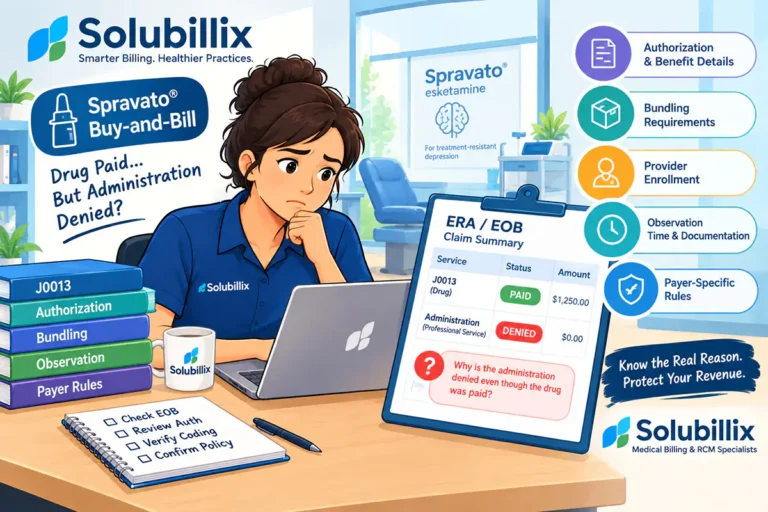
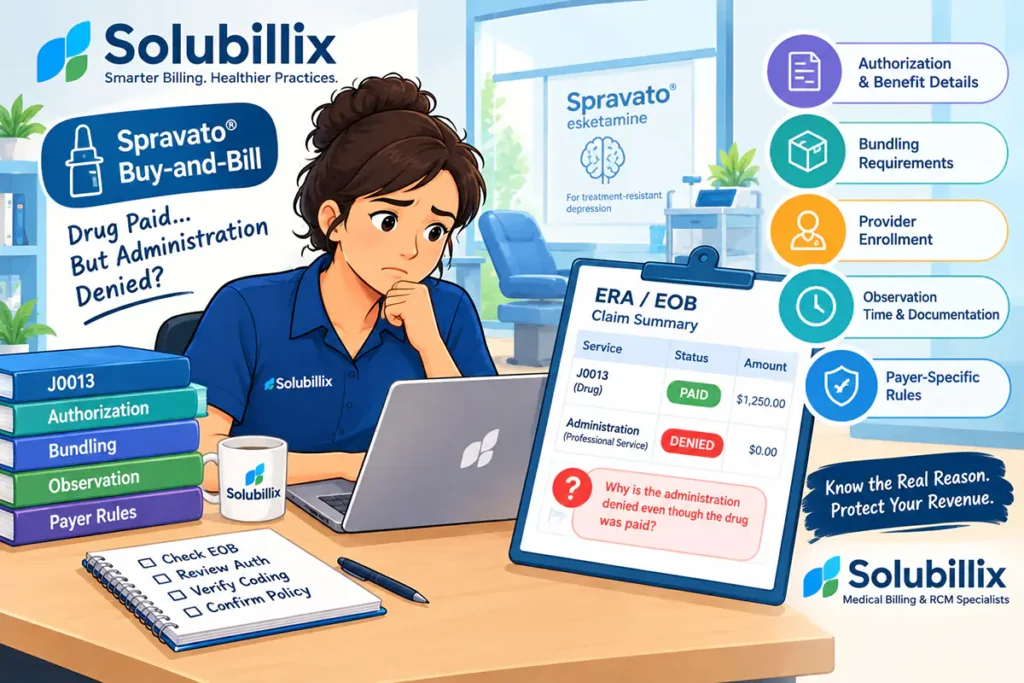
A Spravato® claim can create a particularly frustrating situation for behavioral health practices: the payer pays for the drug, but denies the administration or observation portion of the treatment.
At first glance, this may seem contradictory. If the payer recognized and paid for the Spravato product, why would it deny the service associated with administering and monitoring it?
The answer is that Spravato billing involves more than one reimbursement component, and those components do not always process together. The drug, administration, evaluation and management, observation, authorization, benefit structure, and payer-specific billing rules can all affect the final claim outcome.
For practices operating a Spravato program, understanding why one part of the claim pays while another denies is essential for protecting revenue.
Drug Payment Does Not Automatically Mean Administration Payment
The first mistake billing teams sometimes make is assuming that payment for the drug confirms that the entire Spravato encounter was correctly billed.
It does not.
A payer may recognize the drug line but reject another line because of:
- Incorrect administration coding
- Authorization mismatch
- Benefit limitations
- Bundling edits
- Incorrect place of service
- Provider enrollment issues
- Missing or incorrect modifiers
- Observation requirements
- Incorrect billing pathway
- Payer-specific coding rules
The first step is therefore to separate the claim into its individual components.
Drug paid ≠ administration automatically payable.
2026 Changed the Spravato Billing Landscape
Beginning January 1, 2026, CMS introduced J0013 — esketamine, nasal spray, 1 mg, replacing the previous S0013 code. CMS’s 2026 HCPCS update confirms J0013 as the current code.
However, J0013 should not simply be treated as a universal replacement for every Spravato billing situation.
Medicare has a different structure for Spravato treatment. CMS’s Medicare coverage and billing guidance identifies G2082 and G2083 for applicable Spravato services, while other payer arrangements may separately recognize the drug and professional services.
That distinction is one reason a billing team should never assume that the same claim configuration works for every payer.
What Does “Drug Paid, Administration Denied” Actually Mean?
Imagine a practice submits a Spravato claim containing a drug line and a professional service line.
The payer response shows:
Drug: Paid
Administration/Service: Denied
The billing team may immediately think:
“The payer paid J0013, so why didn’t they pay the administration?”
The correct response is to investigate the denied line independently.
The payer may have determined that:
- The drug is covered but the professional service was not billed correctly.
- The drug and service should have been submitted as a bundled code.
- The authorization covers the medication but not the separately billed service.
- The service was submitted under the wrong benefit.
- The provider or location does not meet the payer’s requirements.
- The administration/observation documentation does not support the billed service.
- The payer’s claim-editing system expects a different coding configuration.
The explanation is usually found in the ERA/EOB rather than on the drug line itself.
1. The Payer May Require a Bundled Billing Structure
One of the biggest issues with Spravato is assuming that J0013 + separate administration is appropriate for every payer.
It isn’t.
For Medicare physician-office buy-and-bill situations, CMS-related guidance uses G2082 or G2083, which incorporate the office visit, esketamine self-administration, and two hours of post-administration observation.
Some commercial plans can use different arrangements.
For example, payer policies may distinguish between:
Buy-and-bill:
The provider acquires the medication and bills according to the payer’s required structure.
Pharmacy-supplied drug:
A REMS-certified pharmacy supplies and may separately bill the drug, while the provider bills the applicable professional service.
This distinction matters because a payer may pay the drug under one billing pathway while rejecting a separately billed service that does not match its required configuration.
2. Authorization May Cover the Drug but Not the Service
Prior authorization is another area that deserves closer attention.
A practice may receive approval for Spravato treatment, but the authorization information may specify:
- Drug code
- Number of treatments
- Dose
- Effective dates
- Diagnosis
- Provider
- Location
- Benefit category
- Specific service codes
If the authorization was built around one billing configuration and the claim was submitted using another, the drug line can potentially process differently from the service line.
This is particularly important during coding transitions.
For example, an authorization created under the previous S0013 code may require updating when the applicable payer transitions to J0013 beginning in 2026. Iowa Medicaid specifically instructed providers to update applicable authorizations from S0013 to J0013 for 2026 claims.
The lesson for billing teams is simple:
Never verify only that “Spravato is authorized.” Verify what exactly was authorized.
3. J0013 Is Not a Universal “Administration” Code
Another common misunderstanding is treating J0013 as if it represents the entire Spravato encounter.
J0013 describes the esketamine drug itself, per 1 mg. It does not automatically represent every professional service associated with treatment.
Current payer guidance demonstrates why this distinction matters. Iowa Medicaid, for example, instructs providers to use J0013 for applicable 2026 claims while using appropriate E/M codes for provider services required for administration and post-administration observation in its specified billing pathway. Medicare crossover claims follow a different structure using G2082/G2083.
Therefore, a billing team should ask:
What exactly does this payer expect the provider to bill for the drug, administration, and observation?
The answer can vary by payer.
4. Observation Requirements Can Affect the Professional Claim
Spravato treatment is not simply a medication charge.
The FDA-approved treatment involves administration under healthcare-provider supervision and a period of observation. CMS’s Medicare Spravato billing article also contains documentation requirements relating to the administered drug, medical necessity, diagnosis, and treatment documentation.
If the payer denies the professional component, the billing team should determine whether the medical record supports:
- Date of treatment
- Dose administered
- Route
- Provider supervision
- Required observation
- Relevant assessment
- Patient response
- Treatment documentation
- Applicable diagnosis
- Provider signature/authentication
The exact documentation requirements can differ by payer and setting, so the payer’s policy should be reviewed rather than assuming that Medicare’s requirements apply identically to a commercial plan.
5. Place of Service Can Trigger a Separate Problem
A Spravato claim can also fail because the place of service does not match the payer’s expected billing arrangement.
For example, the payer may have an established configuration for Spravato treatment in a physician office, outpatient hospital setting, or another eligible location.
If the drug line processes but the professional line does not, compare:
Place of Service → Provider enrollment → Location → Authorization → Billed service
A location mismatch can make a claim appear partially correct while still causing individual service lines to deny.
6. Provider Enrollment and Credentialing Still Matter
Spravato is a specialized service, and the payer may require the rendering or billing provider to meet particular enrollment or credentialing requirements.
Check whether:
- The rendering provider is credentialed
- The provider is linked to the billing group
- The location is enrolled
- The NPI is correct
- The taxonomy is appropriate
- The provider was active on the date of service
- The authorization identifies the same provider/location combination
A paid drug line does not necessarily prove that every professional-service component of the claim has passed provider-level edits.
7. The Denial Code Is More Important Than the Claim Status
If the drug paid and the administration denied, don’t simply look at the word “Denied.”
Review the line-level:
- CARC
- RARC
- EOB message
- Denial reason
- Allowed amount
- Units
- Modifier
- Procedure/HCPCS code
- Benefit category
- Authorization reference
For example, a denial related to bundling requires a completely different response from a denial related to authorization.
Likewise, a provider-enrollment denial should not be handled like a medical-necessity denial.
This is where denial management becomes more than simply resubmitting claims.
A Practical Spravato Denial Investigation
When Solubillix reviews a claim where the Spravato drug paid but the administration or service denied, the investigation should follow the complete claim pathway:
Step 1: Identify the procurement model
Was the medication:
- Purchased by the provider?
- Supplied through a REMS-certified pharmacy?
- Billed by the pharmacy?
- Billed by the provider?
Do not assume that the answer is the same for every payer.
Step 2: Identify the drug code
For applicable 2026 non-Medicare billing, verify whether the payer recognizes J0013 and how it should be reported.
For Medicare, verify whether the applicable service should instead be reported using the established G-code structure.
Step 3: Review the authorization
Compare the authorization against:
Code + dose + date + provider + location + diagnosis + number of treatments
Step 4: Review the denied service
Determine whether the denied line represents:
- Administration
- Evaluation and management
- Observation
- Another professional service
- A bundled service
Step 5: Compare the payer policy
Confirm the payer’s current billing configuration.
This is particularly important because commercial plans may handle Spravato differently from Medicare.
Step 6: Review the medical record
Confirm that the documentation supports the service billed.
Step 7: Determine the appropriate action
Depending on the denial, the appropriate response may be:
Corrected claim → reconsideration → appeal → authorization correction → credentialing correction
Not every denial should be handled with a corrected claim.
A Simple Example
Imagine a behavioral health practice purchases Spravato and submits a claim.
The remittance shows:
| Claim Component | Result |
| Spravato drug | Paid |
| Administration/service | Denied |
| Authorization | Active |
| Patient eligibility | Active |
At first glance, the claim appears confusing.
But suppose the denial reason indicates that the payer expected the service to be submitted under a bundled Spravato code rather than as a separately billed administration line.
In that situation, the drug payment does not prove that the administration line was billed correctly.
The billing team needs to determine the payer’s required billing structure before submitting anything again.
Why Spravato Denials Can Become Expensive
Spravato is different from ordinary office-based behavioral health billing because the practice may have significant acquisition costs associated with the medication.
A claim that partially pays can therefore create a misleading sense that the encounter was successfully reimbursed.
Consider the difference:
Drug paid + service denied
versus
Drug paid + service paid correctly
The first situation can still leave the practice with an unresolved revenue gap.
This is why Spravato programs should monitor line-level reimbursement, not just the overall claim status.
How Solubillix Helps With Spravato Revenue Cycle Management
Spravato billing requires coordination between authorization, drug procurement, coding, claim submission, payment posting, denial management, and accounts receivable follow-up.
At Solubillix, we understand that a partially paid Spravato claim needs more than a generic “resubmit the claim” approach.
Our RCM process can help practices investigate:
- Drug reimbursement
- Administration/service reimbursement
- Authorization discrepancies
- Payer-specific billing rules
- Claim-line denials
- EOB/ERA adjustments
- Corrected claims
- Appeals
- Payment posting
- Outstanding Spravato accounts receivable
The goal is to identify why one part of the claim paid while another did not—and what action is appropriate next.
Frequently Asked Questions
Why would insurance pay for Spravato but deny the administration?
The drug and professional service may be processed under different claim edits, benefit rules, authorization requirements, or billing configurations. A payer can recognize the medication while rejecting the associated professional service.
Can J0013 be billed with a separate administration code?
It depends on the payer and billing arrangement. J0013 is the 2026 HCPCS drug code for esketamine, nasal spray, 1 mg, but it should not automatically be treated as the correct drug-plus-administration configuration for every payer. Medicare uses a different structure for applicable Spravato services, while commercial and Medicaid plans may have their own requirements.
Did J0013 replace S0013?
Yes. J0013 became effective January 1, 2026, replacing S0013 for the applicable billing period. CMS’s 2026 HCPCS update lists J0013 as esketamine, nasal spray, 1 mg.
Does Medicare bill J0013 for Spravato?
Medicare’s applicable Spravato billing structure uses G2082/G2083 for the bundled office service rather than treating J0013 as a separately payable Medicare drug line in the same way some other payers may handle it. Always verify the current Medicare contractor guidance applicable to the claim.
What should a practice do when the drug pays but the administration denies?
Start with the denial reason and determine whether the problem involves bundling, authorization, provider enrollment, place of service, documentation, modifier requirements, or payer-specific billing rules. Then choose the appropriate correction, reconsideration, or appeal pathway.
Final Takeaway
A Spravato claim that pays the drug but denies the administration is not necessarily a simple coding error.
The underlying issue may be the relationship between the drug, professional service, authorization, procurement model, benefit structure, documentation, and payer-specific billing rules.
With the 2026 transition from S0013 to J0013, practices have even more reason to review their Spravato billing workflows carefully rather than relying on older claim configurations.
Solubillix helps behavioral health practices navigate the details behind Spravato reimbursement—from authorization and claim submission to denial resolution and AR follow-up—so providers can focus on patient care while their revenue cycle receives the attention it deserves.