
Telehealth has become an important part of occupational therapy delivery, but being able to provide an OT service remotely does not automatically mean the claim will be paid.
For occupational therapy practices, successful telehealth billing depends on several factors: the CPT code reported, the patient’s location, payer policy, technology used, documentation, medical necessity, modifiers, place of service, authorization requirements, and whether the service is appropriate for remote delivery.
For 2026, Medicare has extended the ability of physical therapists, occupational therapists, and speech-language pathologists to furnish telehealth services through December 31, 2027. CMS also continues to maintain annual therapy code and billing guidance.
So, which OT CPT codes can actually be billed through telehealth?
Let’s break them down.
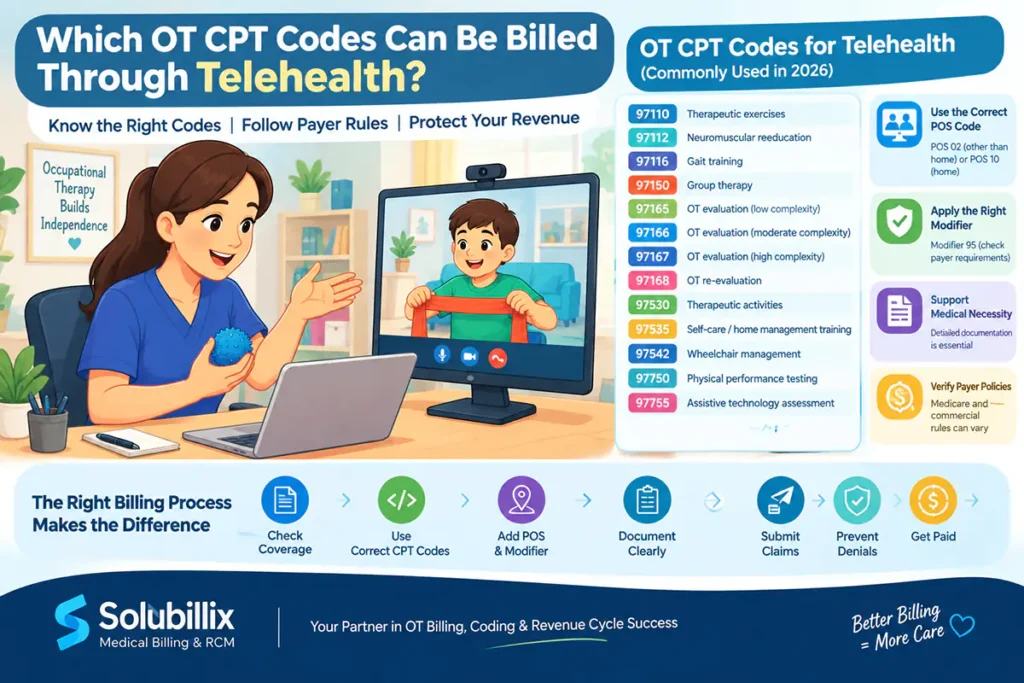
OT CPT Codes Commonly Used for Telehealth
The American Occupational Therapy Association (AOTA) identifies a group of occupational therapy CPT codes that can be used for telehealth services, subject to applicable Medicare, payer, state, and service-specific requirements.
| CPT Code | OT Service | Telehealth Consideration |
| 97110 | Therapeutic exercises | Must be clinically appropriate for remote delivery |
| 97112 | Neuromuscular reeducation | Requires appropriate interactive clinical treatment |
| 97116 | Gait training | Safety and remote feasibility must be considered |
| 97150 | Group therapy | Special group-service requirements apply |
| 97165 | OT evaluation, low complexity | Evaluation must be adequately performed and documented remotely |
| 97166 | OT evaluation, moderate complexity | Documentation must support the complexity level |
| 97167 | OT evaluation, high complexity | Clinical findings and complexity must be supported |
| 97168 | OT re-evaluation | Must support continued skilled therapy |
| 97530 | Therapeutic activities | Appropriate when functional activities can be performed remotely |
| 97535 | Self-care/home management training | Particularly relevant to home-based OT telehealth |
| 97542 | Wheelchair management | Must be clinically appropriate for remote delivery |
| 97750 | Physical performance testing/measurement | Remote testing must produce valid, supportable results |
| 97755 | Assistive technology assessment | Assessment must be sufficiently performed through telehealth |
AOTA notes that 97535 may be furnished using audio-only technology when the patient does not have access to video technology, while the other services in its telehealth list require synchronous audio-video technology under that guidance.
However, this list should not be interpreted as a guarantee that every payer will reimburse every code through telehealth.
AOTA specifically cautions that not all OT CPT codes are accepted by every payer and that state regulations and individual payer policies may impose additional limitations.
1. 97110 — Therapeutic Exercises
CPT 97110 is used for therapeutic exercises designed to improve areas such as strength, endurance, range of motion, and flexibility.
It can be relevant to telehealth when the therapist can safely instruct, observe, and document the patient’s performance remotely.
For example, an OT may use telehealth to:
- Demonstrate therapeutic exercises
- Observe the patient’s technique
- Correct movement patterns
- Provide exercise progression
- Educate the patient or caregiver
- Monitor functional response
The documentation should explain what was performed, why it was medically necessary, the patient’s response, and how the service relates to the treatment plan.
Simply documenting “patient performed exercises via telehealth” is not enough to establish the full clinical picture.
2. 97112 — Neuromuscular Reeducation
CPT 97112 covers neuromuscular reeducation involving areas such as movement, balance, coordination, kinesthetic sense, posture, and related functional activities.
Telehealth may be appropriate when the therapist can adequately observe and guide the patient.
For example, the OT may provide:
- Movement retraining
- Coordination activities
- Balance-related instruction
- Postural training
- Functional movement strategies
The key billing question is not simply whether the therapist used video.
The practice should be able to demonstrate why the service required skilled OT intervention and how the therapist evaluated and responded to the patient’s performance.
3. 97116 — Gait Training
CPT 97116 describes gait training, including stair climbing.
Although gait training can sometimes be delivered remotely, practices need to consider whether the patient’s environment, condition, and safety allow the service to be appropriately performed through telehealth.
Documentation should support:
- The functional problem being addressed
- The skilled intervention provided
- Patient performance
- Safety considerations
- Therapist instruction
- Patient response
- Progress toward functional goals
A telehealth claim should never be submitted simply because the code appears on a telehealth list. The actual service must be appropriate for remote delivery.
4. 97150 — Group Therapy
CPT 97150 describes therapeutic procedures performed in a group setting.
Group therapy has different billing considerations from one-on-one treatment. Practices should confirm the payer’s requirements before billing this service through telehealth.
This is particularly important because payer policies may address:
- Number of participants
- Provider-to-patient interaction
- Group documentation
- Patient-specific treatment
- Telehealth technology
- Modifier requirements
- Reimbursement methodology
OT Evaluation CPT Codes and Telehealth
Occupational therapy evaluations are another important area for telehealth billing.
97165 — Low-Complexity OT Evaluation
This code represents a low-complexity occupational therapy evaluation.
If performed through telehealth, the OT still needs sufficient information to perform and document the evaluation appropriately.
97166 — Moderate-Complexity OT Evaluation
A moderate-complexity evaluation requires documentation supporting the clinical complexity represented by the code.
97167 — High-Complexity OT Evaluation
A high-complexity evaluation requires documentation that supports the higher level of evaluation.
97168 — OT Re-evaluation
97168 is used for an occupational therapy re-evaluation of an established plan of care.
For telehealth services, the provider should document the patient’s current status, changes since the previous assessment, clinical findings, progress, continued limitations, and the rationale for continued skilled OT.
CMS continues to identify 97165–97168 among OT therapy codes subject to Medicare therapy documentation and medical-necessity review.
97530 — Therapeutic Activities
CPT 97530 is one of the particularly relevant OT codes for telehealth.
The code describes direct one-on-one therapeutic activities designed to improve functional performance.
Depending on the patient’s condition and payer requirements, telehealth may be used for activities involving:
- Functional movement
- Household activities
- Fine-motor activities
- Coordination
- Functional task performance
- Problem-solving
- Activity modification
- Patient education incorporated into functional treatment
The documentation should connect the activity to the patient’s functional limitations and treatment goals.
Avoid vague documentation such as:
“Patient completed therapeutic activities via telehealth.”
A stronger record explains what activity was performed, what impairment or functional limitation it addressed, what skilled intervention the OT provided, and how the patient responded.
97535 — Self-Care and Home Management Training
CPT 97535 is especially relevant to telehealth because many occupational therapy interventions naturally occur in the patient’s home environment.
This code includes services related to areas such as:
- Activities of daily living
- Self-care
- Meal preparation
- Safety procedures
- Compensatory strategies
- Assistive technology and adaptive equipment
- Home-management activities
AOTA specifically identifies 97535 as an OT telehealth code and notes an audio-only option when the patient does not have access to video technology, subject to the applicable requirements.
This makes 97535 particularly important for practices serving patients who have difficulty accessing video technology.
However, the medical record should still clearly explain what skilled training was provided and why it was necessary.
97542 — Wheelchair Management
CPT 97542 covers wheelchair management, including assessment, fitting, and training.
Telehealth may be useful for certain aspects of wheelchair-related training and functional management, but the OT must determine whether the required assessment or intervention can be adequately and safely performed remotely.
Documentation should identify:
- The patient’s functional limitation
- Wheelchair-related problem
- Assessment performed
- Training provided
- Patient/caregiver response
- Functional goals
- Medical necessity
97750 — Physical Performance Testing
CPT 97750 involves physical performance testing or measurement with a written report.
Remote performance testing requires additional consideration because the therapist needs to ensure that the testing methodology produces clinically meaningful and supportable information.
The record should identify:
- The test performed
- Why it was necessary
- Results
- Clinical interpretation
- Functional relevance
- How results affect the treatment plan
97755 — Assistive Technology Assessment
CPT 97755 involves an assistive technology assessment intended to restore, augment, or compensate for existing function.
Telehealth can potentially support portions of an assistive technology assessment, particularly when the therapist can adequately observe the patient’s environment and functional needs.
However, the OT should verify the payer’s current telehealth policy before billing this code.
What About POS 02 and POS 10?
Choosing the correct Place of Service (POS) is one of the most important parts of telehealth billing.
For Medicare claims:
POS 02 — Telehealth Provided Other Than in Patient’s Home
This is generally used when the patient is receiving the telehealth service somewhere other than their home.
POS 10 — Telehealth Provided in Patient’s Home
This is used when the patient is located at home when receiving the telehealth service.
The correct POS should reflect where the patient was located when the telehealth service was provided, not simply where the therapist was working.
Practices should also verify the specific payer’s requirements because commercial and Medicare Advantage plans can have different billing rules.
Does Every Telehealth Claim Need Modifier 95?
Not necessarily.
One of the most common mistakes in telehealth billing is assuming that every payer requires the same modifier.
Some payers may require modifier 95, while others may have different requirements. Certain Medicare billing circumstances may rely on the applicable POS and current Medicare telehealth instructions rather than treating modifier 95 as a universal requirement.
Therefore, the billing team should verify:
- Payer
- Plan type
- CPT code
- Patient location
- POS
- Modifier requirement
- Provider eligibility
- Authorization requirement
- Current payer telehealth policy
Never copy a modifier rule from one payer to another without verification.
Medicare vs. Commercial Insurance: Why the Difference Matters
An OT practice may have a service that is eligible for Medicare telehealth but not covered in exactly the same way by a commercial payer.
AOTA’s guidance specifically warns that payer acceptance of CPT codes can differ and recommends reviewing individual insurer policies and applicable state requirements.
Before submitting a telehealth claim, the billing team should verify:
- Is the OT provider eligible for telehealth?
- Is the patient’s plan covering the service?
- Is the CPT code eligible?
- Is telehealth allowed for this diagnosis/service?
- What POS is required?
- Is modifier 95, GT, or another modifier required?
- Is prior authorization required?
- Is video required?
- Is audio-only permitted?
- Are there frequency limitations?
- Are there network restrictions?
This payer-by-payer verification can prevent avoidable denials.
Telehealth CPT Code Does Not Automatically Mean “Payable Claim”
This is one of the most important points for OT practices.
A CPT code appearing on a telehealth list does not mean every claim containing that code will automatically be paid.
For example, a claim can still be denied because:
Incorrect POS
The provider submits POS 02 even though the patient’s location met the payer’s POS 10 criteria.
Incorrect modifier
The billing team uses a modifier that the payer does not recognize or require.
Documentation does not support the service
The record does not demonstrate what skilled OT service was actually provided.
Medical necessity is unclear
The documentation does not establish why skilled occupational therapy was required.
Authorization was missing
The patient’s plan required prior authorization for the service.
Payer policy differs
The CPT code may be covered under one payer but restricted under another.
Units are incorrect
Timed services are billed with unsupported units.
Documentation Checklist for OT Telehealth
Before submitting a telehealth claim, OT practices should consider whether the medical record clearly documents:
- Date of service
- Start and/or stop time when applicable
- Type of telehealth interaction
- Patient location
- Provider location when required
- Technology used
- Patient identity/participation
- Clinical reason for treatment
- Functional limitations
- Skilled intervention
- CPT-specific service performed
- Patient response
- Progress toward goals
- Medical necessity
- Plan for continued treatment
The documentation should tell the story of what the OT did, why it was necessary, and what happened as a result.
CMS’s 2026 therapy compliance program specifically includes review of therapy claims for medical necessity, coding requirements, documentation, and appropriate KX modifier use. OT codes under review include 97110, 97112, 97165–97168, 97530, 97535, 97542, 97750, 97760 and 97761.
OT Telehealth Billing Mistakes That Can Cost Revenue
Here are some of the most common problems practices should monitor:
1. Billing a code without checking the payer’s telehealth policy
A code may be clinically appropriate but still subject to payer-specific restrictions.
2. Using the wrong POS
POS 02 and POS 10 should not be selected interchangeably.
3. Treating modifier 95 as universal
Modifier requirements vary by payer and service.
4. Weak telehealth documentation
A generic statement such as “telehealth visit completed” does not adequately describe the skilled service.
5. Ignoring authorization requirements
Telehealth does not necessarily eliminate the need for authorization.
6. Billing unsupported units
Timed OT services must be supported by appropriate documentation.
7. Failing to monitor denials
A practice that only posts payments without analyzing telehealth denials can continue repeating the same billing errors.
2026 OT Telehealth Billing Checklist
Before submitting an OT telehealth claim, ask:
CPT
- Is the CPT code appropriate for the service actually performed?
- Is the code eligible for telehealth under the applicable payer policy?
Patient location
- Was the patient at home?
- If so, does POS 10 apply?
- If not, does POS 02 apply?
Modifiers
- Does the payer require modifier 95, GT, or another modifier?
- Has the current payer policy been verified?
Documentation
- Does the note describe the actual skilled OT intervention?
- Is medical necessity supported?
- Does the documentation support the units billed?
Payer
- Is the patient’s plan currently covering OT telehealth?
- Is authorization required?
- Are there payer-specific restrictions?
Revenue cycle
- Was the claim accepted by the clearinghouse?
- If denied, was the denial categorized by root cause?
- Are recurring telehealth denials being tracked?
Final Takeaway
OT telehealth billing is not simply a matter of choosing an OT CPT code and adding a telehealth modifier.
Codes such as 97110, 97112, 97116, 97150, 97165, 97166, 97167, 97168, 97530, 97535, 97542, 97750, and 97755 may be relevant to OT telehealth billing, but the actual billing requirements depend on the service, payer, patient location, technology used, documentation, and applicable coverage rules. AOTA’s current guidance identifies these services for occupational therapy telehealth, while also emphasizing that payer and state requirements must be checked.
For Medicare, CMS confirms that PTs, OTs, and SLPs can continue furnishing telehealth services through December 31, 2027, and CMS maintains annual therapy coding and billing updates.
For OT practices, the goal should therefore be more than simply getting a telehealth claim submitted. The goal is to submit a correctly coded, properly documented, payer-compliant claim that has the best chance of being reimbursed correctly.
How Solubillix Can Help
Telehealth billing errors can quickly become an A/R problem when incorrect CPT codes, POS codes, modifiers, authorization issues, or documentation gaps are repeated across multiple claims.
Solubillix Medical Billing & RCM helps occupational therapy practices manage the billing process from claim submission through payment posting, denial management, and A/R follow-up.
If your OT practice is experiencing telehealth denials, inconsistent reimbursement, or payer-specific billing issues, a detailed review of your telehealth billing workflow can help identify where revenue is being lost.
Smarter Billing. Stronger Revenue. Better Patient Care.
Disclaimer: Telehealth coverage, CPT eligibility, POS requirements, modifier rules, authorization requirements, and reimbursement policies can vary by payer, plan, state, and date of service. Practices should verify current requirements with the applicable payer and review official CMS, CPT, and state guidance before submitting claims.