
Medical Billing, Coding & Revenue Cycle Management for Healthcare Providers
Occupational therapy practices can provide excellent patient care and still lose revenue through small billing, documentation, coding, and reimbursement problems.
In 2026, Medicare occupational therapy billing requires particular attention to medical necessity, the KX modifier threshold, multiple procedure payment reduction (MPPR), therapy-assistant payment rules, timed services, documentation, and claim accuracy.
These aren’t simply administrative details. A missed modifier, unsupported unit, incomplete progress documentation, or payer-processing issue can turn a properly performed therapy service into a delayed, reduced, or denied payment.
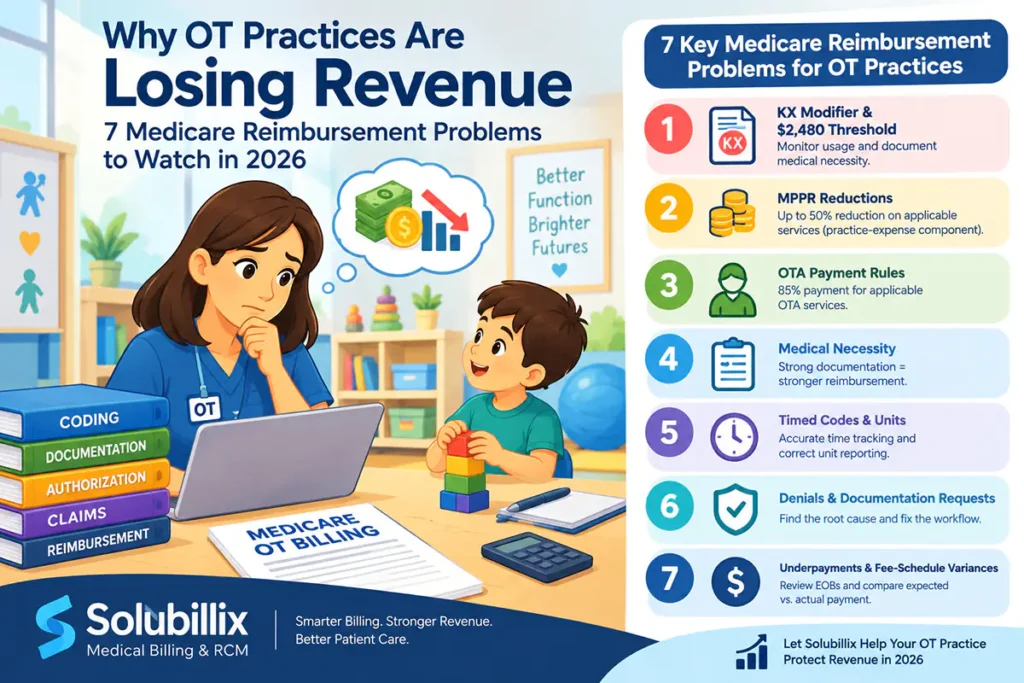
CMS has set the 2026 occupational therapy KX modifier threshold at $2,480, while the targeted medical-review threshold for OT remains $3,000. CMS is also continuing the 50% MPPR reduction on the practice-expense component of certain therapy services and the 85% payment policy for applicable services furnished in whole or in part by occupational therapy assistants.
For OT practice owners, understanding where Medicare revenue can leak is the first step toward protecting it.
1. Missing or Incorrect KX Modifier After the $2,480 Threshold
One of the most important Medicare OT reimbursement issues in 2026 is the KX modifier threshold.
For calendar year 2026, Medicare’s threshold for occupational therapy services is:
$2,480
Once a beneficiary’s applicable OT services reach the threshold, claims for medically necessary services above that amount generally require the KX modifier.
The KX modifier is not simply an automatic “high-dollar” billing modifier.
By reporting KX, the clinician is attesting that the services continue to be medically necessary and reasonable and supported by documentation.
Where OT practices can lose revenue
Problems can occur when:
- The billing team does not monitor the patient’s accumulated therapy expenses.
- KX is omitted after the applicable threshold is reached.
- KX is added without adequate supporting documentation.
- The claim is submitted before the billing team identifies the threshold issue.
- The clinical documentation does not support continued therapy.
CMS specifically identifies therapy claims involving KX, medical necessity, and documentation as a current medical-review area.
What OT practices should do
Create a process to monitor Medicare therapy utilization throughout the year.
Don’t wait until a claim denies.
Your billing team should be able to identify:
Patient → cumulative OT charges → KX threshold → documentation status → claim submission
2. MPPR Can Reduce Payment on Multiple Therapy Services
Another revenue issue that OT practices sometimes overlook is Multiple Procedure Payment Reduction (MPPR).
For applicable therapy services, Medicare applies MPPR to the practice-expense component of certain “always therapy” services.
In 2026, CMS continues to apply a 50% MPPR rate to the practice-expense component of the second and subsequent applicable therapy services performed for the same patient on the same day.
The service with the highest practice-expense RVU is paid at 100% of its applicable practice-expense component, while the remaining applicable services receive the 50% reduction to that component.
This does not mean Medicare simply cuts the entire claim by 50%.
That distinction matters.
The reduction applies to the applicable practice-expense portion, not necessarily the entire Medicare allowed amount.
Why this matters for OT practices
Suppose an OT provides several therapy services during the same visit.
The practice may look at the submitted CPT codes and expect the total allowed amount to equal the sum of each service’s standard payment.
But MPPR can change the actual Medicare payment.
If your practice doesn’t understand this, it can appear that Medicare has underpaid the claim when the payment was actually calculated according to Medicare’s MPPR methodology.
What to monitor
Your billing team should compare:
- CPT codes billed
- Units
- Medicare allowed amount
- Practice-expense RVUs
- MPPR adjustments
- Actual payment
- Contractual adjustment
This is especially important when reviewing OT A/R and determining whether a balance represents a true underpayment or a legitimate Medicare payment adjustment.
3. OTA Services Can Produce a Lower Medicare Payment
Another significant reimbursement issue is the Medicare payment adjustment for services furnished in whole or in part by an occupational therapy assistant (OTA).
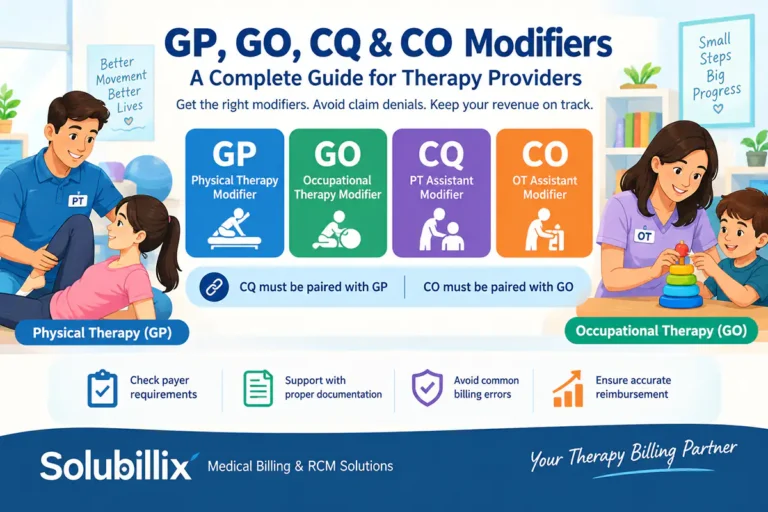
CMS requires the CO modifier to identify applicable outpatient OT services furnished in whole or in part by an OTA.
For applicable services, Medicare pays 85% of the otherwise applicable Part B payment amount when the OTA payment-reduction rules apply.
CMS’s documentation guidance explains that the CQ/CO modifiers generally apply when the assistant independently provides more than 10% of the service under the applicable de minimis standard.
Where revenue problems happen
An OT practice can encounter problems when:
- The CO modifier is missing.
- The CO modifier is incorrectly appended.
- The GO and CO modifier requirements are not followed correctly.
- OTA and OT minutes are not documented clearly.
- Billing staff misunderstand the de minimis standard.
- The practice expects the same reimbursement for OT and applicable OTA-furnished services.
CMS also states that the CO modifier must be paired with the GO therapy modifier when applicable.
Practical solution
Your clinical documentation and billing workflow should clearly identify:
Who performed the service?
How much of the service did each clinician provide?
Does the service meet the applicable OTA modifier requirements?
This information should be available before the claim is submitted.
4. Medical Necessity Documentation May Be Leaving Money on the Table
A therapy claim isn’t supported simply because the patient has a diagnosis.
Medicare requires therapy services to be reasonable and necessary, and the medical record must support the need for skilled therapy.
CMS guidance emphasizes the importance of documentation showing the patient’s condition and functional status and demonstrating meaningful benefit from continued therapy. Objective and comparable functional measures are particularly important when demonstrating progress.
Common documentation weaknesses
OT practices should watch for:
- Vague treatment goals
- No measurable functional outcomes
- Repetitive notes without evidence of progression
- Missing connection between impairment and functional limitation
- Insufficient explanation for continued skilled therapy
- Treatment that does not clearly relate to the plan of care
- Missing progress-report information
- Inconsistent documentation between evaluation and subsequent visits
A note saying that a patient “tolerated treatment well” doesn’t necessarily demonstrate why skilled therapy was medically necessary.
Think beyond the diagnosis
For example:
Weak documentation:
Patient completed therapeutic exercises and tolerated treatment well.
Stronger documentation:
The record connects the intervention to a documented functional limitation, identifies measurable performance, describes the skilled intervention, and explains the patient’s progress toward established goals.
The second approach gives a reviewer more information about why the service was necessary and what functional outcome the treatment was addressing.
CMS guidance states that qualified clinicians should establish comparable objective/functional measures and document progress throughout the episode of care.
5. Timed-Code and Unit Errors Can Create Preventable Revenue Loss
Many OT services are reported using timed CPT codes.
That makes accurate time tracking essential.
Examples of commonly used OT services include:
- 97110 – Therapeutic exercises
- 97112 – Neuromuscular reeducation
- 97530 – Therapeutic activities
- 97535 – Self-care/home management training
- 97542 – Wheelchair management
CMS’s therapy documentation guidance and Medicare billing rules require the submitted units to be supported by the services and time documented in the medical record.
Common revenue problems
An OT practice may lose revenue when:
- Total treatment minutes don’t support billed units.
- Individual code times aren’t documented clearly.
- Different staff members document conflicting times.
- Units are entered incorrectly into the EHR.
- The billing team doesn’t apply the applicable Medicare timed-service rules.
- Services are billed without sufficient supporting documentation.
But there is an equally important risk on the other side:
Underbilling.
If the clinician documents sufficient billable treatment time but the charge capture process consistently reports fewer units, the practice may be leaving legitimate revenue uncollected.
Best practice
Compare:
Clinical note → treatment minutes → CPT units → claim → payment
on a regular basis.
This can reveal both overbilling risks and missed revenue opportunities.
6. Denials and Documentation Requests Can Turn Into A/R Problems
A claim denial isn’t always the point where the financial loss begins.
The revenue cycle can start deteriorating much earlier.
For example:
Incomplete documentation → claim submission → payer review → records request → delayed payment → denial → appeal → extended A/R
Every additional step increases administrative work and delays cash flow.
CMS currently has an approved RAC topic specifically addressing therapy claims billed with the KX modifier, medical necessity, and documentation requirements. The review includes multiple OT services such as 97110, 97112, 97165-97168, 97530, 97535, 97542, 97750, 97760, and others.
OT practices should monitor denial patterns
Don’t simply track the total number of denials.
Break them down by:
- Payer
- CPT code
- Diagnosis
- Modifier
- Rendering provider
- Location
- Denial reason
- Authorization
- Documentation request
- Timely filing
- Medical necessity
- Units
For example, if 97530 repeatedly generates medical-necessity-related denials, that is a workflow problem worth investigating.
If CO-modifier claims repeatedly reject, the issue may be related to assistant billing or modifier configuration.
The denial code is often a symptom. The billing workflow is the potential cause.
7. Underpayments and Fee-Schedule Variances Can Hide in Your A/R
Not every unpaid or partially paid claim is a denial.
OT practices can also lose revenue through underpayments.
Medicare payment amounts are based on applicable fee schedules and payment policies, while payment can vary by locality and other factors. CMS’s Physician Fee Schedule Look-Up Tool provides payment information and related policy information for applicable services.
What should an OT practice compare?
Your revenue-cycle team should periodically compare:
Expected reimbursement vs. actual reimbursement
Look for:
- Incorrect allowed amounts
- Contractual discrepancies
- Incorrect units
- MPPR-related differences
- OTA payment adjustments
- Modifier-related reductions
- Incorrect patient responsibility
- Duplicate adjustments
- Unapplied payments
- Incorrect contractual write-offs
If your practice only focuses on denied claims, you may miss revenue that was paid incorrectly but never challenged.
A simple example
Suppose your practice expects a particular Medicare service to reimburse at a certain allowed amount.
The claim processes and pays.
There is no denial.
The billing team closes the claim.
But the actual payment is lower than expected because the claim was processed under an incorrect configuration or because an adjustment was applied incorrectly.
Without payment variance analysis, that issue can remain invisible.
2026 Medicare OT Revenue-Loss Checklist
OT practice owners can use this checklist to identify potential reimbursement leakage:
Coding
☐ Are the correct CPT codes being selected?
☐ Are timed units supported by documented treatment time?
☐ Are applicable GO/CO modifiers being reported correctly?
☐ Are EHR charge templates current?
Documentation
☐ Does each note support medical necessity?
☐ Are functional limitations clearly documented?
☐ Are objective measures used to demonstrate progress?
☐ Are progress reports completed as required?
☐ Does the documentation support continued skilled therapy?
Medicare Thresholds
☐ Is the $2,480 2026 OT KX threshold being monitored?
☐ Is KX being applied when required?
☐ Does documentation support continued therapy when KX is reported?
☐ Is the practice prepared for potential targeted medical review at the applicable threshold?
CMS lists the 2026 OT KX threshold at $2,480 and the targeted medical-review threshold at $3,000.
Payment
☐ Are MPPR adjustments being reviewed?
☐ Are OTA-related 85% payment adjustments understood?
☐ Are Medicare payments compared against expected reimbursement?
☐ Are underpayments identified?
A/R
☐ Are denials categorized by root cause?
☐ Are medical-record requests tracked?
☐ Are appeals submitted within payer deadlines?
☐ Are recurring denial patterns being escalated?
How Solubillix Helps OT Practices Protect Revenue
Medicare OT billing isn’t just about submitting a clean claim.
A strong revenue cycle connects:
Documentation → Coding → Authorization → Charge Capture → Claim Submission → Payment Posting → Denial Management → A/R Follow-Up
A weakness at any point can affect the practice’s revenue.
At Solubillix, we help occupational therapy practices manage the billing and revenue-cycle challenges that can interfere with timely reimbursement.
Our OT billing support can include:
- CPT and ICD-10 coding review
- Medicare billing
- Claim submission
- Eligibility verification
- Authorization support
- Denial management
- A/R follow-up
- Payment reconciliation
- Underpayment identification
- Credentialing and payer enrollment
- Revenue-cycle workflow review
Instead of looking only at how many claims were paid, practice owners should ask a broader question:
How much revenue should we have collected—and how much are we actually collecting?
That difference can reveal where your revenue cycle needs attention.
Final Takeaway
The biggest Medicare reimbursement problems for OT practices in 2026 aren’t necessarily dramatic billing errors.
They are often small problems repeated across hundreds of claims:
A missing modifier.
An unsupported unit.
A documentation gap.
An overlooked MPPR adjustment.
An OTA payment reduction that wasn’t anticipated.
A KX threshold that wasn’t monitored.
An underpayment that was never identified.
Individually, each issue may seem minor.
Across an entire OT practice, however, those small gaps can become a significant revenue-cycle problem.
The most effective approach is to identify reimbursement leakage before it becomes aged A/R or a denial trend.
Solubillix helps occupational therapy practices strengthen the connection between clinical documentation, accurate billing, payer compliance, and revenue collection.
If your OT practice is seeing increasing Medicare denials, unexplained payment reductions, or growing A/R, a detailed billing and reimbursement review can help identify where revenue is being lost.
Solubillix Medical Billing & RCM — helping healthcare providers protect revenue while staying focused on patient care.
Frequently Asked Questions
What is the Medicare OT KX threshold for 2026?
The 2026 Medicare KX modifier threshold for occupational therapy services is $2,480. Claims above the applicable threshold require the KX modifier when the services remain medically necessary and the documentation supports continued treatment.
What is the Medicare OT targeted medical-review threshold in 2026?
The targeted medical-review threshold for occupational therapy is $3,000 in 2026. CMS notes that exceeding the threshold does not mean every claim will automatically be reviewed.
How much does Medicare pay when an OTA furnishes an applicable service?
For applicable outpatient OT services furnished in whole or in part by an OTA, Medicare pays 85% of the otherwise applicable Part B payment amount when the OTA payment-reduction requirements apply.
What is MPPR in Medicare OT billing?
MPPR stands for Multiple Procedure Payment Reduction. For applicable therapy services, Medicare reduces the practice-expense component of the second and subsequent services provided to the same patient on the same day. CMS’s 2026 therapy guidance identifies the MPPR rate as 50% for the applicable subsequent services.
Why are OT claims denied for medical necessity?
Medical-necessity denials can occur when documentation does not sufficiently establish the patient’s condition, functional limitations, skilled need, progress, or reasonableness of continued therapy. CMS emphasizes objective and comparable functional measures in supporting medical necessity.
How can an OT practice find lost Medicare revenue?
Start by comparing expected reimbursement against actual payment, then analyze denials, underpayments, modifier usage, units, MPPR adjustments, OTA reductions, KX usage, and documentation-related issues. CMS provides the Physician Fee Schedule Look-Up Tool for applicable Medicare payment information.