
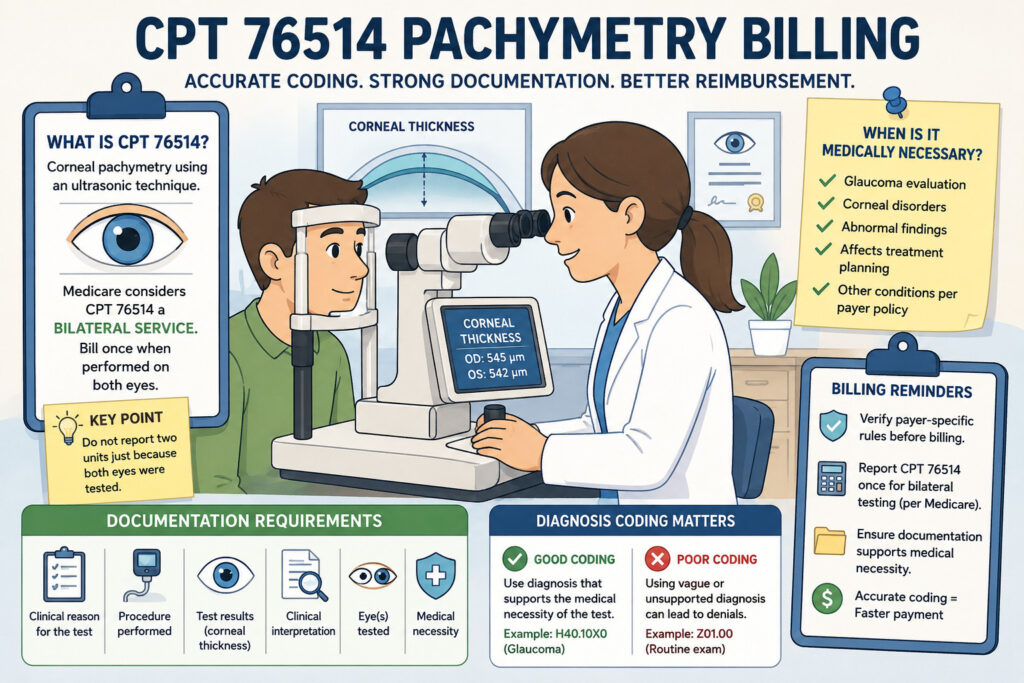
Corneal pachymetry is an important diagnostic service used in ophthalmology and optometry to measure corneal thickness. Although the procedure itself may be straightforward, billing CPT 76514 correctly requires attention to medical necessity, diagnosis coding, documentation, units, laterality, and payer-specific coverage policies.
For eye care practices, a technically correct procedure does not automatically guarantee reimbursement. The claim must also demonstrate why the test was medically necessary and contain documentation that supports the service reported.
This guide explains the key billing and documentation considerations surrounding CPT 76514 pachymetry and highlights common issues that can result in claim delays, denials, or lost reimbursement.
What Is Corneal Pachymetry?
Corneal pachymetry is a diagnostic test used to measure the thickness of the cornea.
Corneal thickness can be clinically relevant when evaluating or managing certain ophthalmic conditions. It may be particularly important in glaucoma-related care, corneal disorders, and other situations where corneal thickness can influence clinical assessment or treatment planning.
From a billing perspective, the important question is not simply whether pachymetry was performed. The medical record should support why the test was ordered or performed and how the result relates to the patient’s clinical condition.
What Is CPT 76514?
CPT 76514 is used for corneal pachymetry performed using an appropriate ultrasonic technique.
For Medicare billing, CMS currently treats CPT 76514 as a bilateral service, meaning the code is generally reported once when the test is performed on both eyes. CMS guidance also addresses situations in which the service is performed unilaterally.
This distinction is important because incorrectly reporting multiple units simply because both eyes were tested can create an unnecessary claim problem.
Key billing consideration
When bilateral pachymetry is performed, the practice should not automatically submit two units of CPT 76514. The applicable Medicare guidance indicates that the service is billed once for bilateral testing.
Always verify the specific requirements of the patient’s payer before submitting the claim because commercial payer policies may differ from Medicare.
When Is CPT 76514 Medically Necessary?
Pachymetry should be supported by the patient’s clinical circumstances.
Examples of situations in which corneal thickness measurement may be relevant include:
- Glaucoma evaluation or management
- Certain corneal disorders
- Evaluation of abnormal corneal findings
- Clinical assessment where corneal thickness affects interpretation or treatment planning
- Other ophthalmic conditions covered under the applicable payer policy
The diagnosis reported on the claim should accurately represent the condition or clinical reason supporting the test.
CMS states that diagnosis codes submitted with corneal pachymetry claims must support the medical necessity of the service. For diagnostic testing, the documentation should also contain the test result when available, or the symptoms prompting the test when appropriate.
Important: A diagnosis should never be selected simply because it is likely to produce reimbursement. The diagnosis must be supported by the patient’s medical record.
CPT 76514 Documentation Requirements
Strong documentation is one of the most important components of successful pachymetry billing.
A well-supported record should establish:
1. The clinical reason for the test
The medical record should explain why pachymetry was medically necessary.
For example, the provider may document the relevant ocular condition, clinical finding, risk factor, or diagnostic concern that prompted the test.
2. The procedure performed
The record should clearly identify that corneal pachymetry was performed.
3. The test results
The measured corneal thickness should be documented in the medical record.
4. The clinical interpretation
When appropriate, the provider should document the clinical significance of the findings and how the results relate to the patient’s care.
5. The affected eye or eyes
The documentation should make clear whether the test involved the right eye, left eye, or both eyes.
6. Medical necessity
The record should connect the test to the patient’s condition or clinical decision-making.
CMS specifically identifies medical necessity and test results as documentation requirements in its current Medicare billing guidance for corneal pachymetry.
Diagnosis Coding for Pachymetry
Correct diagnosis coding is critical.
A common billing mistake is selecting a diagnosis that does not adequately support the reason the pachymetry was performed.
For example, a practice may perform pachymetry as part of glaucoma evaluation but submit a nonspecific diagnosis that does not establish the medical necessity of the test.
The better approach is to:
- Review the provider’s assessment.
- Identify the condition or clinical finding responsible for the test.
- Select the most specific supported ICD-10-CM code.
- Confirm that the diagnosis is covered under the applicable payer policy.
- Ensure the diagnosis is consistent with the documentation.
CMS’s current corneal pachymetry billing article includes diagnosis-code requirements and states that claims without a valid ICD-10-CM diagnosis code may be returned as incomplete.
Bilateral vs. Unilateral Pachymetry Billing
Laterality is an area where billing teams should exercise particular caution.
For Medicare, CMS identifies CPT 76514 as a bilateral service and indicates that it should generally be reported once when performed on both eyes. When performed on only one eye, CMS guidance provides for the appropriate laterality modifier together with the reduced-services modifier when applicable.
Example
Both eyes tested:
- Report the applicable pachymetry code according to the payer’s bilateral billing rules.
- Do not automatically submit two units simply because two eyes were examined.
One eye tested:
- Verify the payer’s unilateral billing requirements.
- Apply the appropriate laterality and reduced-service modifiers when required.
Because payer policies can differ, billing teams should verify the patient’s plan requirements before claim submission.
Common CPT 76514 Billing Mistakes
Even when the test itself is medically appropriate, claims can be denied because of billing or documentation problems.
Mistake #1: Billing two units for bilateral testing
Some practices assume that testing two eyes means billing two units.
That assumption can be incorrect under Medicare’s billing guidance for CPT 76514.
Mistake #2: Weak medical-necessity documentation
Simply documenting “pachymetry performed” may not adequately establish why the service was necessary.
Mistake #3: Unsupported diagnosis coding
The diagnosis on the claim should correspond to the provider’s documentation and the reason for the test.
Mistake #4: Missing test results
The actual pachymetry measurements should be retained in the patient’s medical record.
Mistake #5: Incorrect modifiers
Laterality and reduced-service modifiers should only be reported when supported by the circumstances and applicable payer rules.
Mistake #6: Ignoring payer-specific policies
Medicare policies do not automatically represent every commercial payer’s requirements.
Mistake #7: Failing to check NCCI or other edits
CMS notes that procedure codes may be subject to National Correct Coding Initiative edits or other applicable payment edits.
How to Reduce CPT 76514 Claim Denials
Eye care practices can strengthen their pachymetry billing process by establishing a consistent pre-submission review.
Before submitting the claim, verify:
Patient information
- Patient demographics
- Insurance information
- Member ID
- Coverage status
Clinical documentation
- Reason for pachymetry
- Relevant diagnosis or clinical finding
- Test performed
- Test results
- Provider interpretation when appropriate
Coding
- Correct procedure code
- Correct diagnosis code
- Correct units
- Appropriate laterality
- Applicable modifiers
Payer requirements
- Medical-necessity criteria
- Coverage limitations
- Authorization requirements, when applicable
- NCCI or other claim-edit considerations
This type of front-end review can prevent avoidable denials before the claim reaches the payer.
CPT 76514 and Medicare Billing
Medicare coverage for corneal pachymetry is governed by applicable Local Coverage Determinations and related billing articles.
CMS currently lists Corneal Pachymetry LCD L33630 as active, with its current revision effective April 1, 2026. The associated billing and coding article provides additional guidance regarding diagnosis coding, bilateral billing, documentation, and related claim requirements.
However, Medicare coverage policies can be jurisdiction-specific. Therefore, billing teams should verify the applicable Medicare Administrative Contractor (MAC) policy for the claim being submitted.
For non-Medicare patients, the practice should also review the individual payer’s medical policy and reimbursement requirements.
What Should Be Included in the Medical Record?
A strong pachymetry record should allow a reviewer to understand the entire billing story.
A practical documentation checklist includes:
- Patient’s relevant ocular condition or clinical concern
- Reason for performing pachymetry
- Eye or eyes examined
- Pachymetry measurements
- Date of service
- Provider performing or interpreting the service, as applicable
- Clinical assessment
- Relevant treatment or follow-up decision
- Supporting diagnosis
The documentation should tell a consistent story:
Why was the test needed → What test was performed → What were the results → How did the results contribute to patient care?
That connection is essential for defensible medical billing.
How Solubillix Supports Ophthalmology & Optometry Billing
Accurate eye-care billing requires more than selecting a CPT code.
At Solubillix, we understand that ophthalmology and optometry practices must manage multiple moving parts, including:
- CPT and HCPCS coding
- ICD-10-CM diagnosis coding
- Insurance eligibility and benefits
- Prior authorization
- Claim submission
- Claim rejection and denial management
- Payment posting
- Accounts receivable follow-up
- Underpayment identification
- Payer-specific billing requirements
- Revenue cycle management
For diagnostic services such as pachymetry, our approach focuses on making sure the documentation, diagnosis, procedure coding, payer requirements, and claim submission work together.
The objective is simple: help eye-care practices reduce preventable billing problems and improve the overall efficiency of their revenue cycle.
Final Takeaway
CPT 76514 pachymetry billing may appear straightforward, but reimbursement depends on much more than entering a procedure code on a claim.
Successful billing requires:
Accurate coding + supported diagnosis + medical necessity + complete documentation + correct units/modifiers + payer-specific requirements.
For Medicare, current CMS guidance specifically addresses bilateral reporting, diagnosis requirements, medical necessity, test results, and documentation for corneal pachymetry.
Eye-care practices that consistently review these elements before claim submission can reduce avoidable errors and strengthen their billing process.
Need help with ophthalmology or optometry medical billing?
Solubillix provides specialized medical billing and revenue cycle management support for eye-care practices, helping providers manage coding, claims, denials, AR, and reimbursement more efficiently.
Solubillix — Helping Eye-Care Practices Protect Revenue and Simplify RCM.
Frequently Asked Questions About CPT 76514
What is CPT 76514 used for?
CPT 76514 is used for corneal pachymetry. The procedure measures corneal thickness and may be used when clinically indicated for ophthalmic evaluation or management.
Is CPT 76514 billed once or twice for both eyes?
For Medicare, CMS identifies CPT 76514 as a bilateral service, so it is generally reported once when both eyes are tested rather than billing two units. Unilateral testing has separate modifier considerations.
What documentation is needed for CPT 76514?
The medical record should support the medical necessity of the test and document the test results. The record should also clearly establish the clinical reason for performing pachymetry.
Can CPT 76514 be billed for every eye exam?
Not automatically. The service should be medically necessary and supported by the patient’s clinical condition and the applicable payer’s coverage policy.
Does every insurance company follow Medicare’s CPT 76514 billing rules?
No. Medicare guidance should not automatically be assumed to apply to commercial or other payers. The billing team should verify the patient’s specific payer policy.
What causes CPT 76514 claim denials?
Common issues include unsupported medical necessity, incorrect diagnosis coding, incorrect units, modifier errors, incomplete documentation, and failure to follow payer-specific coverage requirements.
Disclaimer: This article is intended for educational and informational purposes. Coding, coverage, modifier, medical-necessity, and reimbursement requirements can vary by payer, Medicare Administrative Contractor, jurisdiction, provider type, and date of service. Practices should verify current payer policies and official coding resources before submitting claims.