
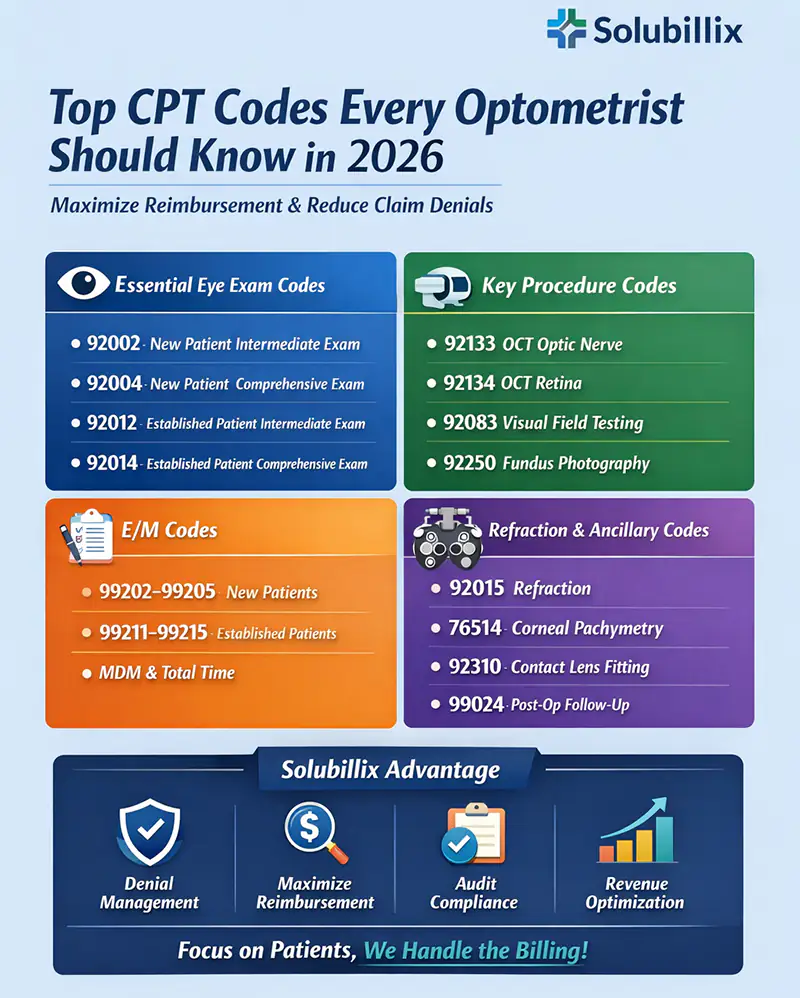
Maximize Reimbursement & Reduce Claim Denials with Solubillix
In today’s rapidly evolving healthcare landscape, accurate coding is more critical than ever for optometry practices. With payer policies tightening and audits increasing in 2026, using the right CPT codes is not just about compliance—it directly impacts your revenue.
At Solubillix, we specialize in helping optometrists streamline billing, minimize denials, and maximize collections. Below are the top CPT codes every optometrist must master in 2026 to stay ahead.
Why CPT Coding Matters More in 2026
Incorrect or outdated CPT coding can lead to:
- Claim denials and delayed payments
- Compliance risks and audits
- Revenue leakage
With increasing payer scrutiny, optometrists must ensure precise documentation and coding alignment—this is where Solubillix delivers unmatched expertise.
Essential Eye Exam CPT Codes
1. 92002 – Intermediate Eye Exam (New Patient)
- Used for evaluation of a new patient with a new or existing condition
- Requires a problem-focused exam and medical decision-making
2. 92004 – Comprehensive Eye Exam (New Patient)
- Covers a full eye exam including:
- Visual acuity
- Ophthalmoscopy
- Refraction (when applicable)
- Commonly used for complete diagnostic evaluations
3. 92012 – Intermediate Eye Exam (Established Patient)
- Ideal for follow-up visits
- Must include evaluation and management of an existing condition
4. 92014 – Comprehensive Eye Exam (Established Patient)
- One of the most frequently billed codes in optometry
- Requires dilation and detailed examination
💡 Pro Tip from Solubillix: Always ensure documentation supports the level of service—overcoding or undercoding can trigger audits.
Evaluation & Management (E/M) Codes (Increasingly Important in 2026)
Optometrists are increasingly using E/M codes due to flexibility:
- 99202–99205 (New Patients)
- 99211–99215 (Established Patients)
These codes are selected based on:
- Medical decision-making (MDM)
- Total time spent on the date of encounter
👉 Solubillix Insight: Many providers underutilize E/M codes, leaving money on the table. Proper training can significantly boost reimbursement.
Special Ophthalmological Procedures
5. 92133 – OCT (Optic Nerve)
- Used for glaucoma evaluation and monitoring
- High reimbursement potential
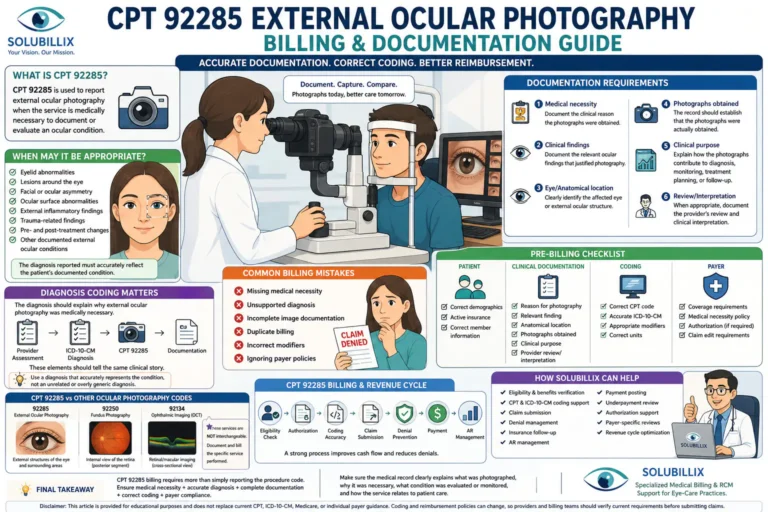
6. 92134 – OCT (Retina)
- Essential for diagnosing:
- Macular degeneration
- Diabetic retinopathy
7. 92083 – Visual Field Testing (Extended)
- Used for glaucoma and neurological assessments
- Requires proper interpretation and report
8. 92250 – Fundus Photography
- Helps document retinal conditions
- Must include interpretation and report
Refraction Code (Often Misused)
9. 92015 – Refraction
- Typically not covered by insurance
- Should be billed directly to patients
⚠️ Common Mistake: Billing this to insurance leads to denials—Solubillix ensures correct patient billing workflows.
Add-On & Ancillary Codes to Watch in 2026
- 99024 – Post-operative follow-up (global period)
- 76514 – Corneal pachymetry
- 92310 – Contact lens fitting
These codes can significantly enhance revenue when used correctly.
Common Billing Challenges for Optometrists
Even experienced providers struggle with:
- Incorrect code selection
- Missing documentation
- Failure to link diagnosis codes properly
- Underbilling high-value procedures
This is where partnering with Solubillix makes a measurable difference.
How Solubillix Helps Optometry Practices Succeed
At Solubillix, we go beyond basic billing. We provide:
✅ Accurate CPT & ICD-10 Coding
✅ Denial Management & AR Recovery
✅ Compliance & Audit Protection
✅ Specialty-Focused Optometry Billing Experts
Our team ensures your practice:
- Gets paid faster
- Reduces claim rejections
- Maximizes every patient encounter
Final Thoughts
Mastering the right CPT codes in 2026 is essential for any successful optometry practice. With evolving payer rules and increasing complexity, having a trusted billing partner is no longer optional—it’s a necessity.
🚀 Solubillix empowers optometrists to focus on patient care while we handle the complexities of billing and coding.