
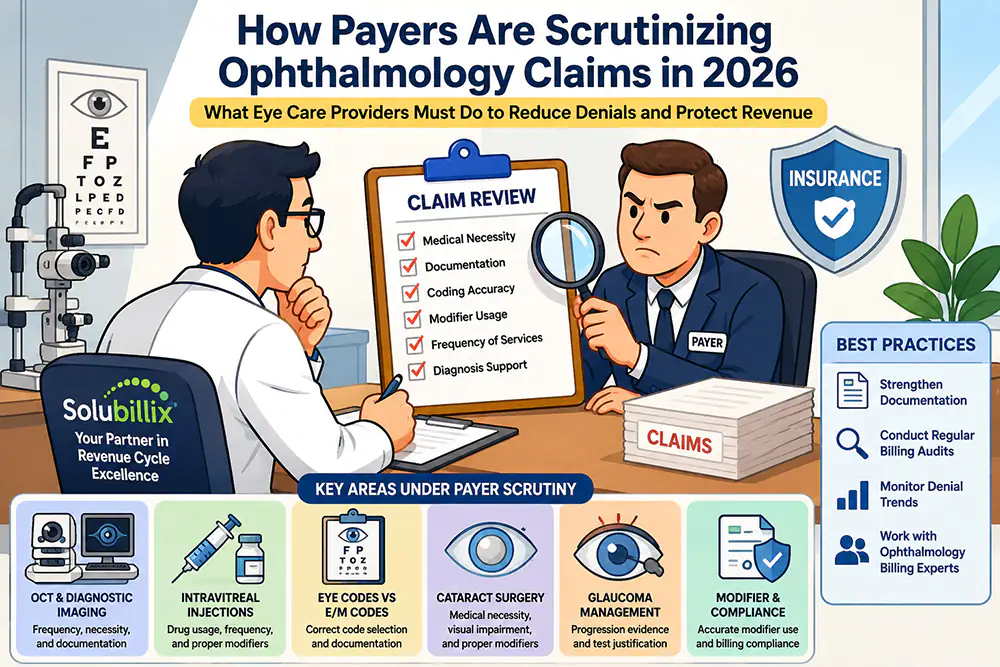
What Eye Care Providers Must Do to Reduce Denials and Protect Revenue
The ophthalmology billing landscape in 2026 is becoming increasingly complex as insurance companies intensify their review processes for eye care claims. Commercial payers and government insurers are placing greater attention on documentation accuracy, medical necessity, modifier usage, surgical compliance, and diagnostic testing patterns.
For ophthalmologists, retina specialists, glaucoma specialists, ambulatory surgery centers, and optometry practices, even minor billing inconsistencies can now lead to claim denials, delayed reimbursements, payment reductions, or payer audits.
At Solubillix, we are seeing a significant increase in payer scrutiny across ophthalmology billing. Practices that fail to adapt to updated billing expectations are experiencing rising denial rates and growing revenue leakage.
Understanding how payers are reviewing ophthalmology claims in 2026 is now essential for financial stability and long-term practice growth.
Why Ophthalmology Claims Are Receiving More Attention
Ophthalmology remains one of the most highly reimbursed specialties due to advanced diagnostic testing, surgical procedures, and specialty drug administration. Because of the financial value attached to these services, payers are aggressively monitoring billing patterns and utilization trends.
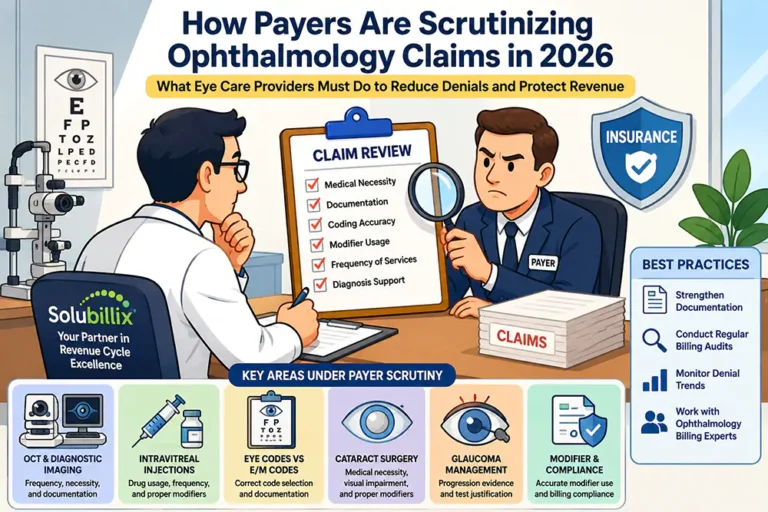
Insurance companies are now closely reviewing:
- High-frequency diagnostic testing
- Modifier usage patterns
- Intravitreal injection billing
- Cataract surgery documentation
- Eye code versus E/M code selection
- Medical necessity support
- Bilateral procedure billing
- Surgical global period compliance
- Retina drug reimbursement claims
Payers are comparing ophthalmology providers against regional billing benchmarks to identify unusual coding or utilization trends. Providers who bill significantly above payer averages may experience additional claim reviews or audits.
OCT and Diagnostic Imaging Are Major Audit Targets
Optical Coherence Tomography (OCT) and other ophthalmic diagnostic tests continue to face increased payer scrutiny in 2026.
Insurance carriers are carefully reviewing:
- Frequency of repeat imaging
- Documentation supporting medical necessity
- Progression monitoring evidence
- Duplicate testing
- Interpretation and report requirements
- Testing performed without clinical justification
Many ophthalmology practices perform OCT routinely during follow-up visits. However, payers now expect clear documentation explaining why the imaging was necessary and how the results impacted treatment decisions.
Common Documentation Problems
- Generic imaging interpretations
- Copy-forward charting
- Missing physician findings
- Lack of disease progression evidence
- Repetitive testing without documented change
Without proper documentation, even correctly coded OCT claims may be denied.
Retina Injection Claims Are Under Heavy Review
Retina-related claims involving intravitreal injections remain one of the highest-risk billing areas in ophthalmology.
Because anti-VEGF medications involve substantial reimbursements, payers are increasing oversight on:
- Injection frequency
- Drug utilization
- JW and JZ modifier accuracy
- Drug wastage reporting
- Diagnosis specificity
- Medical necessity timelines
Insurance companies are reviewing whether injection schedules are clinically supported by retinal findings and treatment response documentation.
Important Documentation Requirements
Providers should clearly document:
- Visual acuity changes
- Active retinal disease findings
- OCT correlation
- Response to prior injections
- Treatment rationale
- Drug lot and administration details
Incomplete retina documentation is becoming a major cause of delayed payments and payer denials.
Eye Codes vs E/M Codes Continue to Trigger Denials
One of the most common ophthalmology billing problems in 2026 involves improper selection between ophthalmological service codes and Evaluation & Management (E/M) services.
Payers are reviewing:
- High-level eye code usage
- Medical decision-making support
- Examination element requirements
- Documentation consistency
- Repetitive charting patterns
Practices using the same documentation structure repeatedly across multiple patient encounters may face increased scrutiny.
High-Risk Billing Behaviors
- Billing comprehensive eye codes without required exam elements
- Unsupported high-level E/M coding
- Repetitive assessment wording
- Incomplete histories
- Insufficient medical necessity documentation
Accurate code selection must reflect the actual complexity of the encounter and the documentation within the medical record.
Cataract Surgery Claims Require Stronger Medical Necessity Support
Cataract surgery remains one of the most reviewed ophthalmology procedures due to its high procedural volume and reimbursement rates.
Payers are now carefully evaluating:
- Functional vision complaints
- Daily activity limitations
- Visual impairment documentation
- Pre-operative testing
- Surgical necessity
- Bilateral surgery timing
- Premium lens compliance
Common Audit Triggers for Cataract Surgery
- Missing functional impairment documentation
- Limited patient complaints
- Incomplete glare testing correlation
- Improper modifier usage
- Unbundled pre-operative services
Medical records must clearly demonstrate how cataracts are affecting the patient’s quality of life and daily activities before surgery is considered medically necessary.
Glaucoma Management Billing Is Facing Increased Scrutiny
Glaucoma-related claims are also receiving closer payer review due to the long-term nature of disease monitoring and repeated diagnostic testing.
Frequently reviewed services include:
- Visual field testing
- Fundus photography
- OCT imaging
- Gonioscopy
- Pachymetry
Insurance companies now expect providers to document:
- Disease progression
- Risk assessment
- Treatment changes
- Clinical reasoning for repeated testing
- Comparison with previous findings
Routine glaucoma testing without individualized clinical support may increase denial risk.
Modifier Usage Is Being Monitored More Aggressively
Incorrect modifier usage continues to be a leading cause of ophthalmology claim denials in 2026.
Payers are closely reviewing:
- Modifier -25
- Modifier -59
- Modifier -24
- Modifier -79
- Modifier -RT and -LT
- Modifier -50
Excessive or inconsistent modifier usage may trigger claim edits, payment delays, or broader payer reviews.
Common Modifier Errors
- Billing unrelated E/M services incorrectly
- Improper procedural unbundling
- Incorrect bilateral billing
- Inappropriate post-operative billing
Proper modifier usage must always be supported by clear documentation within the patient record.
Payers Are Increasing Documentation Reviews
Insurance companies are becoming more detailed in how they review ophthalmology claims and supporting documentation.
Modern payer review systems now analyze:
- Documentation consistency
- Testing frequency
- Coding accuracy
- Utilization trends
- Diagnosis-to-procedure relationships
- Same-day billing combinations
Practices relying on outdated workflows, generic charting, or incomplete documentation are experiencing higher denial rates and reimbursement delays.
This makes detailed, individualized documentation more important than ever before.
How Ophthalmology Practices Can Reduce Denials in 2026
Strengthen Documentation Standards
Providers should ensure documentation:
- Supports medical necessity
- Matches billed services
- Includes individualized findings
- Explains treatment decisions
- Justifies testing frequency
- Reflects accurate clinical complexity
Strong documentation remains the foundation of clean ophthalmology claims.
Conduct Regular Billing Audits
Internal audits help practices identify:
- Coding inconsistencies
- Modifier errors
- Documentation gaps
- Denial trends
- Compliance vulnerabilities
Routine reviews can prevent larger payer issues before they affect revenue.
Monitor Payer-Specific Denial Patterns
Every payer applies different claim edits and review standards.
Tracking denial trends allows practices to identify:
- Frequently denied CPT codes
- Authorization failures
- Medical necessity issues
- Bundling problems
- Payer-specific modifier rules
Data-driven denial management is becoming essential in ophthalmology revenue cycle management.
Invest in Specialty-Specific Billing Expertise
Ophthalmology billing involves highly specialized coding requirements that general billing teams often overlook.
Practices need billing support that understands:
- Retina billing workflows
- Global surgery rules
- Diagnostic testing compliance
- Injection billing
- Ophthalmology modifiers
- Medicare ophthalmology policies
- ASC ophthalmology billing
At Solubillix, we help ophthalmology and optometry practices improve reimbursement accuracy, reduce denials, strengthen compliance, and optimize revenue cycle performance through specialty-focused medical billing solutions.
Final Thoughts
The ophthalmology billing environment in 2026 is becoming increasingly strict as insurance companies intensify claim reviews and documentation requirements.
Practices that fail to adapt may experience:
- Higher denial rates
- Increased AR days
- Delayed reimbursements
- Revenue loss
- Greater audit exposure
However, providers that prioritize coding accuracy, documentation quality, compliance monitoring, and specialty-focused billing strategies can strengthen financial performance and reduce payer-related disruptions.
In today’s healthcare environment, successful ophthalmology billing requires more than claim submission alone — it requires expertise, compliance awareness, and proactive revenue cycle management.
That is why many eye care providers are partnering with experienced billing specialists like Solubillix to navigate evolving payer demands and protect long-term practice profitability.