
CPT 93015 vs 93016–93018: What’s the Difference?
Cardiac stress testing is a common service in cardiology, but billing it correctly can be confusing when multiple providers or facilities are involved.
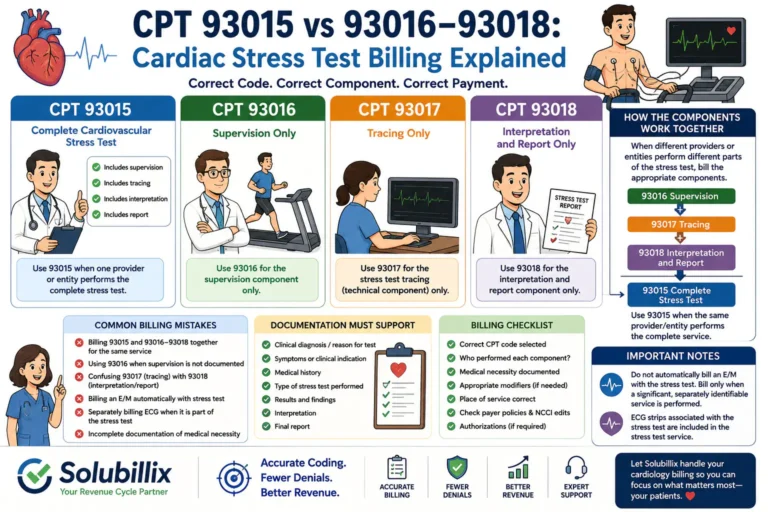
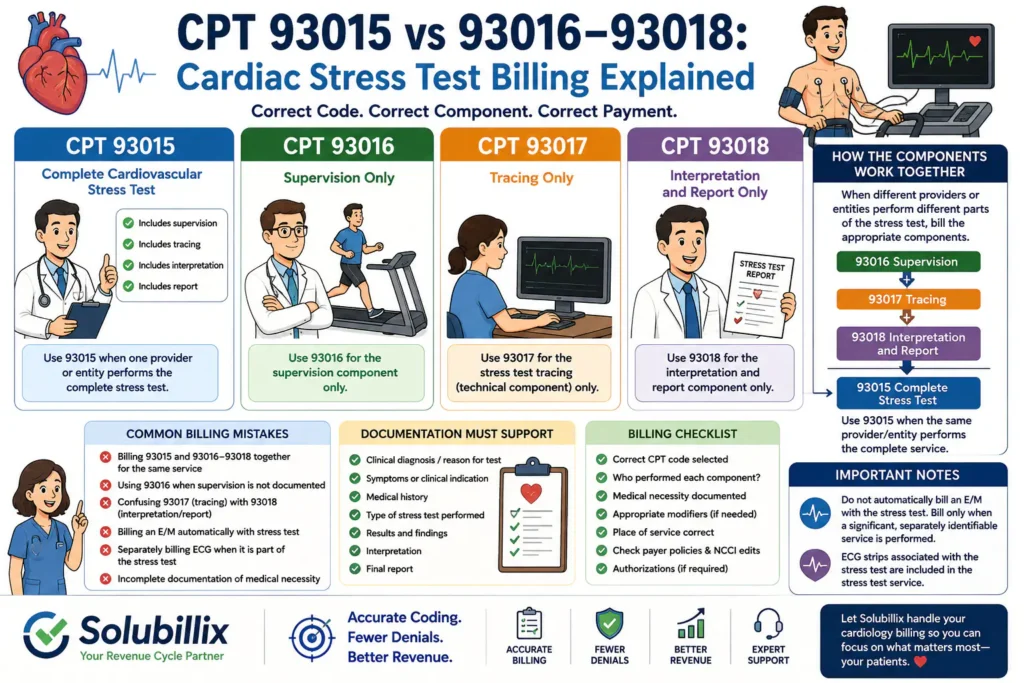
The key difference between CPT 93015 and CPT 93016–93018 is whether the cardiovascular stress test is reported as a complete service or divided into its individual components.
The easiest way to remember the codes is:
- 93015 = Complete cardiovascular stress test
- 93016 = Supervision only
- 93017 = Tracing only
- 93018 = Interpretation and report only
CMS’s current materials identify these four codes as the components of cardiovascular stress testing, and the 2026 update continues to recognize these codes for stress-test billing.
At Solubillix, we frequently see cardiology billing problems caused by incorrect component billing, inappropriate modifiers, insufficient documentation, and confusion about who performed each portion of the test.
This guide explains how 93015 vs 93016, 93017, and 93018 work and how practices can avoid common billing mistakes.
Quick Comparison: 93015 vs 93016–93018
| CPT Code | What It Represents | Who Typically Performs/Reports It? |
| 93015 | Complete cardiovascular stress test | Provider/facility reporting the complete service |
| 93016 | Supervision only | Supervising physician/qualified professional |
| 93017 | Stress-test tracing only | Technical/testing component |
| 93018 | Interpretation and report only | Physician/qualified professional interpreting the test |
The critical point is that 93015 is the complete service, while 93016–93018 break the stress test into its component parts.
What Is CPT 93015?
CPT 93015 represents the complete cardiovascular stress test.
It encompasses the overall stress-test service, including the applicable supervision, continuous ECG monitoring/tracing, interpretation, and report.
When the same entity is responsible for the complete service, 93015 may be appropriate rather than separately reporting 93016, 93017, and 93018.
CMS has historically described 93015 as the complete cardiovascular stress test with supervision, interpretation, and report.
When Is 93015 Appropriate?
93015 may be appropriate when the provider or practice performs the complete stress-test service rather than dividing the components among different entities.
For example:
Cardiology practice performs the test + supervises it + interprets it + provides the report
→ 93015 may be appropriate, assuming all applicable requirements are met.
What Is CPT 93016?
CPT 93016 represents the supervision component of a cardiovascular stress test.
This is different from interpreting the test.
In other words:
93016 = Supervision only
The person supervising the stress test is responsible for the supervision component, while the interpretation and report may be performed separately.
CMS identifies 93016 as the supervision-only component of cardiovascular stress testing.
Important Billing Point
Do not use 93016 simply because a physician was present in the office.
The documentation and circumstances must support the applicable supervision service.
What Is CPT 93017?
CPT 93017 represents the tracing-only component of the cardiovascular stress test.
This is generally associated with the technical portion of the test, including the actual recording/tracing.
Think of it as:
93017 = Tracing only
CMS’s current 2026 coding material identifies 93017 as the cardiovascular stress-test tracing-only component.
Example
Suppose:
- A facility performs the technical portion of the test.
- A physician supervises the test.
- A physician separately interprets the results.
The service may be divided among 93016, 93017, and 93018, depending on who performed each component and the applicable billing rules.
What Is CPT 93018?
CPT 93018 represents the interpretation and report-only component.
This is the physician’s or qualified professional’s interpretation of the stress-test results and preparation of the report.
Think of it as:
93018 = Interpretation + Report
CMS identifies 93018 as the interpretation-and-report-only component of the cardiovascular stress test.
Why Is 93018 Important?
A stress test is not simply the production of an ECG tracing.
The interpretation provides the clinical assessment of the test results and should be supported by an appropriate report.
93015 vs 93016 + 93017 + 93018
This is the most important concept for billing teams.
When the Complete Service Is Performed
If one provider/entity performs the complete stress-test service:
93015
When the Service Is Split
If different parties perform different components:
93016 + 93017 + 93018
may represent the applicable components.
For example:
Physician: Supervises → 93016
Facility/technical provider: Performs tracing → 93017
Physician: Interprets and reports → 93018
The exact billing arrangement depends on the setting, ownership of the technical component, payer rules, and who actually performed each service.
CMS guidance recognizes that the components may be billed separately when the complete service is not performed by one entity.
Simple Example: Complete Stress Test
Imagine a cardiology practice performs the entire stress test in its own office.
The practice:
- Performs the stress testing
- Provides supervision
- Records the tracing
- Interprets the results
- Produces the report
In this situation, the complete-service code 93015 may be appropriate rather than separately billing all three component codes.
Simple Example: Split Components
Now imagine a patient receives a stress test at a facility.
The facility performs the technical tracing, while the cardiologist provides supervision and interpretation.
Depending on the specific arrangement and payer requirements, the components may be reported separately:
- 93016 — Supervision
- 93017 — Tracing
- 93018 — Interpretation/report
This is why billing teams need to determine who performed each portion of the test before selecting the CPT code.
Is 93015 the Same as 93016–93018?
No.
They describe different reporting structures.
93015
Complete stress-test service
93016
Supervision only
93017
Tracing only
93018
Interpretation and report only
A practice should not automatically report all four codes for the same service.
If 93015 accurately represents the complete service performed by the billing entity, separately reporting 93016–93018 for the same work may result in incorrect billing.
Can 93016, 93017, and 93018 Be Billed Together?
They can be reported together when the stress-test service is appropriately divided into its component parts and the different components are actually performed and separately reportable.
For example:
93016 + 93017 + 93018
can represent:
Supervision + Tracing + Interpretation/Report
However, practices should not assume that every payer processes component billing identically.
Always review:
- Payer policy
- Place of service
- Provider roles
- Technical/professional arrangement
- Current NCCI edits
- Documentation requirements
CMS guidance recognizes separate component reporting when the complete service is not performed by one entity.
Professional vs Technical Components
Cardiac stress testing often involves a division between technical and professional work.
Technical Portion
The technical portion can include the equipment, facility resources, and recording of the stress-test tracing.
93017 is the tracing-only component.
Professional Portion
Professional work can include supervision and interpretation.
93016 represents supervision.
93018 represents interpretation and report.
This distinction becomes particularly important when a physician performs the professional work but another entity owns or provides the equipment and technical resources.
Modifier 26 and TC: What Should Billing Teams Know?
Modifiers can become relevant when professional and technical components are separately reported.
Modifier 26
Modifier 26 identifies the professional component when applicable.
Modifier TC
Modifier TC identifies the technical component when applicable.
However, don’t automatically add 26 or TC to 93015–93018.
The correct reporting depends on:
- The CPT code
- Who performed the service
- Whether the code is componentized
- Place of service
- Payer requirements
- Billing arrangement
Before applying a modifier, verify the payer’s current billing instructions.
Medical Necessity for Cardiac Stress Testing
Correct CPT selection is only one part of a clean claim.
The medical record should establish why the stress test was medically necessary.
Documentation should generally support:
- Clinical diagnosis
- Symptoms or clinical concern
- Reason for ordering the stress test
- Relevant medical history
- Appropriate referral/order
- Type of stress test performed
- Results
- Interpretation
- Final report
CMS’s current stress-testing billing guidance specifically states that supporting documentation should substantiate medical necessity and identifies the clinical diagnosis and specific reason for the study as important documentation elements.
Common Clinical Reasons
Depending on the patient’s circumstances, stress testing may be used to evaluate issues such as:
- Chest discomfort
- Suspected ischemia
- Shortness of breath
- Abnormal ECG findings
- Known coronary artery disease
- Exercise tolerance
- Other documented cardiac concerns
The diagnosis must accurately represent the patient’s condition and satisfy the applicable payer’s coverage policy.
Important: Don’t Automatically Bill an E/M With a Stress Test
A physician may perform a limited history or examination related to the stress test.
That does not automatically mean a separate E/M service should be billed.
CMS’s NCCI guidance states that a separate E/M service should not be reported merely for the history and limited examination associated with the stress test. A separate E/M may be appropriate only when a significant, separately identifiable service is performed and the applicable requirements are met.
This is an important area for cardiology practices because inappropriate E/M billing can create avoidable denials.
Are ECG Services Separately Billable With a Stress Test?
Not automatically.
CMS guidance states that cardiovascular stress testing includes the ECG strips associated with the stress test, and certain ECG services should not be separately reported when they are part of the stress-test service.
However, there can be circumstances where a separate ECG is clinically necessary and provides additional information.
CMS notes that when an ECG is performed on the same day but is not part of the stress test and provides additional medically necessary information, separate payment may be possible.
The key question is:
Was the ECG part of the stress test, or was it a separate medically necessary service?
Common Cardiac Stress Test Billing Mistakes
1. Billing 93015 and 93016–93018 Together
This can result in inappropriate duplication when the complete service is already represented by 93015.
Solution: Determine whether you’re billing the complete service or divided components.
2. Confusing 93017 With 93018
Remember:
93017 = Tracing
93018 = Interpretation and report
These are not interchangeable.
3. Billing an E/M Automatically
A brief history or examination associated with the stress test does not automatically justify a separate E/M.
Solution: Look for a significant, separately identifiable E/M service.
4. Separately Billing ECG Services
The ECG tracing associated with a cardiovascular stress test is generally part of the stress-test service.
Solution: Determine whether the ECG was separately performed and medically necessary.
5. Weak Documentation
A claim may be denied when the record does not establish why the stress test was needed.
Solution: Document the diagnosis, clinical indication, order/referral, test performed, findings, and interpretation.
6. Incorrect Component Billing
Billing teams sometimes select codes based on who billed the claim rather than who actually performed the service.
Solution: Identify the party responsible for each component before coding.
Cardiac Stress Test Billing Checklist
Before submitting a stress-test claim, verify:
Correct CPT code
Complete vs component billing
Supervision documented
Tracing performed
Interpretation documented
Final report completed
Medical necessity supported
Correct diagnosis
Provider information
Place of service
Modifier requirements
Payer-specific rules
NCCI edits
E/M billing reviewed
Separate ECG billing reviewed
A few minutes of pre-billing review can prevent significant claim rework and AR.
How Solubillix Helps With Cardiology Billing
Cardiology billing involves more than submitting CPT codes.
Practices must manage:
- Coding
- Documentation
- Medical necessity
- Insurance verification
- Authorizations
- Claim submission
- Payer edits
- Denials
- Underpayments
- Accounts receivable
Solubillix provides medical billing and revenue cycle management services designed to help cardiology practices improve billing accuracy and reduce avoidable revenue leakage.
Our services can include:
- Cardiology billing
- Stress-test billing
- CPT coding review
- Insurance verification
- Prior authorization support
- Claim submission
- Denial management
- Payment posting
- Underpayment review
- AR follow-up
- Revenue cycle reporting
Our goal is simple:
Accurate billing. Fewer avoidable denials. Stronger revenue cycle performance.
Final Takeaway
The difference between 93015 and 93016–93018 is primarily about whether the cardiovascular stress test is billed as a complete service or divided into individual components.
Remember:
93015 → Complete stress test
93016 → Supervision only
93017 → Tracing only
93018 → Interpretation and report only
The correct code depends on who performed each part of the service, what was documented, the place of service, and the applicable payer rules.
For cardiology practices, getting these distinctions right can help prevent duplicate billing, component-billing errors, medical-necessity denials, and unnecessary AR.
Need help with cardiac stress test billing or cardiology revenue cycle management? Contact Solubillix to learn how our billing experts can support your practice.
Frequently Asked Questions
What is CPT 93015?
CPT 93015 represents the complete cardiovascular stress test, including the applicable supervision, interpretation, and report.
What is CPT 93016?
CPT 93016 represents the supervision-only component of a cardiovascular stress test.
What is CPT 93017?
CPT 93017 represents the tracing-only component of a cardiovascular stress test.
What is CPT 93018?
CPT 93018 represents the interpretation and report-only component.
What is the difference between 93015 and 93016–93018?
93015 represents the complete stress-test service. 93016, 93017, and 93018 divide the service into supervision, tracing, and interpretation/report components.
Can 93016, 93017, and 93018 be billed together?
Yes, when the stress-test service is appropriately divided among different parties and each component is actually performed and separately reportable under the applicable payer rules.
Can 93015 and 93018 be billed together?
Not simply to duplicate the interpretation component already included in the complete 93015 service. The claim should reflect the actual services performed and the applicable payer rules.
Can an E/M code be billed with a stress test?
Not automatically. A separate E/M generally requires a significant, separately identifiable service beyond the work inherent to the stress test. CMS NCCI guidance addresses this specifically.
Is an ECG separately billable with a stress test?
Not when the ECG is part of the stress-test service. A separately performed ECG may be reportable in certain circumstances when it provides additional medically necessary information and meets applicable requirements.
What documentation is needed for a cardiac stress test?
Documentation should support the clinical diagnosis, reason for the study, medical necessity, test performed, results, interpretation, and final report. CMS specifically emphasizes documentation supporting medical necessity.
Solubillix Medical Billing & Revenue Cycle Management Experts
Solubillix is a U.S.-focused medical billing and revenue cycle management company helping healthcare providers manage complex claims, payer requirements, denials, accounts receivable, and reimbursement challenges.
Our team focuses on helping medical practices improve billing accuracy, strengthen revenue cycle performance, and reduce the administrative burden associated with healthcare billing.
Solubillix — Expert Medical Billing. Fewer Denials. Better Revenue.