
Transcranial magnetic stimulation (TMS) has become an important treatment option for patients with major depressive disorder (MDD) who meet applicable clinical criteria. For providers offering TMS therapy, however, delivering treatment is only one part of running a successful program. Understanding insurance coverage requirements and maintaining an effective revenue cycle are equally important operational responsibilities.
One common source of confusion is the relationship between Medicare Local Coverage Determinations (LCDs), National Coverage Determinations (NCDs), and commercial insurance medical policies.
Although these documents may address similar clinical and documentation issues, they are not interchangeable. Medicare LCDs apply within the jurisdiction of the Medicare Administrative Contractor (MAC) that issues them, while NCDs establish national Medicare coverage policy. Commercial insurers may maintain their own medical policies, authorization criteria, and reimbursement requirements.
For TMS practices, misunderstanding these distinctions can contribute to authorization delays, claim denials, and avoidable administrative work.
At Solubillix, we understand the importance of coordinating coverage verification, authorization, clinical documentation, accurate claims submission, and accounts receivable follow-up. This guide explains how practices can approach TMS coverage requirements and build a more consistent revenue cycle management (RCM) workflow.
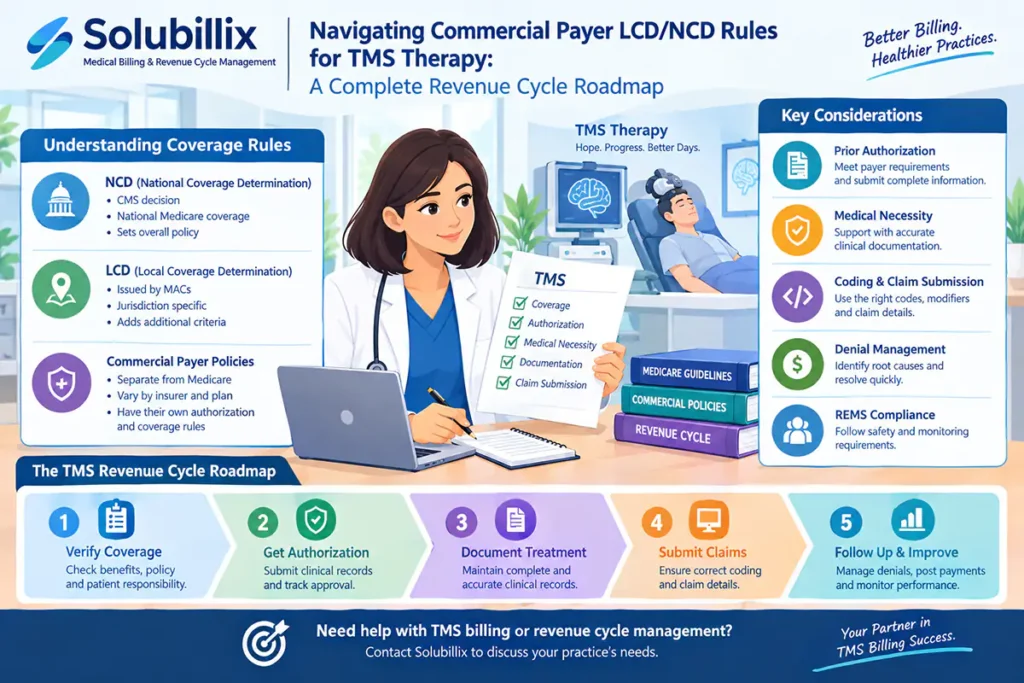
1. Understanding LCDs, NCDs, and Commercial Payer Policies
Before developing a TMS billing workflow, practices should understand which coverage rules apply to each patient’s insurance plan.
What is a National Coverage Determination (NCD)?
An NCD is a Medicare coverage determination issued by the Centers for Medicare & Medicaid Services (CMS). It establishes whether a particular item or service is covered nationally under Medicare and may define the circumstances in which coverage applies.
An NCD does not, by itself, determine every coding or payment detail associated with a service.
What is a Local Coverage Determination (LCD)?
An LCD is a coverage determination developed by a Medicare Administrative Contractor for its jurisdiction. LCDs can establish additional coverage criteria when there is no applicable NCD or provide further detail consistent with national Medicare policy.
For TMS therapy, relevant LCDs may address:
- Covered diagnoses and indications.
- Medical necessity requirements.
- Previous treatment history.
- Provider qualifications and supervision.
- Clinical documentation.
- Treatment limitations and utilization requirements.
The applicable LCD must be checked for the patient’s Medicare jurisdiction and the date of service. A policy used in one region should not automatically be applied to another.
How do commercial insurance policies differ?
Commercial insurance companies may publish their own TMS medical policies, prior authorization requirements, and reimbursement guidelines.
These may address similar issues to Medicare policies, but their requirements can differ regarding:
- Eligible diagnoses and clinical indications.
- Previous medication trials or other treatments.
- Required symptom assessments.
- Initial authorization and continuation of treatment.
- Provider qualifications and treatment settings.
- Documentation and claim-submission requirements.
Important: A Medicare LCD is not automatically binding on a commercial insurer. Always consult the applicable commercial payer’s current policy, the member’s plan benefits, and any relevant provider contract.
2. Verify Coverage Before Beginning the TMS Treatment Course
Eligibility verification is a starting point, not a guarantee that a proposed TMS treatment will be covered.
A patient may have active insurance but still require prior authorization, satisfy specific clinical criteria, or meet other plan requirements before treatment begins.
A comprehensive verification process should address the following questions:
Is the patient’s coverage active? Confirm the effective date, applicable benefits, and whether the plan has any relevant limitations.
Is TMS a covered benefit? Review the member’s applicable plan documents and current medical policy rather than relying solely on general benefit information.
Is prior authorization required? Confirm the authorization process, required forms, clinical records, and submission deadlines.
Are there network restrictions? Verify the practice’s participation status and any relevant referral or network requirements.
What are the patient’s financial responsibilities? Review applicable deductibles, copayments, coinsurance, and out-of-pocket limits, subject to the information available from the payer.
What treatment limitations apply? Determine whether the plan specifies restrictions on treatment frequency, course duration, repeat courses, or other utilization criteria.
Record the verification date, representative or reference number when applicable, and any relevant policy details.
This creates a documented starting point for authorization and subsequent claim follow-up.
3. Prior Authorization: Connect the Clinical Record to the Payer’s Criteria
Prior authorization is a major operational checkpoint in TMS revenue cycle management.
Many commercial plans require clinical information demonstrating that the proposed treatment meets their coverage criteria. The exact requirements depend on the payer, plan, and applicable policy.
Depending on the policy, the authorization submission may need to address:
- The patient’s diagnosis and relevant clinical history.
- Previous medication trials and treatment outcomes.
- Documented contraindications, intolerance, or other relevant treatment considerations.
- Symptom severity and any required standardized assessment results.
- The treating clinician’s rationale for recommending TMS.
- The proposed treatment protocol and requested number of sessions.
- Relevant provider qualifications and treatment-setting requirements.
Not every payer requires every item listed above. The billing and clinical teams should use the specific policy and authorization checklist applicable to the member.
How to strengthen the authorization workflow?
Step 1: Obtain the current policy. Identify the payer’s applicable TMS medical policy and effective date.
Step 2: Build a payer-specific checklist. Translate the actual policy requirements into a standardized internal review process.
Step 3: Coordinate with the clinical team. Identify missing records or information before submitting the request.
Step 4: Track authorization status. Record submission dates, case numbers, approved dates, treatment limits, and outstanding requests.
Step 5: Review the approval carefully. Confirm that the authorized treatment, provider, location, and dates align with the planned services.
Step 6: Monitor authorization limits. Establish a process for identifying upcoming expiration dates or utilization limits before additional services are delivered.
An authorization approval should not be treated as a universal payment guarantee. Claims must still meet applicable coverage, coding, documentation, and contractual requirements.
4. Medical Necessity Documentation: Support the Services Actually Performed
Incomplete or inconsistent clinical documentation can create problems during authorization review, claim adjudication, or a subsequent medical record request.
For TMS services, documentation should be consistent with the applicable payer policy and the treatment actually provided.
Depending on the coverage requirements, relevant records may include:
- The documented diagnosis and clinical assessment.
- Treatment history and relevant medication trials.
- The clinical rationale for TMS.
- The treating clinician’s order and treatment plan.
- Required baseline assessments and follow-up evaluations.
- Treatment dates and relevant session records.
- Provider documentation and signatures.
- Records supporting continuation or repeat treatment when required.
Medicare contractors publish TMS coverage and billing guidance that illustrates why documentation must support medical necessity under the applicable policy. Commercial payers may establish different or additional requirements.
Common documentation problems
Missing treatment history: The record does not contain the information required by the payer to assess previous treatment attempts.
Inconsistent clinical information: The diagnosis, treatment plan, authorization request, and claim documentation do not align.
Incomplete session records: The documentation does not adequately support the services billed.
Unclear continuation rationale: Required progress assessments or supporting information for additional treatment are missing.
How to fix these issues: Use a documentation checklist tailored to the payer’s policy, conduct a pre-billing review when appropriate, and request clarification from the clinical team when information is incomplete.
Billing personnel should not create unsupported clinical statements or alter medical records to satisfy a payer’s criteria. Documentation must accurately reflect the care provided.
5. Coding Accuracy and Claim Submission for TMS Therapy
Even when a patient meets coverage criteria and has an approved authorization, coding or claim-submission errors can delay reimbursement.
A strong TMS billing process should confirm that the submitted claim accurately reflects the service provided and follows the applicable payer requirements.
Before submitting a claim, review:
- The appropriate CPT code for the service performed.
- The date of service and applicable coding rules.
- The diagnosis information supporting the service.
- Rendering and billing provider details.
- Place of service and other applicable claim information.
- Any payer-required modifiers or claim instructions.
- Authorization details when applicable.
- Documentation supporting the billed service.
For example, TMS treatment sessions and initial treatment-planning or mapping services may involve different coding considerations. The appropriate code depends on the actual service performed, applicable coding guidance, and payer policy.
Do not assume that an authorization number resolves a coding discrepancy. Similarly, do not assume that a correctly coded claim will be covered if the underlying medical necessity requirements have not been satisfied.
A pre-submission claim review can help identify inconsistencies before they result in avoidable rejections or denials.
6. Denial Management: Turn Repeated Problems into Actionable Insights
TMS denials should be analyzed by root cause rather than handled as isolated billing events.
Recurring denials may indicate a problem with the authorization workflow, documentation process, coding accuracy, payer configuration, or staff communication.
Common categories include:
| Denial category | Recommended investigation |
| Authorization-related | Compare the claim with the approval dates, approved services, and applicable limits. |
| Medical necessity | Review the payer’s policy and determine whether the submitted records support the billed treatment. |
| Coding-related | Verify the code, diagnosis, modifiers, and payer-specific claim requirements. |
| Eligibility or benefit | Recheck coverage for the date of service and applicable plan restrictions. |
| Provider or network | Verify enrollment, participation, and provider information. |
| Documentation request | Identify the exact records required and submit them through the accepted process. |
| Timely filing | Review original submission evidence, applicable deadlines, and any available exceptions. |
A structured denial-resolution process
1. Identify the denial reason. Review the EOB, ERA, rejection message, or payer communication.
2. Confirm the applicable rule. Check the policy and requirements relevant to the plan and date of service.
3. Review the supporting documentation. Compare the clinical record, authorization, and submitted claim.
4. Determine the correct next action. Depending on the findings, this may involve correcting a claim, supplying records, requesting reconsideration, or filing an appeal.
5. Track the resolution. Record the action taken, submission date, payer reference number, and next follow-up date.
6. Analyze trends. Identify recurring issues by payer, provider, denial category, and treatment stage.
An effective denial-management process should distinguish avoidable administrative errors from legitimate coverage disputes. An appeal should be supported by the applicable policy, claim history, and available documentation.
7. Build a Complete TMS Revenue Cycle Roadmap
Coverage verification, authorization, clinical documentation, coding, and denial follow-up work best as connected processes.
A practical TMS revenue cycle can be organized into five stages.
Stage 1: Pre-treatment verification
Confirm the patient’s coverage, applicable benefits, payer policy, authorization requirements, network status, and potential financial responsibility.
Stage 2: Authorization and clinical coordination
Obtain the required clinical information, submit the authorization request, track its status, and communicate any outstanding requirements to the clinical team.
Stage 3: Treatment and documentation
Ensure that the services are documented accurately and that the clinical record supports the care provided under the applicable requirements.
Stage 4: Claim submission and payment posting
Review coding and claim information, submit claims within applicable deadlines, post payments accurately, and identify underpayments or denials.
Stage 5: Follow-up and performance monitoring
Work unresolved claims, pursue appropriate corrections or appeals, monitor outstanding accounts receivable, and use reporting to identify recurring process gaps.
Key performance indicators to monitor
Practices may benefit from tracking:
- Authorization approval and turnaround times.
- First-pass claim acceptance and denial rates.
- Denial reasons by payer and provider.
- Days in accounts receivable.
- Outstanding claims by aging category.
- Underpayments and unresolved balances.
- Appeal outcomes and recovery amounts.
- Repeat denials associated with the same root cause.
These indicators help practice managers assess workflow performance and identify where additional training, documentation improvements, or billing process changes may be warranted.
8. How Solubillix Supports TMS Billing and Revenue Cycle Management
TMS billing requires close coordination between clinical documentation, insurance requirements, authorization management, and ongoing claims follow-up.
When these processes are disconnected, practices may experience repeated administrative work, delayed claim resolution, and limited visibility into outstanding reimbursement.
Solubillix provides medical billing and revenue cycle management support for healthcare practices seeking a more structured approach to claims and reimbursement operations.
Our services can include:
- Insurance eligibility and benefits verification.
- Authorization workflow support.
- Claim preparation and submission.
- Coding and billing discrepancy review.
- Denial investigation and appeal support.
- Insurance accounts receivable follow-up.
- Payment posting and reconciliation.
- Reporting to identify recurring reimbursement issues.
For TMS practices, the objective is to help establish consistent workflows, improve claim follow-up, and identify avoidable billing problems while respecting payer-specific coverage requirements.
Is your TMS practice experiencing repeated denials or authorization delays?
Solubillix can help your team review its billing workflow, identify recurring administrative challenges, and evaluate opportunities to improve revenue cycle operations.
Contact Solubillix to discuss your TMS billing and RCM needs.
Conclusion
Navigating coverage requirements for TMS therapy requires more than checking a single LCD, NCD, or payer policy.
Medicare coverage determinations and commercial insurer policies serve different purposes, and the applicable requirements must be verified for the specific patient, plan, jurisdiction, and date of service.
By combining accurate benefits verification, payer-specific authorization workflows, complete clinical documentation, correct claim submission, and consistent denial follow-up, practices can build a more reliable TMS revenue cycle.
For providers looking to improve billing operations, Solubillix offers medical billing and RCM support focused on helping practices manage claims, address reimbursement issues, and strengthen workflow consistency.
Disclaimer: This article is for general educational purposes and is not a guarantee of coverage or reimbursement. Medicare coverage determinations, commercial payer policies, provider contracts, and coding requirements may differ and change over time. Verify current applicable policies and clinical documentation requirements before submitting claims. Clinical decisions must remain with qualified healthcare professionals.
References
- Centers for Medicare & Medicaid Services — Medicare Coverage Determination Process
https://www.cms.gov/medicare/coverage/determination-process - CMS Medicare Coverage Database — TMS Local Coverage Determination (L36469)
https://www.cms.gov/medicare-coverage-database/view/lcd.aspx?lcdid=36469 - CMS Medicare Coverage Database — Billing and Coding: Transcranial Magnetic Stimulation (TMS) (A57598)
https://www.cms.gov/medicare-coverage-database/view/article.aspx?articleid=57598 - CMS Medicare Coverage Database — Search for Current Coverage Policies
https://www.cms.gov/medicare-coverage-database/search.aspx
Author: Solubillix Medical Billing Team
Editorial note: Confirm that each cited policy is current and applicable to the patient’s jurisdiction and date of service. Add links to relevant Solubillix TMS billing and denial-management service pages before publication.