
Spravato (esketamine) billing can be complicated because a treatment session may involve the medication, supervised self-administration, post-administration monitoring, evaluation and management (E/M), and potentially prolonged professional services.
The challenge for billing teams is determining which services are included in a bundled code and which may be separately reportable under the patient’s specific insurance policy.
A claim can be denied when a practice reports separate E/M or prolonged-service codes alongside a bundled Spravato code that already includes those services. Problems can also arise when a practice uses the wrong drug code, bills for medication supplied by another entity, or fails to document the services required by the payer.
At Solubillix, we believe that accurate Spravato billing starts with understanding the billing model before selecting the codes.
The most important rule: Do not assume that the same coding combination works for every insurer. Medicare, Medicare Advantage, Medicaid, and commercial plans may have different requirements.
This guide explains how billing teams can review Spravato claims, understand the role of G2082 and G2083, evaluate E/M and prolonged-service reporting, and reduce avoidable same-day bundling denials.
1. Understand the main Spravato billing codes
The first step is to distinguish the codes used for bundled treatment services from those used when the medication and professional services are billed separately.
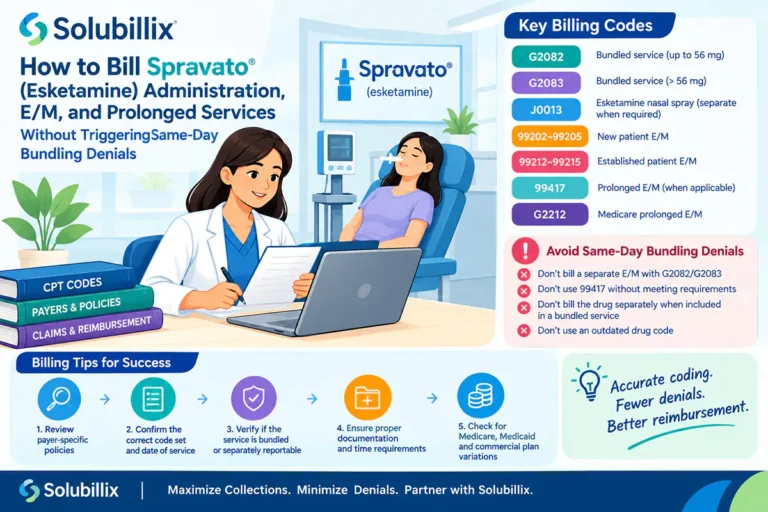
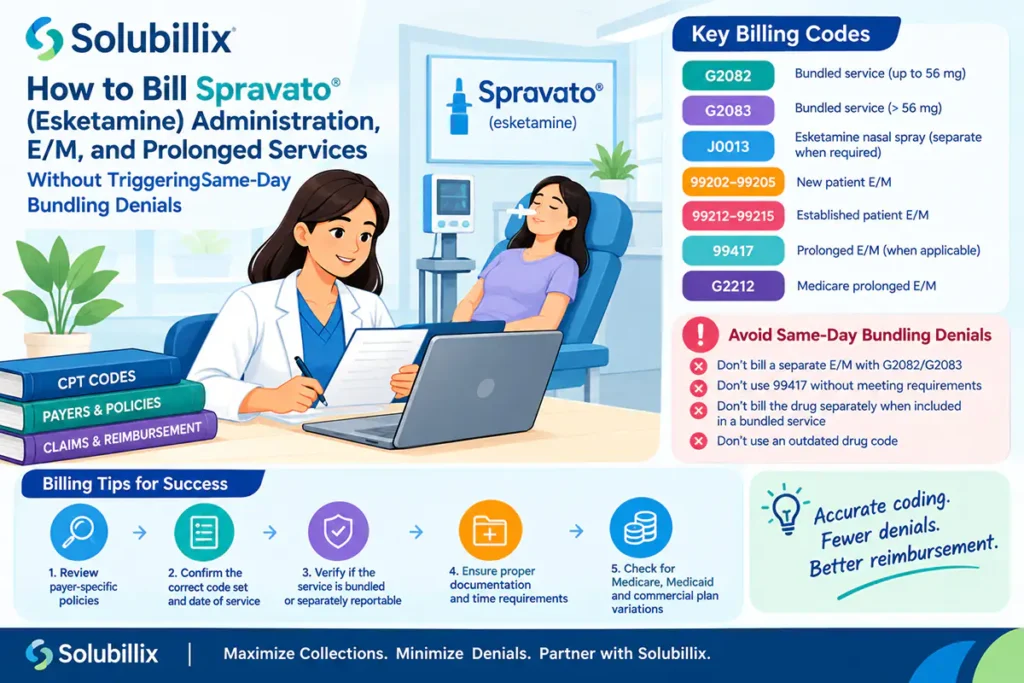
| Code | General purpose | Important billing consideration |
| G2082 | Bundled Spravato office/outpatient service involving up to 56 mg of esketamine | Includes E/M, medication, and two-hour post-administration observation under the applicable Medicare code definition. |
| G2083 | Bundled Spravato office/outpatient service involving more than 56 mg of esketamine | Includes E/M, medication, and two-hour post-administration observation under the applicable Medicare code definition. |
| J0013 | Esketamine nasal spray, 1 mg | Used when the applicable payer requires the drug to be billed separately under this code. Verify current payer rules. |
| 99202–99205 | Office/outpatient E/M for new patients | Select the appropriate level according to applicable E/M rules and payer requirements. |
| 99212–99215 | Office/outpatient E/M for established patients | Select the appropriate level according to applicable E/M rules and payer requirements. |
| 99417 | Prolonged office/outpatient E/M service | Report only when the applicable requirements are met; it is not automatically payable for two-hour observation. |
| G2212 | Medicare prolonged office/outpatient E/M service | Used under applicable Medicare rules instead of CPT 99417 for qualifying prolonged services. |
CMS established G2082 and G2083 as bundled services that incorporate E/M, observation, and the provision of self-administered esketamine. CMS explained that billing a separate E/M service alongside these bundled codes would duplicate services already included in the payment.
Reference: CMS — Medicare Physician Fee Schedule final rule.
The codes in this table are not interchangeable. Before submitting a claim, confirm the applicable code set, date of service, payer policy, and drug acquisition arrangement.
2. Why same-day Spravato claims get denied
Spravato treatment often requires substantial clinical supervision and monitoring. However, the length of the appointment does not automatically establish that all services can be reported separately.
Common billing problems include the following.
Billing a separate E/M code with G2082 or G2083
This is a major risk for Medicare claims.
When the applicable bundled code is reported, its payment already includes the defined E/M component and two-hour post-administration observation. Submitting a separate E/M code for those included services may result in a duplicate-payment denial.
A practice should not add a separate E/M code simply because the provider evaluated the patient during the session.
Reporting CPT 99417 without meeting its requirements
CPT 99417 is a prolonged office/outpatient E/M add-on code. It is not a general code for the time a patient spends in the clinic.
The service must meet the applicable prolonged E/M reporting requirements, including the required primary E/M code and qualifying total time. Payer rules must also permit the combination.
A two-hour observation period does not, by itself, establish that 99417 is reportable.
Billing the drug separately when it is included in a bundled service
When G2082 or G2083 is used under the applicable bundled billing policy, the drug is included in the service. Billing the same medication separately on the same claim can create a duplicate or incompatible-code issue.
By contrast, when the drug is supplied by a specialty pharmacy and the payer permits separate drug and professional-service claims, the billing workflow may be different.
Using an outdated drug code
Code requirements can change by payer and date of service. For example, Iowa Medicaid announced that J0013 became its required Spravato drug code effective January 1, 2026, with G2082 or G2083 used for Medicare crossover claims. This is an Iowa-specific example, not a universal rule for every payer.
Reference: Iowa Medicaid — Claims and Billing.
Reporting services without sufficient documentation
The medical record must support the codes and services reported. Missing observation records, incomplete E/M documentation, unsupported time calculations, or unclear medication-supply arrangements can complicate claim adjudication.
3. Medicare billing: When G2082 and G2083 apply
Under the applicable Medicare bundled billing framework, G2082 and G2083 represent an established-patient office/outpatient service that includes supervision, esketamine self-administration, and two hours of post-administration observation.
- G2082: Up to 56 mg of esketamine.
- G2083: More than 56 mg of esketamine.
The code selection should reflect the service actually furnished and the applicable coding requirements.
What should not be separately billed with these bundled services?
For a claim using the applicable Medicare bundled code, the included components generally should not be billed again as separate services.
This means billing teams should not automatically add:
- A separate E/M code for the E/M work included in the bundle.
- A separate prolonged-service code for time already accounted for by the bundled service.
- A separate drug charge for the medication included in the bundled code.
A separate service should be reported only if the applicable coding rules and payer policy permit it and the record supports a distinct, separately reportable service.
Important: Do not apply this Medicare bundled workflow to every commercial or Medicaid claim without checking the payer’s current policy.
4. Commercial insurance and Medicaid: The billing model matters
Some plans permit the medication and professional services to be billed separately. Others use bundled codes or impose additional restrictions.
Before preparing a claim, determine how the medication was obtained and which billing model the payer requires.
Model A: The provider purchases the medication
In a buy-and-bill arrangement, the practice acquires the medication and bills the drug under the applicable payer rules.
Depending on the plan, the drug may be billed using J0013 or another required code, while qualifying professional services may be reported separately.
Do not assume that a separate drug code and E/M code are always permitted together. Confirm whether the payer instead requires a bundled service code.
Model B: A specialty pharmacy supplies the medication
When the medication is supplied and billed by a specialty pharmacy, the provider generally should not bill for medication that the practice did not supply.
The professional claim may include eligible administration-related services and E/M, subject to the payer’s policy.
The billing team should establish who billed the drug, which benefit applies, and which professional services are separately reportable.
Model C: A bundled code is required
Some plans use G2082 or G2083 under their applicable policies. In these circumstances, the included services should not be unbundled simply to increase the number of claim lines.
Always verify whether the plan permits the bundled code for the particular drug acquisition arrangement and setting.
5. When can E/M codes be reported separately?
The answer depends on the payer’s policy and whether the professional service is separately reportable.
When a payer permits separate E/M billing for a Spravato session, the provider must select an appropriate E/M code based on the applicable E/M rules and the documented service.
For example, an established patient may receive a qualifying E/M service during a treatment session. The claim should reflect the service actually furnished, the correct code level, and the payer’s rules.
However, a practice must not report a separate E/M code merely because the clinician monitored the patient or participated in a service already included in G2082 or G2083.
If the clinician performs a genuinely separate, medically necessary service, the billing team must determine whether it qualifies for separate reporting under the payer’s rules. Modifier use does not automatically make an otherwise bundled service separately payable.
6. CPT 99417 versus Medicare G2212
One of the most important distinctions in prolonged-service billing is the difference between CPT 99417 and HCPCS G2212.
CPT 99417
CPT 99417 is an add-on code for qualifying prolonged office/outpatient E/M services. It is reported with the appropriate primary E/M code, such as 99205 or 99215, when the applicable time requirements and other reporting rules are met.
The total time must meet the applicable threshold for prolonged reporting. The billing team should use the current CPT guidance and the payer’s policy rather than assuming that every additional 15 minutes can be billed.
HCPCS G2212
For qualifying Medicare prolonged office/outpatient E/M services, G2212 is used under Medicare’s applicable rules instead of CPT 99417.
The required time threshold and primary E/M code must be verified against current Medicare guidance.
Why this matters for Spravato
Two hours of post-administration observation does not automatically qualify as prolonged E/M time. Observation time, clinical staff time, provider time, and time included in a bundled code must not be treated as interchangeable.
When the payer requires G2082 or G2083, the billing team should not add 99417 or G2212 for services already included in the bundled payment.
When the payer permits separate E/M and prolonged-service billing, the practice must still meet the applicable code-specific requirements and document the qualifying time.
7. Practical Spravato billing scenarios
These examples illustrate the decision-making process. They do not replace payer-specific instructions or claim-level coding review.
Scenario 1: Medicare bundled service
A practice administers 56 mg of Spravato under a Medicare billing arrangement that requires the applicable bundled code.
Potential approach: Review whether G2082 is the appropriate code and ensure that the bundled service is reported according to the applicable requirements.
Avoid: Adding a separate E/M code, prolonged-service code, or drug charge for components already included in the bundle.
Scenario 2: Commercial payer with separate drug and professional billing
A practice obtains the drug through an arrangement under which the payer permits separate drug and professional claims.
Potential approach: Verify the required drug code, confirm who bills for the medication, and determine which E/M or observation-related services are separately payable.
Avoid: Assuming that the same billing combination is appropriate for every commercial plan.
Scenario 3: Prolonged service is considered for a commercial claim
A patient remains in the clinic for an extended period, and the clinician performs qualifying E/M services.
Potential approach: Review the payer’s prolonged-service policy, the primary E/M code, and the total qualifying time before considering CPT 99417.
Avoid: Reporting 99417 solely because the patient was observed for two hours or because the total appointment was lengthy.
Scenario 4: Drug supplied by a specialty pharmacy
The specialty pharmacy supplies and bills the medication, while the practice provides the treatment-related professional services.
Potential approach: Verify the payer’s rules for separately billing the drug and professional services. Ensure the practice does not duplicate the pharmacy’s drug charge.
Avoid: Billing for medication the practice did not supply or using a bundled code contrary to the payer’s instructions.
8. A pre-submission checklist for Spravato claims
Before submitting a claim, billing teams should verify the following:
Confirm the patient’s exact insurance plan and benefit.
Verify the date-of-service coding and payer policy.
Determine whether the practice or specialty pharmacy supplied the medication.
Select the appropriate drug code and units, where separately reportable.
Determine whether the payer requires G2082/G2083 or permits separate professional billing.
Check whether the E/M service is included in a bundled code.
Review the primary E/M code and qualifying time before reporting 99417 or G2212.
Ensure the medical record supports the medication, service, observation, and any separately reported E/M or prolonged-service time.
Confirm that no duplicate drug or bundled-service charges are present.
Apply required prior authorization, REMS, and payer-specific claim instructions.
A checklist will not guarantee payment, but it can help identify common coding and billing inconsistencies before submission.
9. What to do when a Spravato claim is denied
If a claim is denied for bundling, duplicate services, or an incompatible code combination, do not immediately resubmit it with a different modifier.
Instead:
- Review the denial message and identify the exact code combination involved.
- Confirm whether the payer requires a bundled or separate-billing approach.
- Check the drug acquisition arrangement and determine who billed the medication.
- Review the E/M and prolonged-service documentation.
- Compare the claim with the payer’s current policy for the date of service.
- Correct the claim only when the documentation and applicable rules support the change.
- If the original claim complies with the applicable policy, follow the payer’s reconsideration or appeal process and provide relevant supporting records.
The objective is not to force a claim through a payment edit. It is to submit a claim that accurately represents the services furnished and meets the payer’s requirements.
How Solubillix helps behavioral health practices
Spravato billing requires careful coordination between drug billing, professional services, observation documentation, authorization requirements, and payer-specific reimbursement rules.
Solubillix supports healthcare providers with medical billing and revenue cycle management services, including claim review, denial management, accounts receivable follow-up, and payer-specific billing workflow support.
Our approach focuses on identifying recurring claim issues, improving billing consistency, and helping practices understand why claims are being denied or underpaid.
Need help reviewing your Spravato claims? Contact Solubillix to discuss your billing challenges and explore how professional RCM support may help your practice manage claim submissions, denials, and payer-specific requirements more effectively.
Frequently asked questions
Can G2082 or G2083 be billed with a separate E/M code?
Under the applicable Medicare bundled billing framework, these codes include the defined E/M service. A separate E/M code should not be added for the same included service. Other payer policies must be checked individually.
Can CPT 99417 be billed for Spravato observation time?
Not automatically. The requirements for prolonged E/M reporting must be met, and the payer must permit the code combination. Two hours of observation alone does not establish that 99417 is reportable.
Should Medicare claims use 99417 or G2212 for qualifying prolonged E/M services?
Medicare uses G2212 under its applicable prolonged E/M rules instead of CPT 99417. The service must meet the relevant time and reporting requirements. Neither code should be added for time already included in a bundled Spravato payment.
What is G0023, and is it a Spravato administration code?
No. G0023 describes principal illness navigation services provided by qualifying auxiliary personnel under a practitioner’s direction. It is not the Medicare bundled Spravato administration code. G2082 and G2083 are the bundled codes described in this guide.
Can the medication be billed separately when a specialty pharmacy supplies it?
The provider should not bill for medication supplied and billed by the pharmacy unless the applicable arrangement and payer rules specifically support the reported claim. Verify the drug and professional-service billing instructions for the patient’s plan.
Why are Spravato claims denied when the treatment was performed correctly?
A claim may be denied because of a code mismatch, incompatible bundled and separate services, an incorrect drug code, missing authorization, insufficient documentation, or a payer-specific restriction. The denial reason and policy should be reviewed before correcting the claim.
Final thoughts
Accurate Spravato billing requires more than knowing the codes. Billing teams must understand the distinction between bundled treatment services and separately reportable professional services, verify who supplied the medication, and apply the payer’s requirements for E/M and prolonged services.
G2082 and G2083 include defined services under the applicable bundled billing framework. CPT 99417 and HCPCS G2212 have separate reporting requirements and should not be used to bill again for services already included in a bundled payment.
For practices experiencing recurring Spravato denials, a structured review of coding, documentation, drug acquisition, and payer policy can help identify the underlying issue and improve the consistency of claim submissions.
Solubillix is committed to providing practical medical billing and RCM guidance to help healthcare practices navigate complex reimbursement requirements.
References and authoritative resources
- Centers for Medicare & Medicaid Services (CMS): Medicare Physician Fee Schedule final rule — bundled esketamine services
- CMS Medicare Coverage Database: Billing and Coding: Esketamine
- Centers for Medicare & Medicaid Services: Medicare NCCI and coding resources
- Iowa Medicaid: Claims and Billing — Spravato coding requirements effective January 1, 2026
- New York State Department of Health: Pharmacy and Medical Billing Guidance for SPRAVATO
- DailyMed: Official SPRAVATO prescribing information
Editorial note: Payer rules, code sets, and coverage requirements may change. The CMS esketamine article linked above includes a retired Medicare coverage article, so it should be used for historical context rather than treated as a current coverage determination. Confirm current coding and coverage rules for the date of service. This article is educational and does not replace current official coding guidance or payer-specific instructions. CPT is a registered trademark of the American Medical Association.