
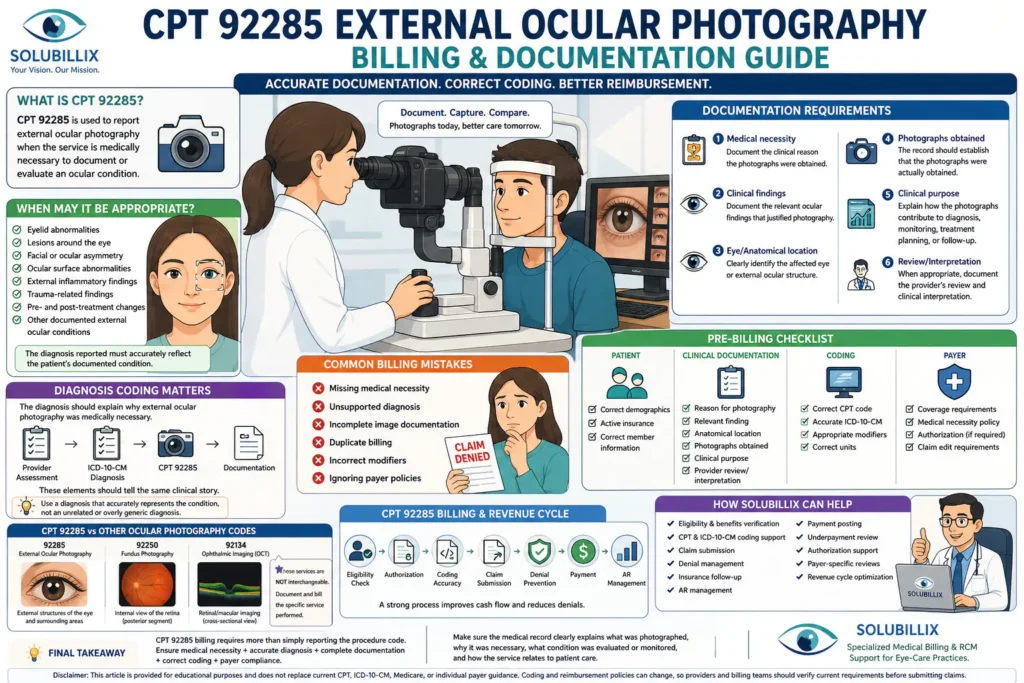
External ocular photography is an important diagnostic service used to document and monitor visible conditions affecting the eye and surrounding structures. While CPT 92285 may appear straightforward, successful reimbursement depends on proper documentation, medical necessity, diagnosis coding, and payer-specific billing requirements.
For ophthalmology and optometry practices, understanding these requirements can help reduce avoidable claim denials and protect revenue.
What Is CPT 92285?
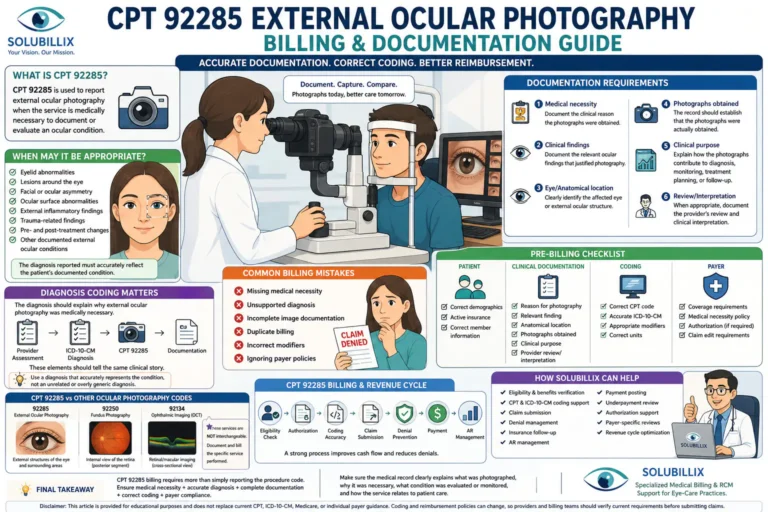
CPT 92285 is used to report external ocular photography when the service is medically necessary to document or evaluate an ocular condition.
The service may be relevant when the provider needs photographic documentation of external eye findings for diagnosis, monitoring, treatment planning, or comparison over time.
The medical record should make clear why the photography was necessary and how the findings relate to the patient’s care.
When May External Ocular Photography Be Appropriate?
Depending on the patient’s clinical condition and payer policy, external ocular photography may be used to document conditions such as:
- Eyelid abnormalities
- Lesions around the eye
- Facial or ocular asymmetry
- Ocular surface abnormalities
- External inflammatory findings
- Trauma-related findings
- Pre- and post-treatment changes
- Other documented external ocular conditions
The diagnosis reported on the claim should accurately reflect the patient’s documented condition.
Do not select a diagnosis simply because it is likely to support reimbursement. The diagnosis must be supported by the provider’s medical record.
CPT 92285 Documentation Requirements
Good documentation is one of the most important factors in defending a 92285 claim.
The medical record should clearly establish:
1. Medical necessity
Document the clinical reason the photographs were obtained.
For example:
“External ocular photographs obtained to document progression of the documented eyelid lesion and establish a baseline for future comparison.”
The actual documentation should reflect the patient’s specific circumstances rather than relying on a generic statement.
2. Clinical findings
Document the relevant ocular findings that justified photography.
3. Eye or anatomical location
Clearly identify the affected eye or external ocular structure whenever applicable.
4. Photographs obtained
The record should establish that the external ocular photographs were actually obtained.
5. Clinical purpose
Explain how the photographs contribute to diagnosis, monitoring, treatment planning, or follow-up.
6. Interpretation or review
When appropriate, document the provider’s review and clinical interpretation of the images.
Diagnosis Coding for CPT 92285
Correct ICD-10-CM diagnosis coding is essential.
The diagnosis should explain why external ocular photography was medically necessary.
Before submitting the claim, the billing team should compare:
Provider assessment → ICD-10-CM diagnosis → CPT 92285 → Documentation
These elements should tell the same clinical story.
For example, if photography is performed to monitor a documented eyelid lesion, the claim should contain a diagnosis that accurately represents that condition rather than an unrelated or overly generic diagnosis.
Common CPT 92285 Billing Mistakes
1. Missing medical necessity
Simply documenting that photographs were taken may not sufficiently explain why the service was required.
2. Unsupported diagnosis
The diagnosis must match the provider’s assessment and the reason for performing the service.
3. Incomplete image documentation
The medical record should support that the photographs were obtained and retained according to applicable requirements.
4. Duplicate billing
Billing teams should review the claim history and payer rules to avoid reporting the same service more than once when it is not separately reimbursable.
5. Incorrect modifiers
Modifiers should only be reported when supported by the circumstances and applicable payer rules.
6. Ignoring payer policies
Medicare, Medicare Advantage, and commercial insurers may have different coverage and documentation requirements.
CPT 92285 vs Other Ocular Photography Codes
One of the most important billing considerations is choosing the correct photography service.
External ocular photography is different from other ophthalmic imaging services that capture internal structures of the eye.
For example:
- 92285 — External ocular photography
- 92250 — Fundus photography
- 92134 — Ophthalmic imaging used for retinal/macular evaluation
These services should not be selected interchangeably.
The provider’s documentation should support the specific type of imaging performed.
How to Reduce 92285 Claim Denials
A simple pre-billing checklist can prevent many avoidable problems.
Before submitting a claim, verify:
Patient
- Correct demographics
- Active insurance
- Correct member information
Clinical documentation
- Reason for photography
- Relevant ocular finding
- Anatomical location
- Photographs obtained
- Clinical purpose
- Provider review/interpretation when applicable
Coding
- Correct CPT code
- Accurate ICD-10-CM diagnosis
- Appropriate modifiers
- Correct units
Payer
- Coverage requirements
- Medical-necessity policy
- Authorization requirements, if applicable
- Claim-edit requirements
This process helps ensure the claim is supported before it reaches the payer.
CPT 92285 Billing and Revenue Cycle Management
For ophthalmology practices, the biggest problem is often not the CPT code itself.
Revenue can be lost through:
Incorrect eligibility → missed authorization → coding errors → claim rejection → denial → delayed AR follow-up → underpayment
A strong ophthalmology billing process addresses the entire revenue cycle rather than focusing only on claim submission.
How Solubillix Helps Ophthalmology & Optometry Practices
Solubillix provides specialized medical billing and revenue cycle management support for eye-care practices.
Our services can include:
- Eligibility and benefits verification
- CPT and ICD-10-CM coding support
- Claim submission
- Denial management
- Insurance follow-up
- AR management
- Payment posting
- Underpayment review
- Authorization support
- Payer-specific billing review
- Revenue cycle optimization
For services such as external ocular photography, our goal is to help practices maintain a billing process where clinical documentation, coding, claims, and payer requirements work together.
Final Takeaway
CPT 92285 billing requires more than simply reporting the procedure code.
Successful reimbursement depends on:
Medical necessity + accurate diagnosis + complete documentation + correct coding + payer compliance.
Before submitting a 92285 claim, make sure the medical record clearly explains what was photographed, why it was necessary, what condition was being evaluated or monitored, and how the service relates to patient care.
If your ophthalmology or optometry practice is experiencing recurring denials, coding problems, or aging AR, Solubillix can help streamline your billing and revenue cycle process.
Solubillix — Specialized Medical Billing & RCM Support for Eye-Care Practices.
Frequently Asked Questions
What is CPT 92285?
CPT 92285 is used for external ocular photography when the service is medically necessary and supported by appropriate documentation.
What documentation supports CPT 92285?
Documentation should establish the medical necessity for photography, relevant clinical findings, the area photographed, and the clinical purpose of obtaining the images.
Is CPT 92285 the same as fundus photography?
No. External ocular photography and fundus photography represent different imaging services and should not be billed interchangeably.
Can CPT 92285 be billed with other eye-care services?
Potentially, depending on the services performed, documentation, payer policy, and applicable coding edits. The services must be separately identifiable and medically supported when separate reporting is appropriate.
What causes CPT 92285 denials?
Common issues include insufficient medical necessity, unsupported diagnosis coding, incomplete documentation, incorrect modifiers, duplicate billing, and failure to follow payer-specific requirements.
Does every insurance company cover CPT 92285?
No. Coverage and reimbursement requirements vary by payer and plan. The practice should verify benefits and applicable medical policies before assuming a service will be covered.
Disclaimer: This article is provided for educational purposes and does not replace current CPT, ICD-10-CM, Medicare, or individual payer guidance. Coding and reimbursement policies can change, so providers and billing teams should verify current requirements before submitting claims.