
A modifier may look like a small detail on a medical claim, but selecting the wrong modifier can affect claim processing and reimbursement.
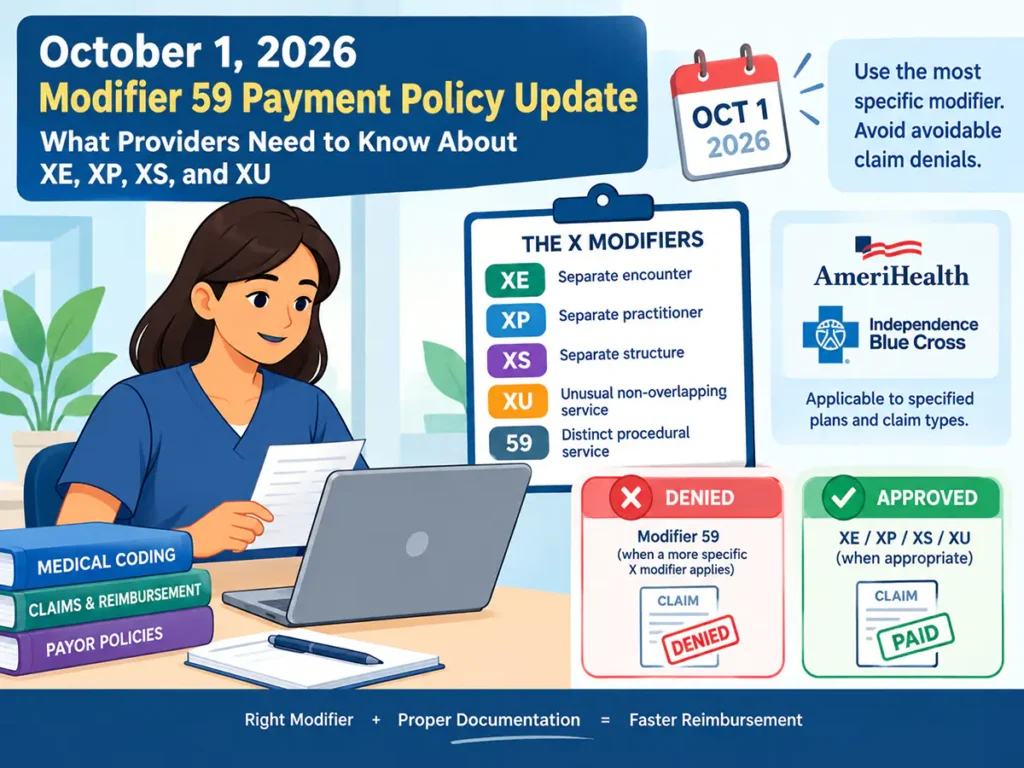
Effective October 1, 2026, certain health plans administered by AmeriHealth and Independence Blue Cross (IBX), including Independence Administrators, implemented an updated payment policy involving Modifier 59 and the X modifiers: XE, XP, XS, and XU. Under the specified policies, Modifier 59 is no longer eligible for reimbursement consideration when reported with a non-time-based service and a more specific X modifier applies.
For medical practices, physical and occupational therapy clinics, and other healthcare providers, this update makes modifier selection and documentation especially important.
The key point: This is not a nationwide deactivation of Modifier 59. The October 1 update applies to the plans and claim types identified in the relevant payer policies. Providers must verify the requirements of each insurer before changing their billing workflows.
At Solubillix, we recognize that payment-policy changes can create confusion for billing teams. This guide explains the policy update, the purpose of each modifier, and practical steps practices can take to reduce preventable claim denials.
What changed on October 1, 2026?
The updated policies address the use of Modifier 59 to identify distinct procedural services.
Under the published AmeriHealth update, effective October 1, 2026, claim lines reporting Modifier 59 for non-time-based services will be denied when the policy indicates that a more specific modifier is available.
Independence Blue Cross and Independence Administrators also published an updated policy FAQ effective October 1, 2026. Their policy specifies that Modifier 59 is no longer eligible for reimbursement consideration for non-time-based services when an appropriate XE, XP, XS, or XU modifier more specifically describes the distinct service.
The IBX policy applies to its specified Commercial and Medicare Advantage products and professional and outpatient facility claims.
These changes reinforce a familiar coding principle: use the most specific modifier that accurately describes the circumstances of the service.
Does this mean Modifier 59 has been discontinued?
No. Providers should not interpret this update as a universal discontinuation of Modifier 59.
Under the IBX policy, Modifier 59 remains relevant for eligible time-based services when none of the more specific X modifiers applies. The exact rules must be checked against the applicable payer policy.
Before changing claim submissions, billing teams should confirm:
- The patient’s specific insurance plan and product.
- Whether the policy applies to the claim’s date of service.
- Whether the service is time-based under the applicable CPT or HCPCS coding guidance.
- Whether XE, XP, XS, or XU accurately describes the circumstances.
- Whether the payer has additional restrictions or documentation requirements.
Understanding Modifiers XE, XP, XS, XU, and 59
The X modifiers provide more specific information about why two services that might ordinarily be considered bundled are distinct.
| Modifier | Description | When it may be appropriate |
| XE | Separate encounter | A distinct service occurred during a separate encounter on the same date. |
| XP | Separate practitioner | A distinct service was performed by a different practitioner. |
| XS | Separate structure | A distinct service was performed on a separate organ or anatomical structure. |
| XU | Unusual non-overlapping service | A distinct service does not overlap the usual components of the primary service. |
| 59 | Distinct procedural service | A distinct service is supported by documentation and no more specific modifier appropriately describes the circumstances, subject to payer policy. |
The modifier must reflect what actually occurred. It should not be selected simply because a claim was previously paid with that modifier or because a particular modifier is believed to improve reimbursement.
CMS also explains that Modifier 59 and the X modifiers should be used only when supported by the circumstances of the service and applicable coding rules.
How the updated policy may affect medical billing
The most immediate concern for affected providers is the possibility of claim denials when Modifier 59 is used in circumstances where the payer requires a more specific modifier.
For example, a practice may continue submitting Modifier 59 based on its previous billing workflow without realizing that a particular payer’s policy has changed. If the service is non-time-based and the policy requires an applicable X modifier, the claim line may be denied.
Potential consequences include:
- Additional claim corrections and resubmissions.
- Delays in reimbursement.
- Increased accounts receivable follow-up.
- More work for coding and billing staff.
- Additional documentation requests or payment reviews.
These outcomes depend on the claim, the applicable policy, and the payer’s adjudication process. Not every claim using Modifier 59 will be denied.
Practical billing scenarios: Choosing the appropriate modifier
The following examples are illustrative. They do not replace official coding guidance, payer edits, or review of the patient’s medical record.
Scenario 1: Services performed during separate encounters
A patient receives a service during a morning appointment and returns later that day for a separate encounter involving another distinct service.
Potential modifier: XE, if the circumstances meet the modifier’s definition and applicable coding and payer requirements.
The medical record should support the separate encounters. The fact that two services occurred at different times does not automatically establish that they qualify for separate reimbursement.
Scenario 2: A different practitioner performs a distinct service
A patient receives a service from one practitioner and a separate, qualifying service from another practitioner.
Potential modifier: XP, if the separate-practitioner criteria are met.
The billing team should verify the identities and roles of the practitioners, the nature of the services, and any applicable payer restrictions. A change in practitioner alone does not guarantee that a separate payment is permitted.
Scenario 3: A distinct service involves a separate anatomical structure
A provider performs procedures involving different anatomical structures, and the applicable coding rules permit reporting the services separately.
Potential modifier: XS, when the separate-structure criteria are satisfied and a more appropriate anatomical modifier does not apply.
The documentation should identify the relevant structures and support the distinct services. Providers should not automatically use XS for every service involving a different body part.
Scenario 4: A distinct service does not overlap the usual components of another service
A provider performs an additional service that is distinct from, and does not overlap, the usual components of the primary service.
Potential modifier: XU, when the service meets the modifier’s definition and applicable coding requirements.
The clinical record must support why the additional service is distinct. XU should not be used merely to bypass a procedure-to-procedure edit.
Scenario 5: Modifier 59 was previously used on a non-time-based service
A billing team has historically reported Modifier 59 on a non-time-based service. The affected payer’s updated policy now requires a more specific X modifier when one appropriately describes the distinct service.
Recommended action: Review the clinical documentation and determine whether XE, XP, XS, or XU accurately reflects the service. Correct the billing workflow for applicable dates of service rather than automatically replacing Modifier 59 on every claim.
If no X modifier accurately describes the circumstances, consult the payer’s policy and dispute or clarification process before assuming that a replacement modifier is appropriate.
How to reduce Modifier 59-related claim denials
Medical billing teams should treat the October 1 update as an opportunity to review modifier selection, claim edits, and staff education.
1. Review affected payer policies
Identify the insurance products affected by the update. Read the current Commercial or Medicare Advantage policy as applicable and confirm the effective date.
Do not assume that every payer follows the same Modifier 59 policy.
2. Review non-time-based services
Identify services for which the billing team routinely reports Modifier 59. Determine whether the service is time-based under the applicable coding guidelines and whether a more specific X modifier accurately describes the circumstances.
3. Update billing software and internal claim edits
Where appropriate, update claim-scrubbing rules, billing checklists, and internal procedures to flag Modifier 59 on affected non-time-based services.
Automated edits should support accurate coding rather than automatically substitute one modifier for another without reviewing the service.
4. Strengthen clinical documentation
The medical record should support the reason the services are distinct. Depending on the circumstances, relevant details may include separate encounters, different practitioners, anatomical structures, or non-overlapping services.
Incomplete documentation can create problems even when the modifier appears appropriate.
5. Train billing and coding staff
Ensure that staff understand the differences between XE, XP, XS, XU, and 59. Training should include examples based on the practice’s specialties, the affected payer policies, and applicable coding guidelines.
6. Monitor denials after implementation
Review claims with modifier-related denials after the policy takes effect. Track denial reasons, affected codes, payer products, and dates of service.
Use this information to identify recurring workflow errors and determine whether corrected claims, appeals, or payer clarification are appropriate.
What should providers do if a claim is denied?
If a claim is denied because Modifier 59 was reported where a more specific modifier is required, the billing team should not automatically resubmit the claim with a different modifier.
Instead:
- Review the denial message and the applicable payer policy.
- Confirm that the policy applies to the claim’s date of service and insurance product.
- Review the clinical documentation and original coding.
- Determine whether XE, XP, XS, or XU accurately describes the distinct service.
- Submit a corrected claim when supported by the documentation and payer requirements.
- If the circumstances do not fit an X modifier, follow the payer’s published clarification or dispute process.
For example, the IBX policy FAQ identifies message code UMD0851 for certain Modifier 59 denials. Its specified dispute process includes a cover letter explaining why a more specific X modifier cannot be used and supporting medical records. Providers should follow the current instructions for the affected plan rather than applying that process to unrelated payers.
How Solubillix helps providers manage claim payment policy changes
Keeping up with payer policy changes is an important part of an effective revenue cycle management strategy. A small coding or claim-editing issue can create recurring denials when billing workflows are not updated.
Solubillix supports healthcare practices with medical billing and revenue cycle management services designed to improve claim accuracy, manage denials, and strengthen accounts receivable follow-up.
Our approach emphasizes:
- Reviewing payer-specific billing requirements.
- Identifying recurring claim rejection and denial patterns.
- Supporting accurate modifier reporting and documentation workflows.
- Following up on unpaid and underpaid claims.
- Helping practices maintain more consistent billing processes.
For practices affected by the October 1, 2026 Modifier 59 policy update, reviewing existing claim workflows can help identify potential issues before they become recurring reimbursement problems.
Need help reviewing your medical billing workflow? Contact Solubillix to discuss your practice’s billing challenges and explore how professional RCM support may help your team manage denials and payer-specific requirements more effectively.
Frequently asked questions
1. Is Modifier 59 discontinued as of October 1, 2026?
No. The update discussed in this article is payer-specific. Under the IBX policy, Modifier 59 remains relevant for eligible time-based services when a more specific X modifier does not apply. Providers must follow the policy for their particular insurance plan.
2. Which modifiers should be reviewed under the updated policy?
Review XE, XP, XS, XU, and 59. Select the modifier that accurately describes the service and complies with the applicable coding and payer rules.
3. Does this policy apply to every insurance company?
No. The October 1 update described here concerns the published policies of AmeriHealth and IBX/Independence Administrators. Other insurers may have different requirements, so providers should verify their own payer policies.
4. Will every claim containing Modifier 59 be denied?
No. The policy does not establish that every claim with Modifier 59 is ineligible for payment. The outcome depends on the service, the circumstances documented, the applicable policy, and the payer’s claim edits.
5. Can billing staff automatically replace Modifier 59 with XE, XP, XS, or XU?
No. The replacement must be supported by the actual circumstances of the service. The billing team should review the clinical documentation and applicable coding guidance before changing a modifier.
6. What is the most important step for providers?
Review affected payer policies, identify claims that may be impacted, educate coding and billing staff, and ensure that medical records support the modifier reported.
Final thoughts
The October 1, 2026 Modifier 59 payment policy update highlights the importance of accurate modifier selection and payer-specific billing knowledge.
For affected plans, Modifier 59 may no longer be eligible for reimbursement consideration on non-time-based services when a more specific X modifier applies. However, the update should not be interpreted as a universal discontinuation of Modifier 59.
Providers and billing teams should verify the relevant policy, review documentation, and update their workflows where necessary. Proactive attention to these details can help reduce avoidable claim rework and support a more consistent revenue cycle.
Solubillix remains committed to sharing practical medical billing and RCM guidance that helps healthcare providers understand payer requirements and manage their billing operations more effectively.
References and authoritative resources
- AmeriHealth: Updates to claim payment policy for Modifiers XE, XP, XS, XU, and 59
- Independence Blue Cross / Independence Administrators: Modifiers XE, XS, XP, XU, and 59 Policy FAQ
- Centers for Medicare & Medicaid Services (CMS): Proper Use of Modifiers 59, XE, XP, XS & XU — MLN guidance
Editorial note: This article is educational and does not replace the current payer policy, official coding guidance, or advice specific to an individual claim. Verify the applicable policy and effective date before changing billing practices. CPT is a registered trademark of the American Medical Association.