
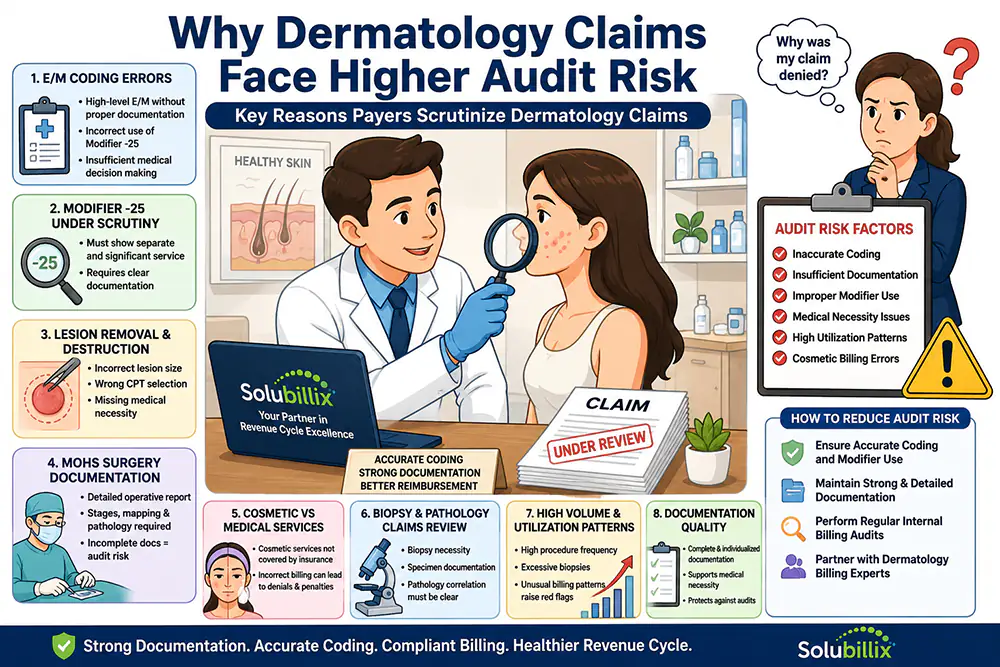
What Dermatology Practices Must Know to Reduce Denials and Protect Revenue
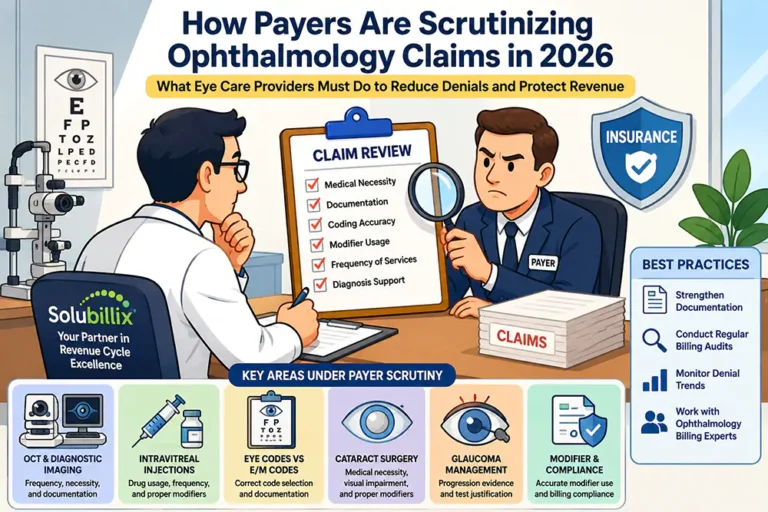
Dermatology practices across the United States are facing increasing claim audits as insurance companies strengthen their review processes for specialty billing. In 2026, payers are paying closer attention to dermatology claims because of high procedure volumes, frequent biopsies, cosmetic versus medical service distinctions, modifier usage, and documentation accuracy.
For dermatologists, Mohs surgeons, cosmetic dermatology clinics, and multi-location skin care practices, even small billing inconsistencies can trigger denials, payment delays, prepayment reviews, or post-payment audits.
At Solubillix, we are seeing a growing number of dermatology providers experiencing increased payer scrutiny, especially in procedural coding and medical necessity documentation. Understanding the reasons behind these audits is critical for maintaining healthy revenue cycle performance and long-term compliance.
Why Dermatology Is Considered High Risk by Payers
Dermatology combines office visits, diagnostic procedures, surgical treatments, pathology services, and cosmetic care within a single specialty. Because of this complexity, payers closely monitor billing patterns to identify coding errors, overutilization, and services lacking medical necessity.
Insurance companies are especially reviewing:
- Biopsy billing frequency
- Modifier usage
- Lesion destruction coding
- Mohs surgery documentation
- E/M coding accuracy
- Cosmetic versus medical procedures
- Pathology billing
- Multiple procedure billing
- Same-day service combinations
Practices with unusually high utilization patterns or inconsistent documentation may experience increased claim reviews.
E/M Coding Errors Are a Major Audit Trigger
Evaluation and Management (E/M) services remain one of the most audited areas in dermatology billing.
Payers are carefully reviewing:
- High-level office visit coding
- Medical decision-making support
- Documentation consistency
- Same-day procedures with E/M services
- Modifier -25 usage
Many dermatology practices perform procedures during office visits, but payers require clear documentation showing that the E/M service was separate and medically necessary beyond the procedure itself.
Common Dermatology E/M Mistakes
- Billing modifier -25 without sufficient documentation
- Using high-level E/M codes without complexity support
- Repetitive charting templates
- Incomplete histories and examinations
- Missing treatment decision details
Improper E/M coding can quickly increase audit exposure and denial rates.
Modifier -25 Is Under Heavy Scrutiny
Modifier -25 continues to be one of the most reviewed modifiers in dermatology.
Insurance carriers frequently investigate whether:
- The E/M visit was truly separate
- Additional physician work was performed
- Documentation supports medical necessity
- The office visit was beyond routine pre-procedure evaluation
Because dermatology providers often perform same-day procedures, excessive modifier -25 usage can trigger payer reviews.
Documentation Must Clearly Show
- Separate patient concerns
- Independent evaluation
- Additional medical decision-making
- Distinct treatment planning
Without detailed documentation, payers may bundle the E/M service into the procedure and deny reimbursement.
Skin Lesion Removal and Destruction Claims Face Frequent Audits
Dermatology claims involving lesion destruction, excisions, and cryotherapy are among the most commonly audited procedures.
Payers are reviewing:
- Lesion measurements
- Number of lesions treated
- Benign versus malignant diagnoses
- Medical necessity
- Procedure documentation
- Anatomical location details
Common Billing Problems
- Incorrect lesion sizing
- Missing pathology correlation
- Insufficient procedural notes
- Unclear diagnosis support
- Improper CPT code selection
Accurate lesion documentation is essential to avoid downcoding and denials.
Mohs Surgery Billing Requires Extensive Documentation
Mohs micrographic surgery remains one of the highest-risk dermatology services due to its high reimbursement and strict medical necessity requirements.
Insurance companies are reviewing:
- Tumor location
- Tissue mapping
- Histological analysis
- Surgical stages
- Reconstruction procedures
- Pathology documentation
Payers expect complete operative reports supporting:
- Why Mohs surgery was medically necessary
- Tumor characteristics
- Surgical complexity
- Margin evaluation
Incomplete Mohs documentation is a major cause of payer audits and reimbursement delays.
Cosmetic vs Medical Dermatology Billing Creates Compliance Risks
One of the biggest challenges in dermatology billing is distinguishing medically necessary treatments from cosmetic procedures.
Insurance carriers are closely reviewing:
- Acne scar treatments
- Botox claims
- Laser procedures
- Chemical peels
- Cosmetic lesion removal
- Skin rejuvenation services
High-Risk Billing Situations
- Billing cosmetic services to insurance
- Insufficient medical necessity documentation
- Incorrect diagnosis coding
- Mixed cosmetic and medical services on the same encounter
Practices must maintain clear separation between cosmetic and medically necessary treatments to avoid compliance risks.
Biopsy and Pathology Claims Are Being Reviewed More Closely
Dermatology practices frequently perform skin biopsies, making pathology-related billing another major audit focus.
Payers are examining:
- Biopsy necessity
- Multiple biopsy billing
- Pathology correlations
- Specimen documentation
- Procedure-to-diagnosis consistency
Common Audit Triggers
- Excessive biopsy frequency
- Missing pathology results
- Incorrect specimen reporting
- Duplicate billing
- Unclear lesion descriptions
Strong biopsy documentation is essential for defending claim accuracy during payer reviews.
Documentation Quality Is More Important Than Ever
Insurance companies are placing greater emphasis on complete and individualized documentation in dermatology claims.
Payers now review:
- Procedure details
- Lesion descriptions
- Clinical decision-making
- Treatment history
- Failed conservative therapies
- Photographic evidence when applicable
Generic templates and copied documentation increase the risk of denials and audit exposure.
Every dermatology claim should clearly support:
- Medical necessity
- Correct CPT selection
- Appropriate diagnosis coding
- Modifier usage
- Treatment rationale
High-Volume Dermatology Practices Face Greater Scrutiny
Large dermatology groups and high-volume procedural practices are increasingly being monitored for utilization trends.
Payers often compare providers based on:
- Procedure frequency
- Modifier usage patterns
- Biopsy rates
- E/M distribution
- Surgical volume
- Same-day billing combinations
Practices with unusually high billing patterns may receive:
- Prepayment reviews
- Documentation requests
- Payment holds
- Targeted audits
Maintaining compliance-focused workflows is essential for protecting revenue.
How Dermatology Practices Can Reduce Audit Risk
Improve Documentation Accuracy
Providers should ensure documentation:
- Supports medical necessity
- Includes lesion measurements
- Explains treatment decisions
- Matches billed services
- Justifies modifiers
- Reflects procedural complexity
Detailed documentation remains the strongest defense against payer audits.
Conduct Regular Internal Audits
Routine coding audits help identify:
- Modifier misuse
- Incorrect CPT selection
- Documentation gaps
- Overcoding risks
- Denial trends
Proactive audits allow practices to correct issues before payers identify them.
Train Providers on Dermatology Billing Compliance
Clinical providers should understand:
- E/M documentation rules
- Modifier requirements
- Lesion coding guidelines
- Cosmetic billing compliance
- Mohs surgery documentation standards
Billing compliance education helps reduce costly claim errors.
Partner With Dermatology Billing Specialists
Dermatology billing requires specialty-specific expertise that many general billing companies do not fully understand.
Successful dermatology revenue cycle management requires knowledge of:
- Procedural dermatology coding
- Mohs surgery billing
- Modifier compliance
- Pathology billing
- Cosmetic service regulations
- Medicare dermatology guidelines
At Solubillix, we help dermatology practices strengthen billing accuracy, reduce denials, improve reimbursement performance, and navigate complex payer requirements with specialized medical billing solutions designed specifically for dermatology providers.
Final Thoughts
Dermatology claims are facing increased audit risk in 2026 as insurance companies tighten oversight on procedural billing, modifier usage, documentation quality, and medical necessity.
Practices that fail to maintain accurate coding and compliance-focused workflows may experience:
- Higher denial rates
- Revenue loss
- Payment delays
- Increased audit exposure
- Compliance penalties
However, dermatology providers that prioritize documentation accuracy, specialty-focused coding, internal auditing, and proactive revenue cycle management can improve financial performance while reducing payer-related risks.
In today’s healthcare environment, dermatology billing success depends not only on clinical care — but also on strong compliance, coding precision, and expert revenue cycle management.
That is why many providers trust Solubillix for specialized dermatology billing support and long-term revenue optimization.