
How Urgent Care Practices Can Reduce Denials, Improve Reimbursement, and Build a Stronger Revenue Cycle
By Solubillix – Healthcare Medical Billing & Revenue Cycle Management Experts
Urgent care centers have become one of the fastest-growing segments of healthcare delivery. Patients rely on urgent care facilities for convenient access to treatment for illnesses, injuries, diagnostic services, and minor procedures without the long wait times associated with emergency departments.
However, behind every successful urgent care operation is a complex billing process.
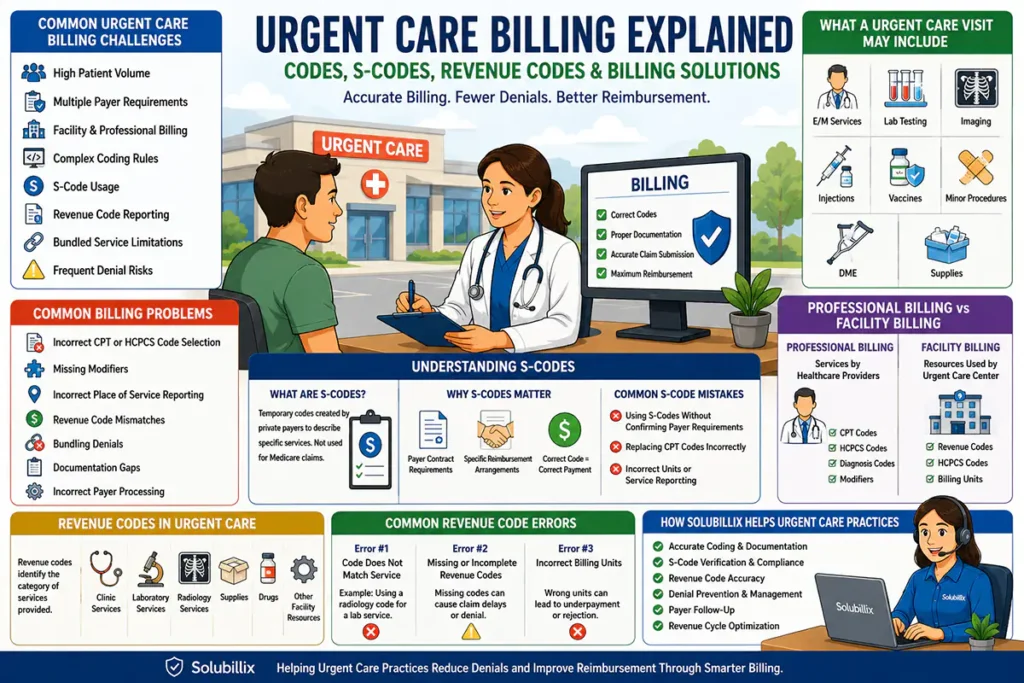
Unlike traditional physician offices, urgent care billing involves unique challenges, including:
- High patient volume
- Multiple payer requirements
- Facility and professional billing considerations
- Complex coding rules
- S-code usage
- Revenue code reporting
- Bundled service limitations
- Frequent denial risks
A single coding mistake may appear small, but when multiplied across thousands of visits, it can create significant revenue loss.
Common urgent care billing problems include:
- Incorrect CPT or HCPCS code selection
- Missing modifiers
- Incorrect place of service reporting
- Revenue code mismatches
- Unnecessary bundling denials
- Documentation gaps
- Incorrect payer processing
At Solubillix, we help urgent care practices simplify complex billing challenges, reduce claim denials, and improve reimbursement through specialized revenue cycle management solutions.
Understanding Urgent Care Billing Complexity
Urgent care billing is different from many other healthcare specialties because services are often provided quickly, with multiple procedures performed during one encounter.
A single urgent care visit may include:
- Evaluation and management (E/M) services
- Laboratory testing
- Imaging
- Injections
- Vaccines
- Minor procedures
- Durable medical equipment
- Supplies
Each service must be properly coded, documented, and billed according to payer guidelines.
Professional Billing vs Facility Billing in Urgent Care
One of the biggest challenges in urgent care billing is understanding the difference between:
Professional Billing
Professional billing represents services performed by healthcare providers.
Examples:
- Physician or advanced practice provider evaluation
- Medical decision-making
- Procedures performed by clinicians
Professional claims typically use:
- CPT codes
- HCPCS codes
- Diagnosis codes
- Modifiers
Facility Billing
Facility billing represents the resources used by the urgent care center.
Examples:
- Supplies
- Equipment
- Facility resources
- Certain technical services
Facility claims often involve:
- Revenue codes
- HCPCS codes
- Billing units
Understanding the difference between these two billing models is essential for avoiding claim errors.
Understanding S-Codes in Urgent Care Billing
What Are S-Codes?
S-codes are temporary national codes created by private payers, especially commercial insurance companies, to describe specific healthcare services or procedures.
Unlike CPT codes, S-codes are not generally used for Medicare claims.
Many urgent care organizations encounter S-codes because commercial payers may use them for:
- Urgent care facility services
- Certain healthcare programs
- Specific reimbursement arrangements
Why S-Codes Matter for Urgent Care Practices
Urgent care centers may receive payer contracts that require specific S-code reporting.
Using the wrong code can result in:
- Claim rejection
- Incorrect reimbursement
- Contract payment issues
- Increased administrative work
Common S-Code Billing Mistakes
Mistake #1: Using S-Codes Without Confirming Payer Requirements
Not every payer accepts the same codes.
A common mistake is assuming a code accepted by one insurance company will work for another.
Best Practice:
Verify:
- Payer contract requirements
- Code acceptance
- Billing instructions
before claim submission.
Mistake #2: Replacing CPT Codes Incorrectly
S-codes do not automatically replace CPT codes.
The correct billing method depends on:
- Service performed
- Payer policy
- Contract terms
Mistake #3: Incorrect Units or Service Reporting
Some S-codes require specific billing units.
Incorrect reporting may cause:
- Underpayment
- Overpayment
- Denial
Revenue Codes in Urgent Care Billing
What Are Revenue Codes?
Revenue codes are four-digit codes used primarily on facility claims to identify categories of services provided.
They communicate to payers what type of facility service was delivered.
Examples of revenue code categories may include:
- Clinic services
- Laboratory services
- Radiology services
- Supplies
- Drugs
- Other facility resources
Why Revenue Codes Matter
Revenue codes help payers understand:
- What service was provided
- Where the service occurred
- How reimbursement should be calculated
Incorrect revenue code reporting can cause claim processing problems.
Common Revenue Code Billing Errors
Error #1: Revenue Code Does Not Match Service
Example:
A laboratory service is billed with an inappropriate revenue code.
Possible outcome:
- Claim delay
- Denial
- Manual review
Error #2: Missing Revenue Code Details
Incomplete facility claims may result in payer requests for additional information.
Error #3: Incorrect Revenue Code and HCPCS/CPT Relationship
The revenue code should support the service being billed.
A mismatch between:
- Revenue code
- HCPCS/CPT code
- Documentation
may trigger payer edits.
Global Visit Bundling in Urgent Care Billing
What Is Global Visit Bundling?
Global billing rules determine whether certain follow-up services are included in the payment for a previous procedure.
Some procedures have a global period where related follow-up care is bundled into the original payment.
The global period may include:
- Routine follow-up visits
- Post-procedure care
- Certain related services
Why Global Bundling Creates Challenges for Urgent Care Centers
Urgent care providers frequently see patients after procedures performed elsewhere.
Examples:
- Wound checks
- Suture removal
- Post-procedure evaluations
- Follow-up treatment
The challenge is determining whether the visit is:
- Included in another provider’s global period
- Separately billable
- Related to the original procedure
Common Global Bundling Mistakes
Mistake #1: Billing Included Follow-Up Services
A provider may submit a claim for a service already included in a global package.
Result:
- Bundling denial
- Reduced reimbursement
Mistake #2: Missing Modifier Usage
Certain situations may require modifiers to indicate that a service is separate from the global procedure.
Examples may include:
- Modifier 24
- Modifier 25
- Modifier 57
The correct modifier depends on the circumstances and payer rules.
Mistake #3: Poor Documentation
Documentation must explain why the urgent care visit was separately necessary.
Example:
Weak documentation:
“Follow-up wound check.”
Strong documentation:
“Patient presents with increasing redness, swelling, and drainage following previous procedure. Evaluation performed due to suspected infection requiring separate medical management.”
Common Urgent Care Billing Mistakes That Reduce Revenue
1. Incorrect E/M Coding
Urgent care encounters require proper documentation to support the selected E/M level.
Errors include:
- Overcoding
- Undercoding
- Missing medical decision-making details
2. Incorrect Modifier Usage
Common modifier problems include:
- Missing modifier 25
- Incorrect modifier 59
- Improper global modifiers
3. Failure to Capture All Billable Services
High-volume urgent care environments may miss:
- Procedures
- Supplies
- Laboratory services
- Medication administration
4. Poor Documentation Workflow
Incomplete documentation creates:
- Coding delays
- Denials
- Audit risk
Documentation Requirements for Urgent Care Billing
Strong documentation should support:
Patient Evaluation
Include:
- Chief complaint
- History
- Examination findings
- Medical decision-making
Procedures
Document:
- Procedure performed
- Medical necessity
- Technique
- Supplies used
- Patient response
Diagnostic Services
Include:
- Test performed
- Results
- Clinical interpretation
Strategies to Reduce Urgent Care Billing Denials
1. Verify Insurance Before Visits
Eligibility verification helps identify:
- Active coverage
- Copay requirements
- Network status
2. Perform Coding Audits
Regular audits identify:
- Coding errors
- Documentation problems
- Lost revenue opportunities
3. Monitor Payer Trends
Different payers have different rules.
Analyze:
- Denial patterns
- Payment delays
- Contract issues
4. Improve Charge Capture
Ensure all services performed are properly captured and billed.
How Solubillix Helps Urgent Care Practices Improve Revenue
Urgent care billing requires a specialized understanding of:
- High-volume claims
- Coding guidelines
- Payer requirements
- Denial management
- Revenue optimization
At Solubillix, we help urgent care organizations improve financial performance through:
✔ Complete revenue cycle management
✔ Claim submission accuracy
✔ Coding review
✔ Denial management
✔ Insurance follow-up
✔ AR recovery
✔ Billing workflow improvement
Our team helps urgent care providers reduce administrative complexity while improving reimbursement performance.
Frequently Asked Questions About Urgent Care Billing
What are S-codes used for in urgent care billing?
S-codes are payer-specific codes used mainly by commercial insurance plans for certain healthcare services.
What are revenue codes?
Revenue codes identify categories of services reported on facility claims, such as laboratory, supplies, and technical services.
Why are urgent care claims denied?
Common reasons include coding errors, documentation issues, missing modifiers, incorrect revenue codes, and payer-specific billing problems.
How does global bundling affect urgent care billing?
Global bundling may prevent separate billing for certain follow-up services related to previous procedures unless documentation supports separate care.
How can urgent care practices improve reimbursement?
Practices can improve reimbursement through accurate coding, documentation improvement, denial prevention, payer analysis, and professional billing support.
Conclusion: Optimize Your Urgent Care Revenue Cycle With Smarter Billing
Urgent care billing is more complex than simply submitting claims. Successful reimbursement requires accurate coding, proper documentation, payer knowledge, and continuous revenue cycle improvement.
Understanding S-codes, revenue codes, and global visit bundling rules helps urgent care practices avoid costly mistakes and protect revenue.
However, managing these challenges internally can be overwhelming.
Partnering with an experienced medical billing company allows urgent care providers to focus on patient care while billing experts manage the complexities of reimbursement.
Solubillix helps urgent care practices reduce denials, improve collections, and build a stronger revenue cycle through specialized medical billing solutions.
About Solubillix
Solubillix is a US-based medical billing and revenue cycle management company specializing in urgent care billing, behavioral health billing, ophthalmology billing, denial management, coding support, and insurance follow-up services. We help healthcare providers maximize reimbursement, reduce administrative burden, and achieve better financial outcomes.