
How Retina Practices Can Prevent Medication Billing Errors, Reduce Claim Denials, and Protect Revenue
By Solubillix – Ophthalmology Medical Billing & Revenue Cycle Management Experts
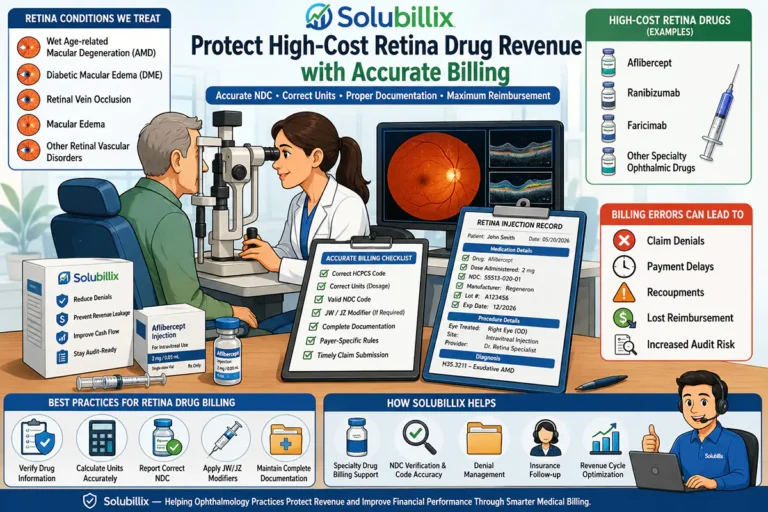
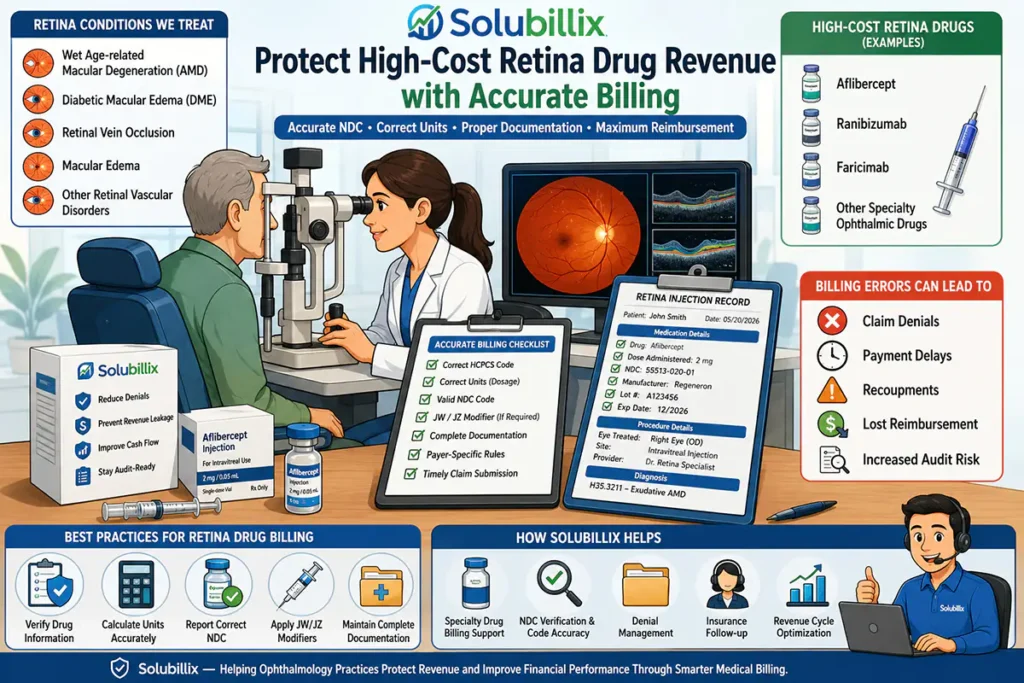
Retina specialists provide life-changing treatments for patients suffering from complex eye conditions such as:
- Wet age-related macular degeneration (AMD)
- Diabetic macular edema (DME)
- Retinal vein occlusion
- Macular edema
- Other retinal vascular disorders
Many of these treatments involve physician-administered injectable medications that can cost hundreds or thousands of dollars per dose.
Examples include anti-VEGF medications such as:
- Aflibercept
- Ranibizumab
- Faricimab
- Other specialty ophthalmic drugs
Because these medications are expensive, payers closely examine claims for accuracy. A small mistake involving:
- National Drug Code (NDC)
- HCPCS units
- Drug quantity
- Billing measurements
- Wastage reporting
- Modifier requirements
can result in:
- Claim denials
- Payment delays
- Recoupments
- Lost reimbursement
- Increased audit risk
For retina practices, medication billing errors are not minor administrative issues. They can create significant revenue leakage.
At Solubillix, we help ophthalmology and retina practices optimize their revenue cycle by improving coding accuracy, reducing denials, and ensuring high-cost drug claims are submitted correctly.
Understanding High-Cost Retina Drug Billing
Why Retina Drugs Require Special Billing Attention
Unlike standard office visits, physician-administered medications require multiple layers of billing accuracy.
A retina drug claim typically involves:
- Office procedure documentation
- Medication administration coding
- Drug HCPCS code reporting
- Correct unit calculation
- NDC reporting requirements
- Wastage documentation
- Payer-specific billing rules
Each component must match.
A claim can fail even when the medication was medically necessary and properly administered.
The Importance of NDC Codes in Retina Drug Billing
What Is an NDC Code?
The National Drug Code (NDC) identifies a specific medication product, including:
- Manufacturer
- Drug name
- Package size
- Product formulation
Payers use NDC information to verify:
- What medication was administered
- The quantity billed
- The package used
- Whether the claim matches the drug submitted
Why Incorrect NDC Reporting Causes Denials
Many retina drug claims are denied because the NDC information does not match the billed medication.
Common NDC-related problems include:
- Missing NDC information
- Incorrect manufacturer code
- Incorrect package size
- Wrong unit conversion
- NDC does not match HCPCS code
- Billing an outdated NDC
Example:
A practice administers one drug product but submits the NDC associated with a different manufacturer or package size.
The payer may consider the claim invalid and deny payment.
Common NDC Code Mistakes Retina Practices Should Avoid
Mistake #1: Using the Wrong NDC From Inventory
Many practices maintain multiple drug products in inventory.
A common error occurs when billing staff use:
- An old NDC
- A commonly used NDC
- A default NDC
instead of the actual product administered.
Best Practice:
The medication record should capture:
- Drug name
- Manufacturer
- NDC
- Lot number
- Expiration date
- Quantity administered
at the time of injection.
Mistake #2: Incorrect NDC Formatting
Many payers require specific NDC formatting.
Examples may include:
- 11-digit NDC conversion
- Hyphen removal
- Zero padding
Incorrect formatting can trigger electronic claim rejection.
Mistake #3: NDC Does Not Match HCPCS Code
The medication billed under the HCPCS code must correspond to the NDC submitted.
Example:
The claim reports one medication but the NDC identifies another.
This creates a mismatch that may result in denial.
Understanding HCPCS Units for Retina Drugs
Why Unit Calculation Matters
Physician-administered drugs are not billed based on the vial price.
They are billed according to:
- HCPCS code description
- Dosage amount
- Billing unit measurement
A common mistake is assuming:
One vial equals one billing unit.
This is often incorrect.
Example of Unit Calculation Error
A medication HCPCS code may represent:
- A specific number of milligrams
- A specific quantity measurement
- A defined billing unit
If the administered dose does not match the billed units, the claim may be denied.
Example:
Medication administered:
- 2 mg
Claim submitted:
- Incorrect number of units
Possible result:
- Underpayment
- Overpayment
- Denial
- Recoupment request
Common Unit Calculation Errors in Retina Drug Billing
Error #1: Billing the Entire Vial Instead of the Administered Amount
A practice may accidentally bill the full vial quantity even when only part of the medication was administered.
This creates compliance concerns.
Error #2: Incorrect Decimal Conversion
Some medications require precise calculations.
Examples:
- Milligrams
- Milliliters
- Micrograms
A decimal mistake can significantly change the billed amount.
Error #3: Incorrect HCPCS Unit Conversion
Every drug code has specific billing unit requirements.
The billing team must understand:
- Drug dosage
- Code descriptor
- Unit measurement
before submitting claims.
JW and JZ Modifier Requirements for Drug Wastage
Why Waste Reporting Matters
CMS requires specific reporting for certain discarded amounts of single-dose container drugs.
Practices may need to report:
JW Modifier
Used when:
- Drug amount is discarded after administration
JZ Modifier
Used when:
- No drug amount was discarded
Failure to report appropriately can result in claim issues.
Example:
A vial contains:
10 mg medication
Patient receives:
7 mg
Remaining:
3 mg discarded
The claim may require:
- Administered amount billing
- JW reporting for discarded amount
Proper documentation is essential.
Documentation Requirements for Retina Drug Claims
Strong documentation protects practices during:
- Claim review
- Appeals
- Audits
A complete retina injection record should include:
Patient Information
- Patient name
- Date of service
- Diagnosis
Medication Details
Include:
✔ Drug name
✔ Dose administered
✔ Route of administration
✔ NDC number
✔ Manufacturer
✔ Lot number
✔ Expiration date
Procedure Details
Document:
- Injection site
- Eye treated (right, left, bilateral)
- Procedure performed
- Provider performing service
Medical Necessity Support
Documentation should support:
- Diagnosis
- Treatment rationale
- Clinical indication
Common Retina Drug Billing Denials
Denial #1: Incorrect Drug Units
Cause:
Wrong HCPCS quantity reported.
Solution:
Verify dosage conversion before claim submission.
Denial #2: Invalid NDC Information
Cause:
Missing or incorrect NDC details.
Solution:
Maintain accurate medication inventory records.
Denial #3: Duplicate Drug Billing
Cause:
Medication billed multiple times incorrectly.
Solution:
Review injection logs and claim history.
Denial #4: Missing JW/JZ Modifier
Cause:
Incorrect wastage reporting.
Solution:
Follow current payer requirements.
How Retina Practices Can Prevent Drug Billing Revenue Leakage
1. Create a Drug Billing Verification Process
Before claims are submitted, verify:
- Medication administered
- Correct HCPCS code
- Correct units
- Correct NDC
- Required modifiers
2. Integrate Clinical and Billing Workflows
Many errors happen because:
- Clinical staff document medication details
- Billing staff manually enter information later
A connected workflow reduces mistakes.
3. Perform Regular Drug Claim Audits
Audits should review:
- High-cost medications
- Unit calculations
- Denial trends
- Payment accuracy
4. Train Staff on Specialty Drug Billing
Retina medication billing requires specialized knowledge.
Training should cover:
- Drug codes
- NDC reporting
- Unit calculations
- Modifier requirements
How Solubillix Helps Retina Practices Protect High-Cost Drug Revenue
High-cost medication billing requires precision.
At Solubillix, we help retina and ophthalmology practices improve reimbursement through:
✔ Specialty medication billing support
✔ HCPCS code review
✔ NDC verification
✔ Unit calculation audits
✔ Denial management
✔ Insurance follow-up
✔ Revenue cycle optimization
Our team understands the complexity of ophthalmology billing and helps practices reduce avoidable losses caused by billing errors.
Frequently Asked Questions About Retina Drug Billing
Why are retina drug claims denied?
Common reasons include incorrect NDC reporting, inaccurate HCPCS units, missing modifiers, and documentation issues.
What is an NDC code used for in medical billing?
An NDC identifies the specific medication product, manufacturer, and package information used for billing verification.
Why are unit calculations important for retina drugs?
Incorrect units can cause underpayment, overpayment, denials, and compliance concerns.
What documentation is needed for retina injections?
Documentation should include medication details, dosage, NDC, administration details, diagnosis, and medical necessity.
How can retina practices reduce drug billing errors?
Practices can reduce errors through accurate documentation, billing audits, staff training, and specialized ophthalmology billing support.
Conclusion: Stop Losing Revenue on High-Cost Retina Medications
High-cost retina drugs represent a significant investment for ophthalmology practices. While these medications improve patient outcomes, billing mistakes can quickly turn them into revenue challenges.
Incorrect NDC codes, inaccurate unit calculations, and incomplete documentation are among the most common causes of payment delays and denials.
The solution is a proactive billing approach that combines accurate documentation, specialty coding knowledge, and strong revenue cycle management.
With Solubillix, retina practices can reduce billing errors, improve reimbursement accuracy, and focus more on delivering exceptional patient care.
Solubillix — Helping Ophthalmology Practices Protect Revenue and Improve Financial Performance Through Smarter Medical Billing.
About Solubillix
Solubillix is a US-based medical billing and revenue cycle management company specializing in ophthalmology billing, retina billing, denial management, coding support, and insurance follow-up services. We help healthcare providers maximize reimbursement and reduce administrative challenges through expert billing solutions.