
How Ophthalmology Practices Can Avoid Denials, Improve Documentation, and Maximize AMT Revenue
By Solubillix – Ophthalmology Medical Billing & Revenue Cycle Management Experts
Amniotic Membrane Transplant (AMT) has become an important treatment option in ophthalmology for managing various ocular surface conditions. Cornea specialists, ophthalmologists, and eye care practices use amniotic membrane products to support healing, reduce inflammation, and promote tissue repair.
While AMT can provide significant clinical benefits, reimbursement can be challenging.
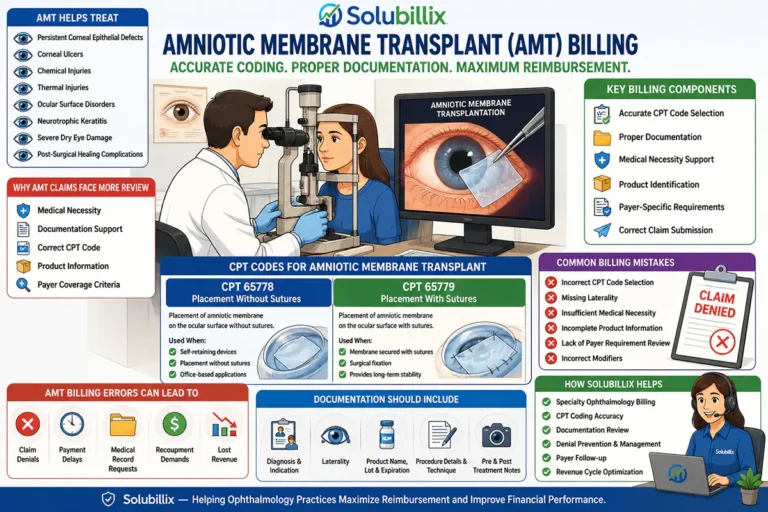
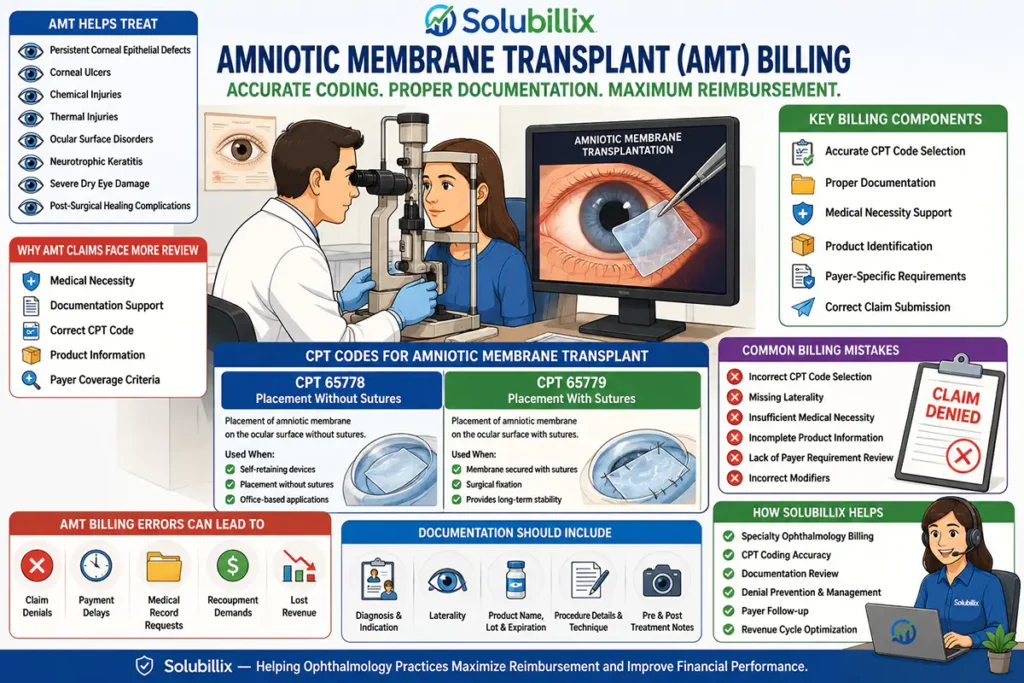
Unlike routine office procedures, AMT billing involves multiple components that must align correctly:
- Accurate CPT code selection
- Proper documentation
- Medical necessity support
- Product identification
- Payer-specific coverage requirements
- Correct claim submission
A small mistake in coding or documentation can result in:
- Claim denials
- Payment delays
- Medical record requests
- Recoupment demands
- Lost revenue
For ophthalmology practices, understanding AMT coding requirements is essential to maintaining a healthy revenue cycle.
At Solubillix, we help ophthalmology practices improve reimbursement by combining specialty billing knowledge with proactive denial prevention strategies.
Understanding Amniotic Membrane Transplant (AMT)
What Is Amniotic Membrane Transplant?
Amniotic membrane transplantation is an ophthalmic procedure where a biologic tissue graft derived from the amniotic membrane is placed on the ocular surface.
The amniotic membrane contains properties that may help:
- Support epithelial healing
- Reduce inflammation
- Protect damaged tissue
- Promote ocular surface recovery
AMT may be used for conditions affecting the cornea and ocular surface.
Common Ophthalmic Indications for AMT
Amniotic membrane procedures may be considered for conditions such as:
- Persistent corneal epithelial defects
- Corneal ulcers
- Chemical injuries
- Thermal injuries
- Ocular surface disorders
- Neurotrophic keratitis
- Severe dry eye-related surface damage
- Post-surgical healing complications
The specific diagnosis and clinical documentation play a major role in reimbursement approval.
Why AMT Claims Receive Increased Payer Review
Amniotic membrane products can be expensive, and payers often evaluate claims carefully.
Insurance companies may review:
- Whether the procedure was medically necessary
- Whether documentation supports the diagnosis
- Whether the correct CPT code was billed
- Whether the product information is complete
- Whether payer coverage criteria were met
Because AMT involves both a procedure and a biologic product, billing accuracy is critical.
Understanding CPT Codes for Amniotic Membrane Transplant
The correct CPT code depends on how the amniotic membrane is applied.
Two commonly used ophthalmology procedure codes include:
CPT 65778: Placement of Amniotic Membrane Without Sutures
What Does CPT 65778 Represent?
CPT 65778 describes:
Placement of amniotic membrane on the ocular surface without sutures.
This code is generally used when the physician places the amniotic membrane using a method that does not require suturing.
Examples may include:
- Self-retaining amniotic membrane devices
- Placement without surgical fixation
- Office-based ocular surface applications
CPT 65779: Placement of Amniotic Membrane With Sutures
What Does CPT 65779 Represent?
CPT 65779 describes:
Placement of amniotic membrane on the ocular surface with sutures.
This applies when the provider secures the membrane using sutures.
The documentation should clearly describe:
- Placement technique
- Use of sutures
- Ocular surface location
- Medical reason for the procedure
Choosing Between CPT 65778 and CPT 65779
One of the most common AMT billing mistakes is selecting the wrong CPT code.
The decision should be based on the actual procedure performed.
Example:
Scenario 1:
A provider places an amniotic membrane device without sutures.
Appropriate coding consideration:
- CPT 65778
Scenario 2:
A provider surgically places and secures the membrane using sutures.
Appropriate coding consideration:
- CPT 65779
The medical record must support the selected code.
Common Amniotic Membrane Transplant Coding Mistakes
Mistake #1: Incorrect CPT Code Selection
Some practices choose codes based on the product used rather than the procedure performed.
Coding should be based on:
- Placement method
- Surgical technique
- Documentation
not simply the brand or type of membrane.
Mistake #2: Missing Laterality Documentation
Eye procedures require clear laterality.
The documentation should identify:
- Right eye
- Left eye
- Both eyes when applicable
Missing laterality can create:
- Claim rejection
- Medical review
- Payment delays
Mistake #3: Insufficient Medical Necessity Documentation
Payers need to understand why AMT was required.
Documentation should explain:
- Patient condition
- Failed previous treatments if applicable
- Clinical severity
- Reason AMT was selected
Example:
Weak documentation:
“Amniotic membrane placed.”
Strong documentation:
“Patient presents with persistent corneal epithelial defect unresponsive to conservative treatment. Amniotic membrane placement performed to promote epithelial healing and protect the ocular surface.”
Mistake #4: Incomplete Procedure Notes
A complete AMT procedure note should include:
Patient Information
- Patient demographics
- Date of service
- Provider information
Clinical Information
- Diagnosis
- Symptoms
- Medical necessity
Procedure Details
Include:
- Eye treated
- Type of membrane used
- Placement technique
- Whether sutures were used
- Patient tolerance
Product Information
Depending on payer requirements, documentation may include:
- Product name
- Manufacturer
- Tissue identification information
- Lot number
- Expiration date
Product Billing and Documentation Requirements
AMT involves both:
- Professional procedure billing
- Product/supply billing when applicable
The product component requires careful tracking.
Practices should maintain accurate records regarding:
- Product received
- Product used
- Product information
- Quantity
- Patient-specific documentation
Incorrect product reporting can lead to reimbursement issues.
Common AMT Claim Denials and How to Prevent Them
Denial Reason #1: Lack of Medical Necessity
Why It Happens:
The payer does not see sufficient evidence that AMT was required.
Prevention:
Document:
- Diagnosis
- Clinical findings
- Failed treatments
- Reason for AMT
Denial Reason #2: Incorrect CPT Coding
Why It Happens:
The billed code does not match the documented procedure.
Prevention:
Review:
- Procedure note
- Placement technique
- CPT selection
before claim submission.
Denial Reason #3: Missing Documentation
Why It Happens:
The record lacks important details.
Examples:
- No laterality
- No procedure description
- No medical indication
Prevention:
Use standardized AMT templates.
Denial Reason #4: Coverage Policy Issues
Why It Happens:
Some payers have specific requirements before covering AMT.
Requirements may include:
- Prior authorization
- Specific diagnoses
- Documentation review
Prevention:
Verify payer requirements before performing the procedure.
AMT Documentation Checklist for Ophthalmology Practices
Before submitting an AMT claim, confirm:
✅ Correct CPT code selected
✅ Diagnosis supports medical necessity
✅ Eye laterality documented
✅ Procedure technique documented
✅ Suture use documented when applicable
✅ Product information recorded
✅ Provider signature completed
✅ Authorization requirements verified
✅ Supporting clinical records available
How Ophthalmology Practices Can Improve AMT Reimbursement
1. Verify Benefits Before Treatment
Before performing AMT:
- Confirm coverage
- Review payer guidelines
- Check authorization requirements
2. Standardize Provider Documentation
Create templates that remind providers to document:
- Diagnosis
- Procedure details
- Product information
- Medical necessity
3. Audit High-Dollar Procedures
AMT procedures should be reviewed regularly because they involve:
- Expensive products
- Complex coding
- Increased payer scrutiny
Regular audits help identify revenue leakage.
4. Monitor Denial Trends
Track:
- Denial reasons
- Payer patterns
- Coding issues
- Documentation problems
This allows practices to correct problems before they repeat.
How Solubillix Helps Ophthalmology Practices With AMT Billing
Amniotic membrane transplant billing requires specialized ophthalmology revenue cycle knowledge.
At Solubillix, we help eye care practices with:
✔ Ophthalmology coding support
✔ AMT claim review
✔ Denial management
✔ Insurance follow-up
✔ Documentation improvement strategies
✔ Revenue cycle optimization
Our team understands the challenges involved in specialty ophthalmology billing and helps providers receive accurate reimbursement while reducing administrative workload.
Frequently Asked Questions About AMT Coding and Reimbursement
What CPT code is used for amniotic membrane transplant?
Common CPT codes include 65778 and 65779, depending on whether the membrane is placed without sutures or with sutures.
Why are AMT claims denied?
Common reasons include incorrect CPT coding, insufficient documentation, lack of medical necessity, and payer coverage requirements.
Does AMT require documentation of medical necessity?
Yes. Documentation should clearly explain the patient’s condition and why the procedure was clinically appropriate.
What information should be documented for AMT?
Documentation should include diagnosis, laterality, procedure details, placement technique, and product information when required.
How can ophthalmology practices improve AMT reimbursement?
Practices can improve reimbursement through accurate coding, strong documentation, payer verification, and proactive denial management.
Conclusion: Accurate AMT Coding Protects Ophthalmology Revenue
Amniotic Membrane Transplant procedures provide valuable treatment options for patients with challenging ocular surface conditions. However, reimbursement success depends on more than performing the procedure.
Accurate CPT selection, complete documentation, proper product tracking, and payer-specific billing knowledge are essential for preventing denials and protecting revenue.
Ophthalmology practices that build strong billing workflows can reduce administrative challenges and improve financial performance.
With specialized ophthalmology billing support from Solubillix, providers can focus on patient care while experienced billing professionals manage the complexities of coding, reimbursement, and denial prevention.
Solubillix — Helping Ophthalmology Practices Maximize Revenue Through Smarter Medical Billing.
About Solubillix
Solubillix is a US-based medical billing and revenue cycle management company specializing in ophthalmology billing, retina billing, behavioral health billing, denial management, and insurance follow-up services. We help healthcare providers improve collections, reduce claim denials, and achieve stronger financial outcomes through expert billing solutions.