
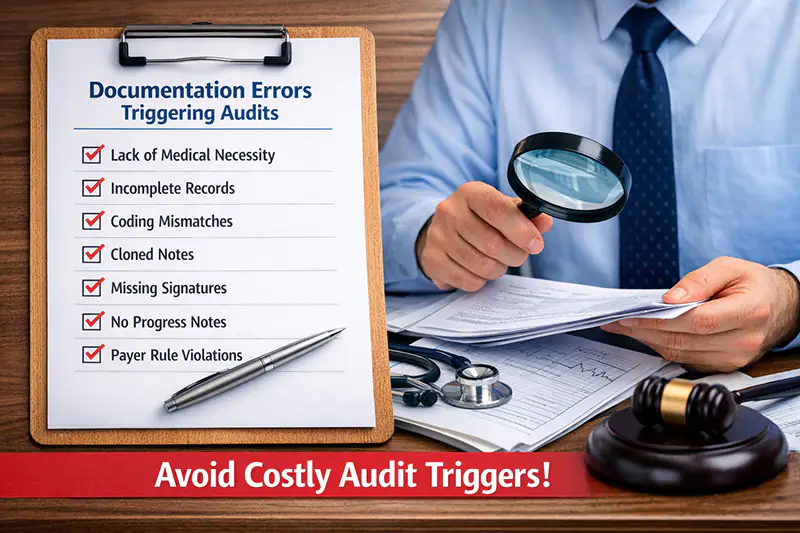
Healthcare audits are no longer rare events—they are a routine risk for medical practices, therapy clinics, and specialty providers. Payers, Medicare, and Medicaid auditors rely heavily on clinical documentation to validate medical necessity, coding accuracy, and compliance.
Unfortunately, even well-intentioned providers often make documentation mistakes that trigger audits, payment recoupments, or penalties.
In this guide, we’ll break down the top 7 documentation errors that commonly trigger audits—and more importantly, how to avoid them.
Why Documentation Accuracy Matters More Than Ever
Auditors don’t guess. They rely entirely on what’s documented in the medical record. If it’s not clearly documented, it’s considered not done, regardless of the care actually provided.
Poor documentation can lead to:
- Claim denials and delayed payments
- Post-payment audits and refunds
- Increased payer scrutiny
- Risk of compliance violations
Strong documentation protects both clinical integrity and revenue.
1. Insufficient Medical Necessity Documentation
❌ The Error
One of the most common audit triggers is failure to clearly justify medical necessity. Notes may describe what was done, but not why it was necessary.
Examples:
- Generic diagnoses with no supporting symptoms
- Missing clinical rationale for procedures or therapies
- Copy-pasted statements that don’t reflect patient-specific needs
✅ How to Avoid It
- Clearly connect symptoms, diagnosis, and treatment plan
- Document failed prior treatments when applicable
- Use measurable data (pain scale, functional limitations, test results)
Tip: Medical necessity should be obvious to someone who has never seen the patient.
2. Incomplete or Missing Documentation
❌ The Error
Missing required elements such as:
- Provider signature or credentials
- Date of service
- Start/stop times (especially for time-based CPT codes)
- Progress notes supporting billed services
Even a single missing component can invalidate an entire claim during an audit.
✅ How to Avoid It
- Use documentation checklists before claim submission
- Ensure EHR templates capture all required fields
- Perform internal documentation reviews regularly
3. Inconsistencies Between Documentation and Billed Codes
❌ The Error
When documentation does not support the level or type of service billed, auditors flag it immediately.
Common examples:
- Billing high-level E/M services with minimal documentation
- Procedure codes billed without procedural detail
- Time-based services without documented time
✅ How to Avoid It
- Ensure documentation supports code selection criteria
- Train providers on E/M and time-based coding rules
- Align clinical notes with CPT and payer guidelines
4. Overuse of Copy-Paste or Cloned Notes
❌ The Error
Repeated, identical notes across visits suggest:
- Lack of individualized care
- Potential upcoding or misrepresentation
- Poor clinical oversight
Auditors see cloned documentation as a high-risk red flag.
✅ How to Avoid It
- Customize each note to reflect the patient’s current condition
- Update assessments, treatment plans, and outcomes
- Use templates wisely—but avoid duplication without edits
5. Missing Provider Signatures or Authentication
❌ The Error
Unsigned or improperly signed records are considered invalid documentation during an audit—even if services were legitimately provided.
This includes:
- Missing electronic signatures
- Incorrect credentials
- Delayed authentication
✅ How to Avoid It
- Implement automated signature alerts in your EHR
- Ensure credentials match payer enrollment records
- Sign documentation promptly after each encounter
6. Lack of Progress or Outcome Documentation
❌ The Error
Auditors often deny claims when documentation does not show ongoing improvement, response to treatment, or medical justification for continuation of care.
This is especially common in:
- Therapy services
- Behavioral health
- Chronic care management
✅ How to Avoid It
- Document measurable progress or clinical changes
- Update goals and treatment plans regularly
- Justify continued services when progress is slow
7. Non-Compliance with Payer-Specific Documentation Rules
❌ The Error
Each payer may have unique documentation requirements. Ignoring them increases audit risk.
Examples:
- Medicare vs commercial payer documentation standards
- Missing prior authorization references
- Not following local coverage determinations (LCDs)
✅ How to Avoid It
- Stay updated on payer-specific policies
- Educate providers on coverage guidelines
- Conduct payer-focused documentation audits
How Strong Documentation Reduces Audit Risk
Proper documentation:
- Supports accurate coding
- Justifies medical necessity
- Speeds up reimbursements
- Protects against recoupments and penalties
Audit-ready documentation is not just a compliance strategy—it’s a revenue protection strategy.
Why Solubillix?
At Solubillix, we understand that documentation is the foundation of clean claims and audit defense.
What Sets Solubillix Apart:
✔ Documentation & Coding Alignment Reviews
We ensure your clinical notes fully support billed CPT, HCPCS, and ICD-10 codes.
✔ Audit-Focused Compliance Expertise
Our team stays updated with Medicare, Medicaid, and commercial payer documentation standards.
✔ Proactive Risk Identification
We identify documentation gaps before they trigger audits or denials.
✔ Specialty-Specific Knowledge
From behavioral health to specialty practices, we tailor documentation strategies to your services.
✔ End-to-End Revenue Cycle Support
From documentation to denial management, we help protect your revenue at every stage.
Final Thoughts
Audits are not always avoidable—but documentation errors are.
By addressing these seven common mistakes and implementing structured documentation practices, providers can significantly reduce audit exposure and improve reimbursement outcomes. Partnering with an experienced billing and compliance team like Solubillix ensures your documentation is not only complete—but audit-ready.