

Retinal diseases are among the most complex and rapidly evolving conditions treated in ophthalmology. From diabetic retinopathy to retinal detachments and macular degeneration, retina specialists rely on advanced diagnostic imaging and specialized procedures to preserve vision and prevent permanent vision loss.
However, billing for retina procedures can be challenging due to complex coding rules, payer policies, and documentation requirements. Even small coding mistakes can lead to denied claims, delayed reimbursements, or compliance risks.
For ophthalmology practices, understanding the correct billing approach for retina procedures is essential for maintaining financial stability and maximizing reimbursement. At Solubillix, we provide specialized ophthalmology billing services that help retina practices streamline coding, reduce denials, and optimize revenue cycle management.
This guide explains how retina procedure billing works, which codes are commonly used, and how ophthalmology practices can improve reimbursement accuracy.
Understanding Retina Procedures in Ophthalmology
The retina is the light-sensitive tissue located at the back of the eye that plays a critical role in vision. Damage or disease affecting the retina can lead to serious visual impairment if not diagnosed and treated promptly.
Ophthalmologists perform a wide range of retina procedures to diagnose and manage retinal conditions, including:
- Retinal imaging and diagnostic testing
- Laser therapy for retinal disease
- Intravitreal injections
- Retinal detachment repair
- Vitrectomy surgery
Because these procedures often involve specialized equipment and expertise, accurate coding and documentation are essential for proper reimbursement.
Common Retinal Conditions Requiring Medical Procedures
Medical necessity plays a central role in retina billing. Most retina procedures are performed to diagnose or treat specific eye diseases that require medical intervention.
Some of the most common retinal conditions include:
- Diabetic retinopathy
- Age-related macular degeneration (AMD)
- Retinal detachment
- Macular edema
- Retinal vein occlusion
- Epiretinal membrane
- Macular hole
Properly linking these diagnoses with procedure codes helps establish medical necessity and improves claim approval rates.
Key CPT Codes for Retina Procedures
Accurate CPT coding is one of the most important components of retina billing. Ophthalmology practices frequently use the following codes when billing retinal services.
Diagnostic Retina Imaging
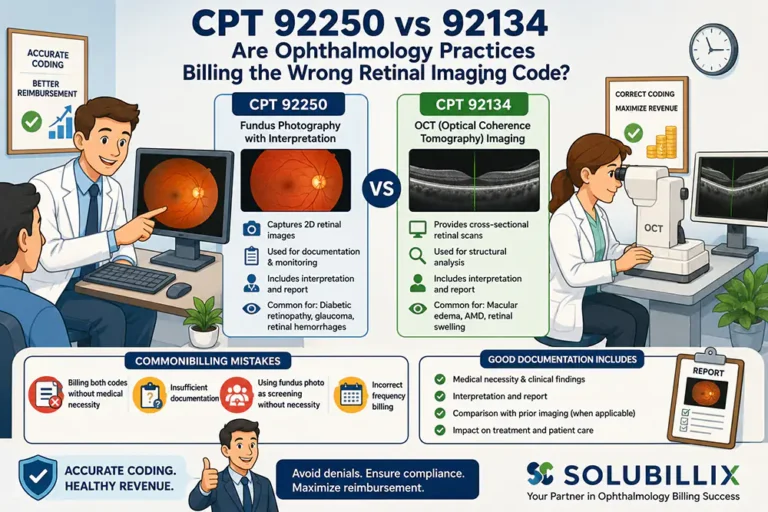
92134 – Optical Coherence Tomography (OCT) of the Retina
This code is used for retinal imaging when evaluating macular conditions such as macular degeneration, diabetic macular edema, or retinal abnormalities.
Fundus Photography
92250 – Fundus Photography with Interpretation and Report
This imaging test documents retinal structures and is often used to monitor disease progression in patients with diabetic retinopathy or macular degeneration.
Fluorescein Angiography
92235 – Fluorescein Angiography
This diagnostic test evaluates retinal circulation and helps detect vascular abnormalities.
Laser Treatment
67210 – Laser Photocoagulation of Retina
This procedure is commonly used to treat retinal tears, diabetic retinopathy, and other retinal conditions.
Intravitreal Injection
67028 – Intravitreal Injection of Pharmacologic Agent
This is one of the most frequently billed retina procedures and is commonly used to administer medications for macular degeneration or retinal edema.
Correct CPT code selection ensures the service performed is accurately represented in the claim submission.
Documentation Requirements for Retina Procedure Billing
Detailed documentation is essential to support retina procedure claims. Insurance carriers require clinical records that clearly demonstrate the medical necessity of the treatment or diagnostic service.
Documentation should include:
- Patient symptoms and clinical findings
- Confirmed or suspected retinal diagnosis
- Procedure performed and clinical justification
- Physician interpretation of diagnostic imaging
- Treatment plan and follow-up recommendations
For diagnostic tests such as OCT or fundus photography, providers must include an interpretation and report in addition to storing the image in the medical record.
Proper documentation not only supports reimbursement but also helps protect practices during audits or payer reviews.
Retina Billing Modifiers Ophthalmology Practices Should Know
Modifiers are often required when billing retina procedures, especially when multiple services are performed during the same visit.
Some commonly used modifiers include:
Modifier 25
Used when a significant and separately identifiable evaluation and management service is performed on the same day as a procedure.
Modifier 59
Used to indicate that procedures performed on the same day are distinct and should not be bundled together.
Modifier RT / LT
Used to indicate the right or left eye when applicable.
Using the correct modifier ensures accurate claim processing and prevents reimbursement delays.
Common Retina Billing Challenges
Retina practices often face unique billing challenges due to the complexity of ophthalmology procedures and insurance rules. Some of the most common issues include:
Claim Denials Due to Coding Errors
Incorrect CPT or ICD-10 codes can lead to immediate claim rejections or delayed payments.
Lack of Medical Necessity Documentation
Payers may deny retina procedures if documentation does not clearly justify the medical need for the service.
Bundled Services
Some retina procedures are subject to bundling rules, meaning certain services cannot be billed separately during the same encounter.
Prior Authorization Requirements
Certain retinal treatments and medications require prior authorization before they can be billed to insurance carriers.
Addressing these challenges requires experienced billing knowledge and careful attention to payer guidelines.
How Effective Retina Billing Improves Practice Revenue
Retina services represent a significant portion of revenue for many ophthalmology practices. However, inefficient billing processes can result in lost revenue opportunities.
Optimizing retina billing can help practices:
- Improve claim acceptance rates
- Reduce administrative workload
- Accelerate insurance reimbursements
- Minimize billing errors
- Strengthen overall revenue cycle performance
When billing workflows are optimized, ophthalmologists can focus on patient care instead of administrative challenges.
Why Ophthalmology Practices Choose Solubillix
Retina procedure billing requires specialized expertise in ophthalmology coding, documentation standards, and payer regulations. Many practices struggle to manage these complex requirements while maintaining efficient operations.
Solubillix provides advanced medical billing solutions specifically designed for optometry and ophthalmology practices.
Our experienced team helps eye care providers improve financial performance through:
- Accurate ophthalmology CPT and ICD-10 coding
- Retina procedure billing expertise
- Insurance verification and eligibility checks
- Claim submission and denial management
- Compliance monitoring and audit protection
- Complete revenue cycle management services
By partnering with Solubillix, ophthalmology practices gain access to a dedicated billing team that understands the complexities of retina procedure billing and works to maximize reimbursement for every claim.
Final Thoughts
Retina procedures play a critical role in diagnosing and treating serious eye diseases that threaten vision. Because these services involve complex diagnostic imaging and specialized treatments, proper billing and documentation are essential for successful reimbursement.
Ophthalmology practices that implement accurate coding, maintain strong documentation, and follow payer guidelines can significantly reduce claim denials and improve revenue performance.
For retina specialists looking to streamline billing operations and maximize reimbursements, Solubillix offers expert ophthalmology billing services designed to support the success and growth of modern eye care practices.