
Introduction
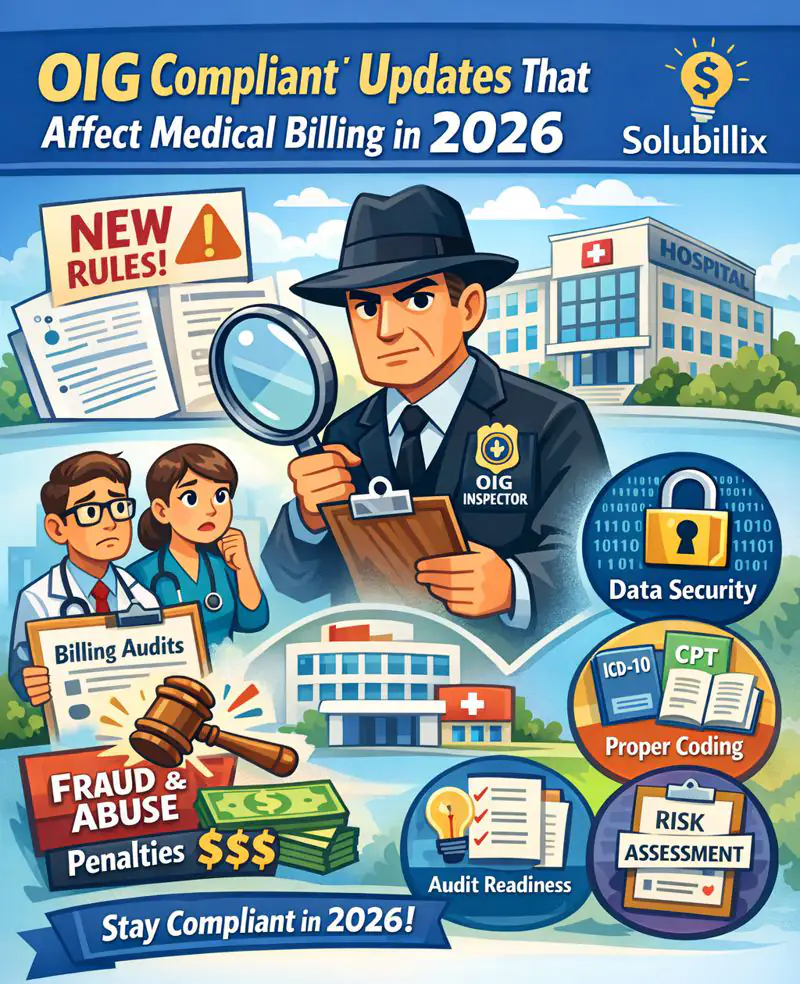
In 2026, compliance is no longer optional for healthcare providers and medical billing companies. The Office of Inspector General (OIG) continues to tighten oversight, focusing heavily on billing accuracy, documentation integrity, and revenue cycle transparency. For providers, even small compliance gaps can lead to audits, payment recoupments, or civil penalties.
At Solubillix, we work closely with practices to stay ahead of OIG updates and convert compliance into a revenue-protection strategy—not just a regulatory burden.
What Is the OIG and Why It Matters in 2026
The OIG (Office of Inspector General) oversees federal healthcare programs such as Medicare and Medicaid. Its mission is to prevent:
- Fraud
- Waste
- Abuse
- Improper payments
In 2026, OIG enforcement is increasingly data-driven, using analytics to identify abnormal billing patterns across providers, specialties, and billing companies.
👉 This makes having a strong medical billing compliance program more critical than ever.
Key OIG Compliance Updates Impacting Medical Billing in 2026
1. Increased Scrutiny on Evaluation & Management (E/M) Coding
OIG continues to flag upcoding and insufficient documentation for office visits.
What’s changing in 2026:
- Greater focus on medical decision-making (MDM) accuracy
- Comparison of providers against peer benchmarks
- Retrospective audits for overutilization of higher-level E/M codes
How Solubillix helps:
Our Medical Coding & Auditing Services include routine E/M audits to ensure documentation fully supports billed codes.
2. Modifier Misuse Remains a Top Risk Area
Modifiers such as -25, -59, and -24 remain on the OIG watchlist.
OIG concerns include:
- Unbundling services
- Billing separately for inclusive procedures
- Modifier use without clinical justification
2026 trend:
Claims with frequent modifier usage are more likely to trigger payer and OIG audits.
🔗 Internal support: Solubillix’s Denial Management Services proactively review modifier usage to reduce audit risk.
3. Telehealth Billing Compliance Tightens
While telehealth remains widely used, OIG is narrowing its focus to ensure:
- Services are medically necessary
- Place of service (POS) codes are correct
- Documentation meets payer-specific rules
Common 2026 audit triggers:
- Incorrect POS 02 vs POS 10
- Billing telehealth for non-eligible services
- Missing consent documentation
Solubillix supports practices with Telehealth Billing Compliance Reviews as part of our full Medical Billing Services.
4. Medical Necessity Documentation Is Under the Microscope
OIG audits in 2026 emphasize why a service was provided—not just what was billed.
High-risk areas include:
- Diagnostic testing
- Repeated procedures
- Injection and infusion services
Best practice:
Clear linkage between diagnosis, treatment plan, and billed service.
🔗 Solubillix integrates documentation checks into our Revenue Cycle Management (RCM) Services to protect providers before claims are submitted.
5. Third-Party Billing Company Accountability
In 2026, OIG is holding billing companies more accountable than ever.
This includes:
- Shared liability for improper claims
- Oversight of offshore billing operations
- Compliance program expectations for vendors
Why Solubillix stands out:
We operate with U.S.-based compliance oversight, documented QA processes, and transparent reporting—reducing risk for both providers and partners.
OIG’s Focus on Data Analytics & Outliers
OIG now relies heavily on predictive analytics, flagging providers who:
- Bill significantly above peer averages
- Show unusual service frequency patterns
- Have high denial or reversal rates
Solubillix uses billing performance dashboards to identify and correct these risks early—before they escalate into audits.
How Providers Can Stay OIG-Compliant in 2026
Compliance Best Practices:
- Conduct internal coding audits quarterly
- Train providers on documentation standards
- Monitor denial trends and CARC/RARC codes
- Maintain written compliance policies
- Partner with a billing company that prioritizes compliance
🔗 Solubillix supports all of the above through our Compliance-Focused Medical Billing Solutions.
Why Compliance-Driven Billing Protects Revenue
OIG compliance is not just about avoiding penalties—it directly impacts:
- Faster claim approvals
- Lower denial rates
- Reduced recoupments
- Long-term financial stability
At Solubillix, compliance is embedded into every step of our billing workflow—from charge entry to payment posting and appeals.
Final Thoughts
OIG compliance updates in 2026 signal a clear message: accuracy, transparency, and documentation matter more than ever. Providers who rely on outdated billing practices face increased audit risk and revenue loss.
Partnering with a compliance-first billing company like Solubillix ensures your practice stays protected, profitable, and prepared for ongoing regulatory changes.
Ready to Strengthen Your Billing Compliance?
Explore Solubillix’s:
- Medical Billing Services
- Revenue Cycle Management Solutions
- Denial Management & Appeals Services
- Medical Coding & Auditing Services
📩 Contact Solubillix today to turn compliance into a competitive advantage in 2026.