
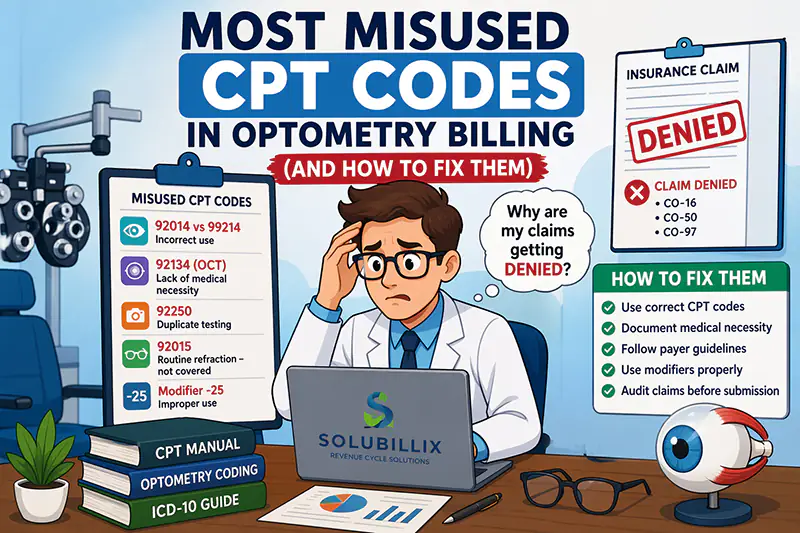
If your optometry practice is losing revenue, there’s a high chance it’s not due to low patient volume—but incorrect CPT coding.
In 2026, coding errors remain one of the top reasons for claim denials, underpayments, and audit risks in eye care practices.
This guide breaks down the most commonly misused CPT codes in optometry billing, why they trigger denials, and exactly how to fix them—based on real billing scenarios.
🚨 Why CPT Coding Errors Are Costing You Money
Even small coding mistakes can lead to:
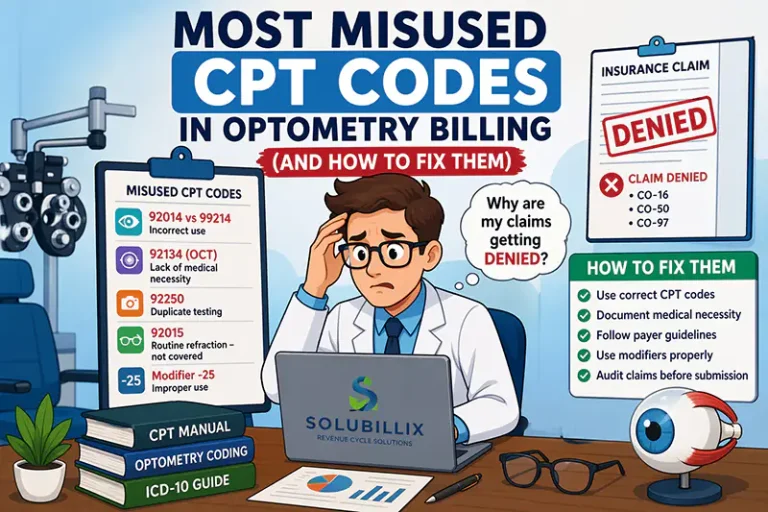
- ❌ Claim denials (CO-16, CO-50, CO-97)
- ❌ Downcoding by insurance payers
- ❌ Audit risks and recoupments
- ❌ Delayed reimbursements
In many practices, 10–20% of revenue leakage comes directly from incorrect coding.
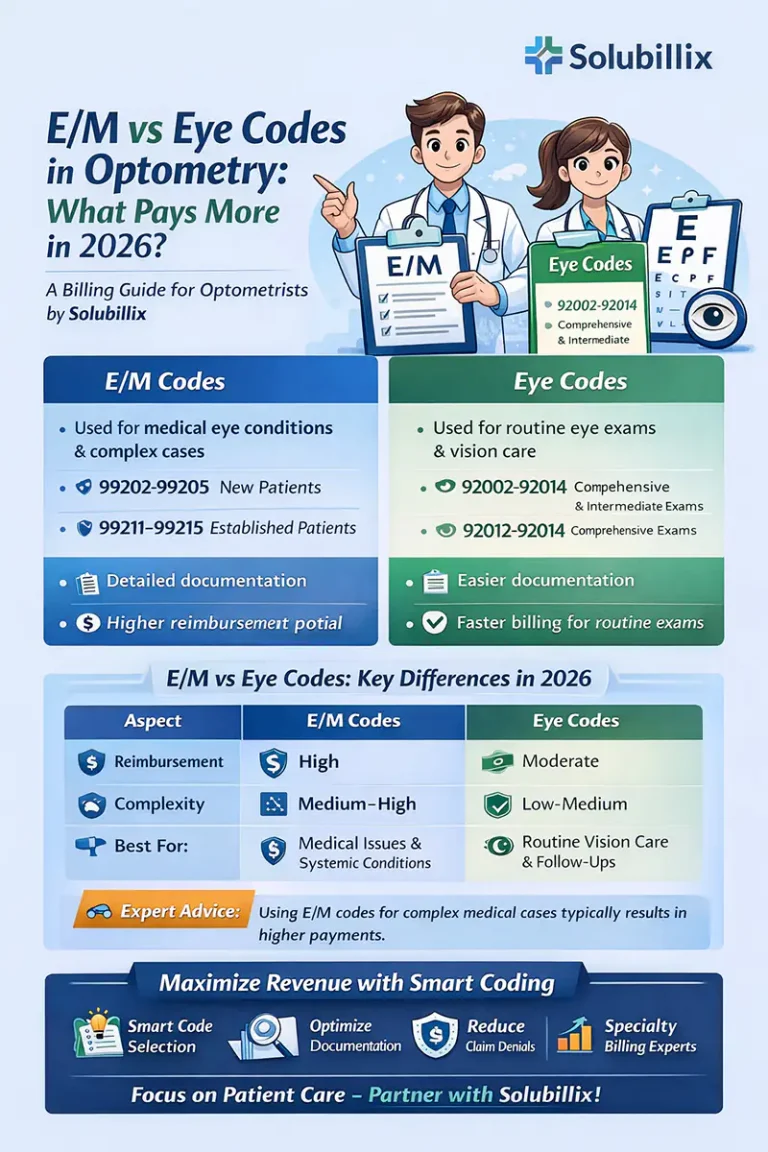
🔍 1. 92014 vs 99214 – The Most Confusing Pair
❌ The Mistake
Billing 92014 (comprehensive eye exam) and 99214 (E/M visit) together incorrectly—or choosing the wrong one.
⚠️ Why It Gets Denied
Payers often consider these services overlapping unless:
- A separately identifiable medical service is documented
- Proper use of modifier -25 is applied
✅ How to Fix It
- Use 92014 for routine/comprehensive ophthalmological exams
- Use 99214 only when addressing a medical condition with proper documentation
- Append modifier -25 ONLY when both services are truly distinct
💡 Pro Tip: If documentation doesn’t clearly support medical necessity, expect denial.
🔍 2. 92004 vs 92014 – New vs Established Patient Confusion
❌ The Mistake
Using 92004 (new patient) for established patients—or vice versa.
⚠️ Why It Gets Denied
Insurance systems track patient history. If the patient has been seen within 3 years, billing as “new” triggers rejection.
✅ How to Fix It
- Confirm patient status (new vs established) before coding
- Use practice management software alerts to flag incorrect usage
🔍 3. 92134 (OCT) – Overuse & Documentation Gaps
❌ The Mistake
Billing Optical Coherence Tomography (92134) without proper medical necessity or too frequently.
⚠️ Why It Gets Denied
- No documented diagnosis supporting OCT
- Frequency limits exceeded
- Missing interpretation/report
✅ How to Fix It
- Always include:
- Medical necessity (e.g., glaucoma, macular degeneration)
- Physician interpretation
- Track frequency limits per payer
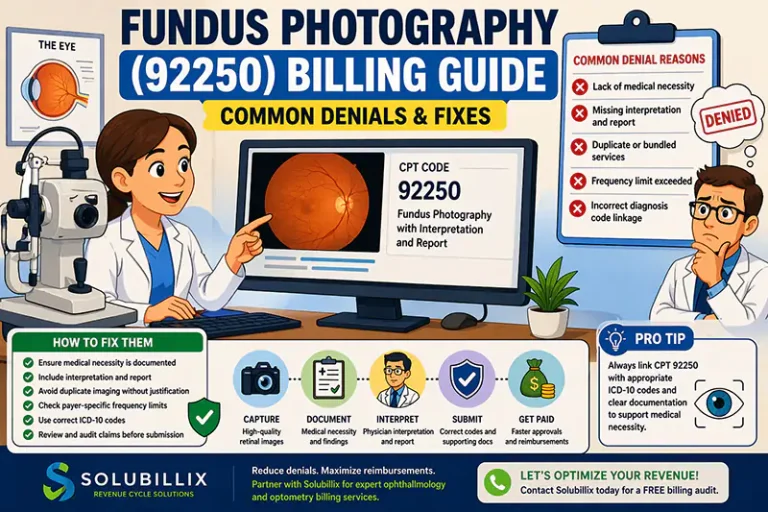
🔍 4. 92250 (Fundus Photography) – Duplicate Testing Issues
❌ The Mistake
Billing 92250 alongside OCT or other imaging without justification.
⚠️ Why It Gets Denied
Payers may consider it duplicate or redundant testing.
✅ How to Fix It
- Clearly document why both tests are needed
- Avoid routine bundling without clinical reasoning
🔍 5. 92015 (Refraction) – Patient vs Insurance Confusion
❌ The Mistake
Billing refraction (92015) to insurance expecting reimbursement.
⚠️ Why It Gets Denied
Most insurance plans consider refraction a non-covered service.
✅ How to Fix It
- Bill refraction as patient responsibility
- Inform patients upfront to avoid disputes
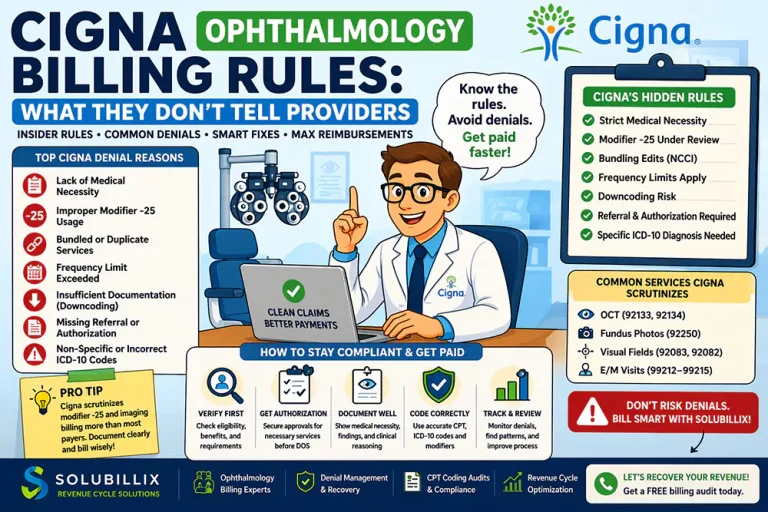
🔍 6. Modifier -25 Misuse – A Silent Revenue Killer
❌ The Mistake
Overusing or incorrectly applying modifier -25
⚠️ Why It Gets Denied
Payers flag this modifier for potential abuse, leading to audits or automatic denials.
✅ How to Fix It
- Use ONLY when:
- A separate E/M service is performed
- Documentation clearly supports it
- Avoid “default” usage
🛠 Step-by-Step Fix: How to Reduce Coding Errors
✔️ 1. Implement Pre-Submission Audits
Review CPT codes before claim submission
✔️ 2. Train Staff on Payer-Specific Rules
Each payer behaves differently—this matters
✔️ 3. Use Coding Checklists
Standardize workflows to avoid guesswork
✔️ 4. Track Denial Patterns
Identify which codes are causing repeated issues
✔️ 5. Audit Documentation Monthly
Ensure every billed service is fully supported
📈 Real Impact: What Fixing CPT Errors Can Do
Practices that optimize CPT coding typically see:
- 💰 15–25% increase in collections
- ⏱ Faster claim processing
- 📉 Significant reduction in denials
🚀 Final Thoughts
CPT coding isn’t just a billing task—it’s a revenue driver.
Fixing even a few commonly misused codes can recover thousands of dollars annually for your optometry practice.
💼 Need Help Fixing Your Billing? (Solubillix)
If your practice is:
- Facing repeated denials
- Struggling with coding accuracy
- Losing revenue without knowing why
Solubillix can help.
👉 We specialize in:
- Optometry & ophthalmology billing
- Denial management & recovery
- CPT coding audits & compliance
- Revenue cycle optimization
Let us identify hidden revenue leaks and recover what you’re losing—often within 30 days.
📩 Get Started Today
Contact Solubillix for a free billing audit and see how much revenue your practice is missing.