
A Complete Billing Guide for Optometrists by Solubillix
Choosing between Evaluation & Management (E/M) codes and Eye visit codes is one of the most critical—and confusing—decisions in optometry billing. Selecting the wrong code can lead to lost revenue, claim denials, or compliance risks.
At Solubillix, we help optometry practices make smarter coding decisions that maximize reimbursement while staying fully compliant.
Let’s break down what truly pays more in 2026 👇
👁️ What Are Eye Codes?
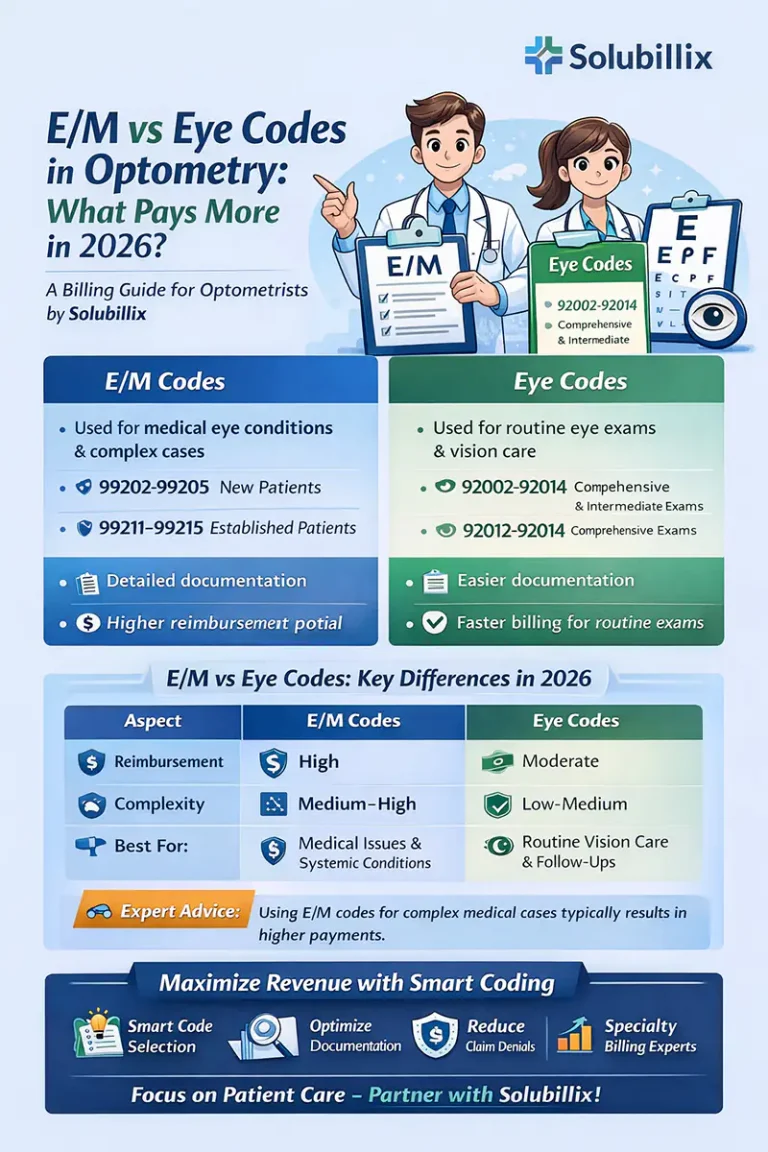
Eye codes are specific to ophthalmology and optometry services:
Common Eye Codes:
- 92002 – Intermediate exam (new patient)
- 92004 – Comprehensive exam (new patient)
- 92012 – Intermediate exam (established patient)
- 92014 – Comprehensive exam (established patient)
Key Features:
- Focused on eye-related conditions
- Require specific exam elements (e.g., ophthalmoscopy, dilation)
- Easier documentation compared to E/M codes
👉 Best for: Routine eye conditions, follow-ups, and comprehensive eye exams
🩺 What Are E/M Codes?
E/M (Evaluation & Management) codes are used across all medical specialties:
Common E/M Codes:
- 99202–99205 – New patients
- 99211–99215 – Established patients
Key Features:
- Based on:
- Medical Decision Making (MDM)
- Time spent with the patient
- More flexible for medical conditions and complex cases
👉 Best for: Medical eye care, systemic conditions affecting the eye, and complex decision-making
💰 E/M vs Eye Codes: Which Pays More?
📊 Reimbursement Comparison (General Trend in 2026)
| Service Type | Typical Reimbursement | Complexity | Documentation | |
| Eye Codes | Moderate | Low–Medium | Easier | |
| E/M Codes | Moderate–High | Medium–High | Detailed |
👉 Key Insight from Solubillix:
E/M codes often pay more for complex visits, while eye codes are faster and simpler for routine care.
⚖️ When to Use Eye Codes (Better Choice)
Use eye codes when:
- Performing a routine or comprehensive eye exam
- Managing stable or straightforward eye conditions
- Documentation supports required exam elements
✅ Faster billing
✅ Lower audit risk
✅ Ideal for high-volume practices
⚖️ When to Use E/M Codes (Higher Revenue Potential)
Use E/M codes when:
- Treating medical conditions (e.g., glaucoma, infections)
- Managing systemic diseases affecting vision (diabetes, hypertension)
- Performing complex medical decision-making
✅ Higher reimbursement potential
✅ More flexibility
✅ Better for specialty care
⚠️ Common Mistakes That Cost Optometrists Money
Many providers lose revenue due to:
❌ Always Using Eye Codes
→ Missing higher-paying E/M opportunities
❌ Incorrect Documentation
→ Leads to downcoding or denials
❌ Mixing Codes Improperly
→ Risk of audits and compliance issues
❌ Not Understanding Payer Preferences
→ Some insurers favor E/M codes
👉 Solubillix Tip: Each visit should be coded based on medical necessity—not habit.
📈 Real-World Example
Scenario 1:
Routine vision exam → 92014 (Eye Code)
✔ Efficient and appropriate
Scenario 2:
Diabetic patient with retinal complications → 99214 (E/M Code)
✔ Higher reimbursement due to complexity
🚀 How Solubillix Maximizes Your Revenue
At Solubillix, we ensure you always choose the most profitable and compliant coding strategy:
✅ Smart Code Selection (E/M vs Eye Codes)
✅ Documentation Review & Optimization
✅ Denial Reduction Strategies
✅ Revenue Cycle Management for Optometry
✅ Audit Protection & Compliance
Our goal is simple:
👉 Help optometrists get paid more—without increasing workload
🔥 Final Verdict: What Pays More?
✔ E/M Codes → Higher reimbursement for complex care
✔ Eye Codes → Faster billing for routine exams
👉 The real winner?
Using the RIGHT code at the RIGHT time
📣 Take Your Optometry Billing to the Next Level
If you’re unsure whether you’re maximizing your billing potential, it’s time to partner with experts.
💼 Solubillix helps optometrists:
- Increase revenue
- Reduce denials
- Stay fully compliant
👉 Focus on patient care—we’ll handle the billing.