
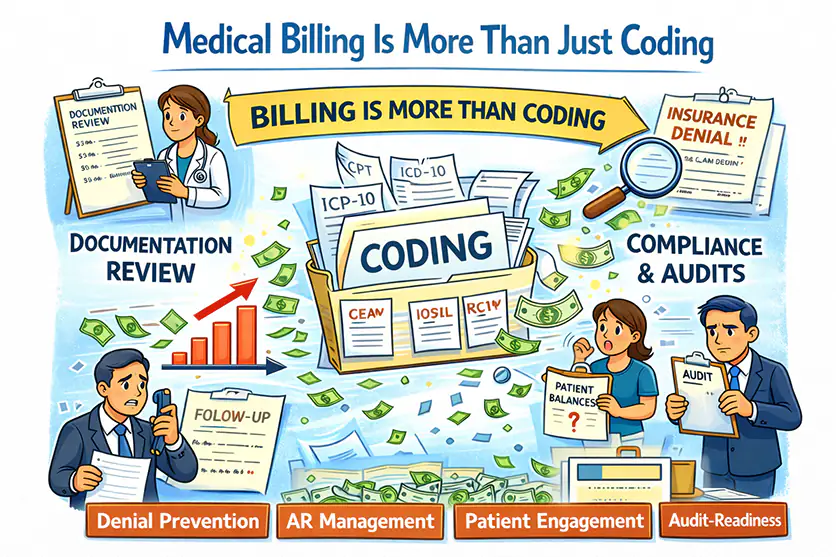
For many providers, medical billing has traditionally been seen as simply coding diagnoses and procedures accurately. But in today’s healthcare environment, billing is no longer just about coding — it has evolved into a complex, strategic process that directly affects revenue, compliance, and patient satisfaction.
At Solubillix, a New York-based medical billing company, we help providers navigate this evolving landscape so they can maximize reimbursement, prevent denials, and stay audit-ready.
The Evolution of Medical Billing
In the past, the primary responsibility of billing staff was to assign the correct CPT and ICD-10 codes and submit claims. Accuracy was important, but the process was largely transactional.
Today, medical billing involves:
- Revenue Cycle Management (RCM): Tracking the entire claim lifecycle from patient intake to final payment.
- Compliance and Risk Management: Ensuring documentation supports every billed service to avoid denials and audits.
- Patient Financial Experience: Communicating patient responsibilities, statements, and collections.
- Data Analysis: Using insights to reduce AR days, spot payer trends, and improve operational efficiency.
This shift means billing is no longer a back-office task — it’s a critical business function that drives practice sustainability.
Why Coding Alone Is Not Enough
1. Denial Prevention Requires Documentation and Workflow Analysis
Even perfectly coded claims can be denied if documentation is incomplete, inconsistent, or fails to demonstrate medical necessity. Modern billing involves reviewing SOAP notes, procedure logs, lab results, and authorization compliance to reduce denials before submission.
2. Payer-Specific Rules Are More Complex Than Ever
Each payer has unique requirements for coding, modifiers, billing sequences, and documentation. Understanding these nuances is essential to ensure claims are processed correctly and on time.
3. AR Management Impacts Cash Flow
Billing is no longer just about submitting claims; it’s about ensuring claims are paid promptly. Tracking accounts receivable (AR), following up on delayed claims, and analyzing denial trends are now integral to the billing process.
4. Technology Integration Is Essential
With EHRs, telehealth platforms, and automated coding tools, modern billing professionals must ensure systems communicate accurately. Errors in data transfer or auto-populated notes can lead to denials, underpayments, or compliance risks.
5. Patient Engagement Matters
Patients today are more aware of costs and responsibilities. Billing professionals now play a role in explaining patient balances, copays, and insurance coverage, which affects collections and patient satisfaction.
How Solubillix Bridges the Gap
At Solubillix, we understand that billing is no longer just about coding — it’s about revenue, compliance, and practice health. Our approach includes:
1. Pre-Billing Documentation Audits
We review medical records to ensure every claim is fully supported, reducing denials and audit risk.
2. Denial Analysis & Prevention
By analyzing denial patterns and root causes, we implement proactive strategies to reduce recurring claim issues.
3. Specialty-Specific Billing Expertise
Behavioral health, primary care, telehealth, and procedural specialties each have unique billing needs. We align our process with payer rules for each specialty.
4. AR & Revenue Optimization
Solubillix monitors accounts receivable, follows up with payers, and ensures collections are maximized while maintaining compliance.
5. Compliance & Audit-Readiness
We keep providers audit-ready with accurate coding, detailed documentation, and payer-compliant billing workflows.
The Bottom Line
Medical billing is no longer a back-office coding task — it’s a strategic function that drives revenue, compliance, and patient satisfaction.
Providers who treat billing as just coding risk:
- Delayed or denied claims
- Lost revenue opportunities
- Audit exposure
- Operational inefficiencies
With Solubillix as your partner, providers gain a full-service billing strategy that ensures accuracy, maximizes revenue, and reduces risk — all while staying compliant with today’s complex payer landscape.