
For optometry and ophthalmology practices, patient care doesn’t stop with an accurate prescription or a successful clinical diagnosis. A significant portion of a practice’s daily revenue is generated right in the optical boutique or through specialized contact lens fittings. However, this is precisely where eye care clinics encounter their most persistent billing headache: the friction between major medical insurance and routine vision plans.
Every week, optometry billing departments leave money on the table or unnecessarily balance-bill patients for specialty items like polycarbonate lenses, custom scleral lenses, high-index materials, or specialized anti-reflective coatings. The culprit? Failing to unlock the strategic power of Healthcare Common Procedure Coding System (HCPCS) Level II S-codes with commercial medical payers.
Many practices assume these premium materials can only be processed through routine vision networks (like VSP or EyeMed) or written off as out-of-pocket patient expenses. In reality, when medical necessity is established, commercial medical insurance plans can—and will—reimburse these items.
This in-depth guide reveals the commercial payer secrets to mastering S-codes, eliminating material denials, and capturing the full value of your optical and specialty lens services.
The Core Dilemma: Routine Vision vs. Major Medical
To maximize optical revenue, your team must understand when an optical material transitions from a “cosmetic upgrade” to a “medical necessity.”
Routine vision plans provide capped, standard allowances for basic materials. If a patient requires complex, custom specialty lenses due to a severe corneal pathology (such as keratoconus or severe irregular astigmatism), routine allowances will not even cover the lab costs of the lenses.
When a patient presents with a medical eye condition, the entire encounter—including the specialized lens materials required to restore their visual acuity—shifts under the jurisdiction of their commercial major medical insurance. This is where S-codes become your most valuable financial asset.
Key Specialty Lens S-Codes Your Practice Must Use
S-codes are temporary national codes established by commercial payers for tracking and reimbursement of specific items that lack permanent CPT or standard HCPCS codes. While Medicare fundamentally does not recognize or reimburse S-codes, commercial medical payers (such as Blue Cross Blue Shield, Aetna, Cigna, and UnitedHealthcare) actively utilize them.
Your billing desk should have these high-yield S-codes built directly into your EHR super-bill:
1. Specialty Scleral and Rigid Gas Permeable (RGP) Lenses
- S0512: Daily-wear specialty contact lens, per lens
- S0515: Scleral lens, liquid-ventilated, for gas permeation, per lens
- S0522: Evaluation and fitting of specialty contact lens (RGP or scleral)
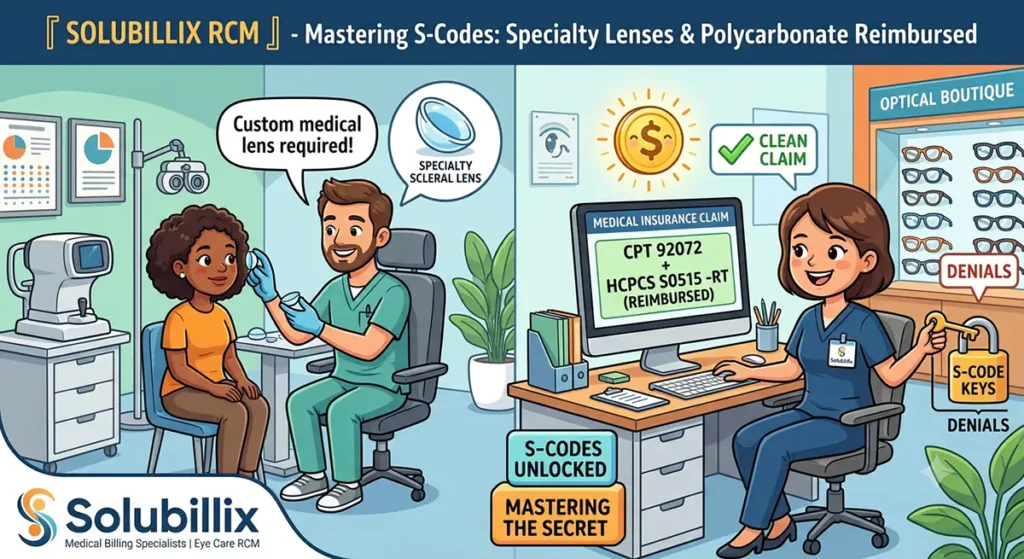
- The Blueprint: When billing a major medical payer for scleral lenses required due to corneal ectasia, pair S0515 (reported as two units if bilateral, specifying the right/left modifiers -RT and -LT) with the appropriate clinical diagnosis code (e.g., H18.603 for bilateral keratoconus).
2. Spectacle Lenses and Material Upgrades
- S0500: Disposable contact lens, per lens
- S0580: Polycarbonate lens, per lens
- S0581: Nonstandard spectacle lens, item description (e.g., high-index, specialized prism)
- S0592: Comprehensive eye exam, established patient (used strictly for specific commercial medical contracts requiring specific encounter metrics)
The Polycarbonate Blueprint: When is S0580 Medicinally Necessary?
Polycarbonate lenses are impact-resistant, making them standard for children and safety glasses. However, routine vision plans usually charge the patient a premium copay for this upgrade. If you are billing a commercial medical plan for a patient’s glasses following complex ocular surgery, you can get S0580 reimbursed at 100% of the allowed medical rate if you prove medical necessity.
Valid Medical Triggers for Polycarbonate Reimbursement:
- Monocular Vision: If a patient has an ocular injury or disease causing permanent blindness or profound vision loss in one eye (e.g., H54.41 – Blindness, one eye), polycarbonate protection for the remaining functional eye is a medical necessity to prevent total blindness.
- Aphakia: Patients who have undergone complex cataract surgery where an intraocular lens could not be safely implanted (H27.02 – Aphakia, left eye) require heavy aphakic spectacle lenses. Polycarbonate material provides the necessary structural integrity and safety profile.
- Severe Neurological or Physical Safety Risks: Patients with severe epilepsy or physical tremors who face an elevated risk of falling require impact-resistant lenses to prevent devastating ocular trauma from shattered glass or standard plastic.
Overcoming the “Not Covered” Denial: Clear Documentation Rules
Commercial insurance algorithms are aggressively designed to deny S-codes on the first pass, labeling them as “non-covered routine optical benefits.” To bypass these algorithmic claims scrubbers, your revenue cycle team must adhere to strict documentation protocols:
Clear Separation of the Fitting vs. the Material
Do not bundle your clinical expertise with the physical product. Bill the medical fitting procedure using appropriate CPT codes (e.g., 92072 for fitting of a contact lens for management of symptomatic corneal disease) alongside the physical material line item (S0515).
Prior Authorizations Are Non-Negotiable
Before a specialized lab custom-manufactures a $1,500 pair of scleral lenses, your billing team must secure a formal medical prior authorization. Submit the lab’s cost breakdown sheet, the doctor’s corneal topography scans, visual acuity charts proving standard glasses fail to correct the vision, and the specific S-codes intended for billing.
Utilize the Right Modifiers
Commercial payers require precise anatomical tracking. If you are billing for a custom medical contact lens for the right eye only, your line item must read: S0512 -RT. Failing to append laterality modifiers triggers an immediate denial for incomplete coding.
Protect Your Optical and Specialty Revenue with Solubillix
Managing the intersection of routine vision allowances and major medical S-codes requires an extraordinary level of granular expertise. General medical billers often make the mistake of assuming all glasses and contact lenses belong on a routine vision claim, causing practices to lose out on thousands of dollars in legitimate major medical reimbursements.
At Solubillix, based right here in New York, we deploy dedicated eye care RCM specialists who understand the complex mechanics of specialty optical billing. We know exactly which commercial medical payers recognize S-codes, how to build bulletproof prior authorization packages for scleral and RGP lenses, and how to counter automatic denials with strong, evidence-backed appeals. We stop the material revenue leaks in your optical boutique and specialty clinics so your providers can focus entirely on delivering life-altering vision care.Stop writing off your premium specialty lens materials. Contact Solubillix today for a comprehensive, complimentary audit of your practice’s optical and medical eye billing performance.