
Occupational & Speech Therapy Medical Billing Specialists
Choosing the correct occupational therapy evaluation code can be challenging, particularly when a patient’s medical history is complicated or the evaluation requires extensive clinical reasoning.
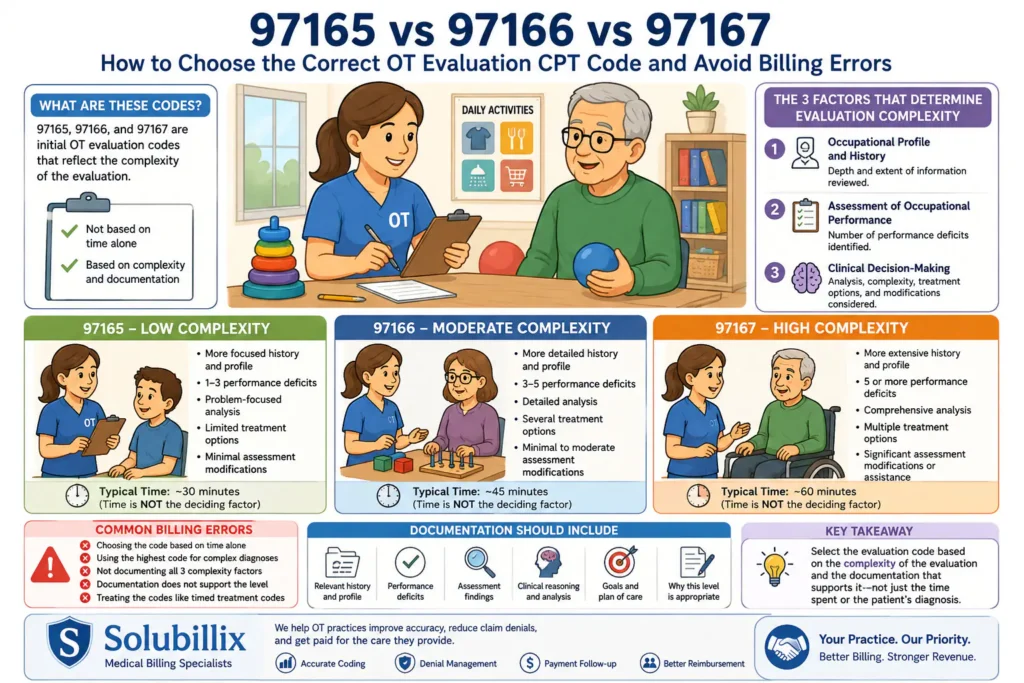
For occupational therapists, 97165, 97166, and 97167 represent three levels of OT evaluation complexity. The correct selection is based on the documented complexity of the evaluation—not simply the patient’s diagnosis, the number of medical conditions, or how long the therapist spent with the patient.
At Solubillix, we understand that accurate OT billing requires more than selecting a code from a list. The evaluation must be properly documented, the selected complexity must be defensible, and the claim must accurately reflect the services provided.
This guide explains the differences between 97165, 97166, and 97167 and highlights common billing mistakes that can create unnecessary claim problems.
What Are 97165, 97166, and 97167?
Occupational therapy has three initial evaluation levels:
- 97165 — Low complexity
- 97166 — Moderate complexity
- 97167 — High complexity
These codes replaced the former single OT evaluation code structure beginning in 2017. CMS adopted 97165–97167 for Medicare OT evaluations, and AOTA explains that the three levels were designed to reflect differences in evaluation complexity.
The important point is that the three codes are differentiated by the complexity of the evaluation.
They are not simply:
30 minutes = 97165
45 minutes = 97166
60 minutes = 97167
Those typical times can be useful as general reference points, but time alone does not determine the evaluation level. AOTA specifically explains that the evaluation codes are not time-based codes and that complexity, rather than time, determines code selection.
The Three Factors That Determine OT Evaluation Complexity
The evaluation complexity is based on three primary components:
1. Occupational Profile and History
The therapist considers the patient’s occupational profile and relevant medical and therapy history.
The depth of this review can range from a more focused history to a substantially more extensive review of physical, cognitive, and psychosocial factors affecting occupational performance.
2. Assessment of Occupational Performance
The therapist identifies performance deficits that result in activity limitations or participation restrictions.
The number of identified performance deficits is one factor used in determining complexity:
| Evaluation Level | Performance Deficits |
| 97165 — Low | 1–3 |
| 97166 — Moderate | 3–5 |
| 97167 — High | 5 or more |
However, the number of deficits alone does not determine the final code. The occupational profile, history, assessment, and clinical decision-making must also support the selected level.
3. Clinical Decision-Making
The therapist’s clinical reasoning is another major component.
The evaluation may involve consideration of:
- The complexity of the patient’s presentation
- Comorbidities affecting occupational performance
- The depth of assessment required
- Modifications or assistance needed during assessment
- The number and complexity of treatment options considered
AOTA explains that these factors help distinguish low-, moderate-, and high-complexity evaluations.
97165 vs 97166 vs 97167: Quick Comparison
| Factor | 97165 | 97166 | 97167 |
| Complexity | Low | Moderate | High |
| History/profile | More focused | More detailed | More extensive |
| Performance deficits | 1–3 | 3–5 | 5+ |
| Clinical analysis | Problem-focused | Detailed | Comprehensive |
| Treatment options | Limited | Several | Multiple |
| Assessment modifications | Generally not required | Minimal to moderate | Significant may be required |
| Typical face-to-face time | 30 minutes | 45 minutes | 60 minutes |
| Is time alone enough? | No | No | No |
The typical times shown above are not mandatory time thresholds. AOTA specifically states that the typical times are guidelines rather than requirements or limits.
The Biggest Mistake: Choosing the Code Based on Time
One of the most common misconceptions is:
“The evaluation took 60 minutes, so I should bill 97167.”
That approach can create a coding problem.
An evaluation taking 60 minutes does not automatically qualify as high complexity.
Likewise, a clinically complex evaluation should not automatically be reduced to a lower level simply because it took less than the typical time associated with that code.
The complexity of the evaluation and the documentation supporting that complexity are what matter.
AOTA specifically states that time is not the determining factor in selecting among the OT evaluation codes.
Does a Complicated Diagnosis Automatically Mean 97167?
No.
This is another important distinction.
A patient may have multiple diagnoses or significant medical history, but the OT evaluation may still focus on a relatively limited occupational problem.
Conversely, a patient with one primary diagnosis may require a more complex evaluation because of significant functional limitations, assessment challenges, comorbidities affecting performance, or multiple treatment options.
The diagnosis is therefore context, not an automatic shortcut to a particular evaluation level.
The documentation should explain why the evaluation required the level of clinical reasoning and assessment reflected by the selected code. AOTA emphasizes that the number of performance deficits is only one factor and that the overall profile, history, and clinical reasoning must also be considered.
Example: When 97165 May Be Appropriate
Consider a patient referred to OT for a focused functional problem.
The therapist completes:
- A focused occupational profile
- Relevant medical and therapy history
- Assessment identifying a limited number of performance deficits
- Problem-focused analysis
- A plan of care addressing the identified limitations
If the documentation supports a low-complexity evaluation across the required components, 97165 may be appropriate.
The important factor is not simply that the evaluation was relatively short. The documentation must support the low-complexity level.
Example: When 97166 May Be Appropriate
Consider a patient with several functional limitations and relevant medical history affecting occupational performance.
The OT may need to:
- Review a broader medical and therapy history
- Assess several areas of occupational performance
- Analyze multiple sources of information
- Consider several treatment approaches
- Make some modifications during assessment
When the required components support moderate complexity, 97166 may be appropriate.
Again, the documentation—not simply the clock—should support the selection.
Example: When 97167 May Be Appropriate
A high-complexity evaluation may involve a patient with substantial functional challenges requiring a comprehensive assessment.
The therapist may need to:
- Review extensive relevant history
- Assess numerous performance deficits
- Analyze complex clinical information
- Consider multiple treatment options
- Make significant modifications or provide substantial assistance during portions of the assessment
When the required evaluation components support high complexity, 97167 may be appropriate.
The record should clearly demonstrate the clinical reasoning behind the higher level.
Why Documentation Matters So Much
The selected evaluation code should be supported by the evaluation record.
CMS states that an initial OT evaluation should document the medical necessity of the therapy plan through objective findings and patient information and should identify conditions and complexities that make the treatment course more difficult when applicable.
A strong OT evaluation should connect:
Patient history → occupational profile → functional limitations → performance deficits → assessment findings → clinical reasoning → treatment plan
When those elements are clearly connected, the selected evaluation level becomes easier to defend.
Common 97165, 97166 and 97167 Billing Errors
Error #1: Selecting the Code by Minutes Alone
This is perhaps the most common mistake.
Typical evaluation times should not be treated as mandatory thresholds.
Error #2: Automatically Using 97167 for Complex Patients
Multiple diagnoses do not automatically equal high-complexity OT evaluation.
The documentation must support the required evaluation components.
Error #3: Counting Performance Deficits Without Considering the Other Components
The number of performance deficits is important, but it is not the only factor.
The history/profile and clinical decision-making components also matter.
Error #4: Documentation Does Not Explain the Complexity
A claim may contain the correct code, but if the evaluation note does not demonstrate why that level was selected, the claim can become difficult to defend during payer review.
Error #5: Treating the Codes Like Timed Treatment Codes
The initial OT evaluation codes are not billed as 15-minute timed units in the same manner as many treatment procedures.
The evaluation level is selected based on complexity. AOTA explains that one unit is reported for the evaluation regardless of the amount of time spent, with complexity determining the appropriate level.
Error #6: Billing Additional Testing Separately Without Checking the Rules
CMS guidance states that many assessment activities are included within the initial therapy evaluation and should not automatically be separately reported. CMS specifically discusses situations involving evaluation codes and certain testing procedures, as well as Correct Coding Initiative edits.
Before separately billing an assessment or testing service on the same date, the practice should verify the current payer and coding requirements.
Can 97165, 97166 or 97167 Be Billed With Treatment on the Same Day?
Potentially, yes—but the circumstances and payer rules matter.
When an OT evaluation and treatment are provided on the same date of service, the documentation should clearly support both the evaluation and the separately performed treatment service.
The practice should also check current payer policies and applicable NCCI edits before submitting multiple services on the same claim. AOTA explains that NCCI edits evaluate code combinations reported for the same patient, provider, and date of service.
This is an area where simply knowing the CPT codes is not enough. The billing team needs to understand the payer’s current processing rules.
What Should an OT Evaluation Note Demonstrate?
For a defensible evaluation, consider whether the documentation clearly shows:
- The reason for the OT evaluation
- Relevant occupational profile and history
- Medical and therapy history
- Functional concerns
- Performance deficits
- Assessment findings
- Clinical reasoning
- Relevant comorbidities affecting occupational performance
- Assessment modifications or assistance when applicable
- Treatment options considered
- Medical necessity
- Functional goals
- Plan of care
- Why the selected complexity level is appropriate
The documentation should tell a coherent clinical story rather than simply listing diagnoses and test results.
97165 vs 97166 vs 97167: A Simple Decision Framework
A practical way to approach the selection is:
Ask 1: How extensive was the profile and history?
Was the information relatively focused, moderately detailed, or extensive?
Ask 2: How many meaningful performance deficits were identified?
Use the applicable complexity criteria, but do not treat the deficit count as the only determining factor.
Ask 3: How complex was the clinical reasoning?
Consider assessment depth, comorbidities, modifications, assistance, and treatment options.
Ask 4: Do all three components support the same complexity level?
This is critical.
AOTA explains that to move to a higher evaluation level, all three components must support that higher level.
Ask 5: Does the documentation clearly support the selected code?
If a reviewer reads the evaluation without speaking to the therapist, should the reasoning behind the code selection still be understandable?
If the answer is no, the documentation may need improvement.
OT Evaluation Coding Checklist
Before submitting an OT evaluation claim, the billing team can review:
- Correct OT evaluation code selected
- Occupational profile documented
- Relevant history documented
- Performance deficits identified
- Complexity criteria supported
- Clinical reasoning documented
- Comorbidities affecting occupational performance addressed when applicable
- Assessment modifications documented when applicable
- Medical necessity established
- Goals and plan of care supported
- Evaluation and claim information are consistent
- Payer-specific requirements checked
- Applicable coding edits reviewed
How Solubillix Helps OT Practices With Evaluation Billing
OT evaluation billing requires more than choosing between three numbers.
The real challenge is making sure the clinical documentation, coding decision, payer requirements, and claim submission all align.
At Solubillix, we help occupational therapy practices manage the revenue-cycle details behind their claims, including:
- OT claim submission
- Coding review
- Eligibility and benefits verification
- Authorization support
- Denial management
- Corrected claims
- Payment posting
- Accounts receivable follow-up
- Payer follow-up
- Revenue-cycle support
Our focus is simple:
Help OT practices reduce avoidable billing problems and protect the reimbursement they have earned.
Need Help With Occupational Therapy Billing?
If your practice is experiencing recurring OT evaluation denials, coding questions, delayed payments, or growing accounts receivable, Solubillix can help review your billing workflow and identify opportunities for improvement.
Contact Solubillix to discuss your occupational therapy medical billing needs.
Frequently Asked Questions
What is the difference between 97165, 97166, and 97167?
They represent three levels of OT evaluation complexity: low, moderate, and high. The selection depends on the documented evaluation components, including the occupational profile and history, assessment of performance deficits, and clinical decision-making.
Does evaluation time determine whether I bill 97165, 97166, or 97167?
No. Typical times are associated with the three levels, but time alone does not determine the code. AOTA specifically states that the evaluation codes are not time-based codes.
Does having multiple diagnoses mean I should use 97167?
No. Multiple diagnoses can contribute to complexity, but they do not automatically establish a high-complexity evaluation. The overall evaluation must support the selected level.
How many performance deficits support each OT evaluation level?
The commonly referenced criteria are 1–3 for low complexity, 3–5 for moderate complexity, and 5 or more for high complexity. However, the performance-deficit count is only one part of the evaluation-level determination.
Can an OT bill 97165, 97166, or 97167 based only on the evaluation duration?
No. The code should be selected based on the complexity criteria supported by the evaluation, not simply by the number of minutes spent.
Is 97168 the same as 97165–97167?
No. 97168 is the OT re-evaluation code. It is used for an appropriate re-evaluation under an established and ongoing plan of care, rather than as another initial evaluation complexity level. AOTA identifies 97168 separately from the three initial evaluation codes.
Final Takeaway
Choosing between 97165, 97166, and 97167 should never be a matter of simply looking at the clock or selecting the highest code because a patient appears medically complicated.
The strongest approach is to evaluate the three core areas:
Occupational profile & history → Performance assessment → Clinical decision-making
Then make sure the documentation supports the selected complexity level.
For OT practices, accurate evaluation coding can help create cleaner claims, stronger documentation, and a more defensible billing process.
At Solubillix, we understand the connection between clinical documentation and the revenue cycle. Our goal is to help occupational therapy practices spend less time resolving billing problems and more time focusing on patient care.
Solubillix — Medical Billing & Revenue Cycle Support for Healthcare Providers.