
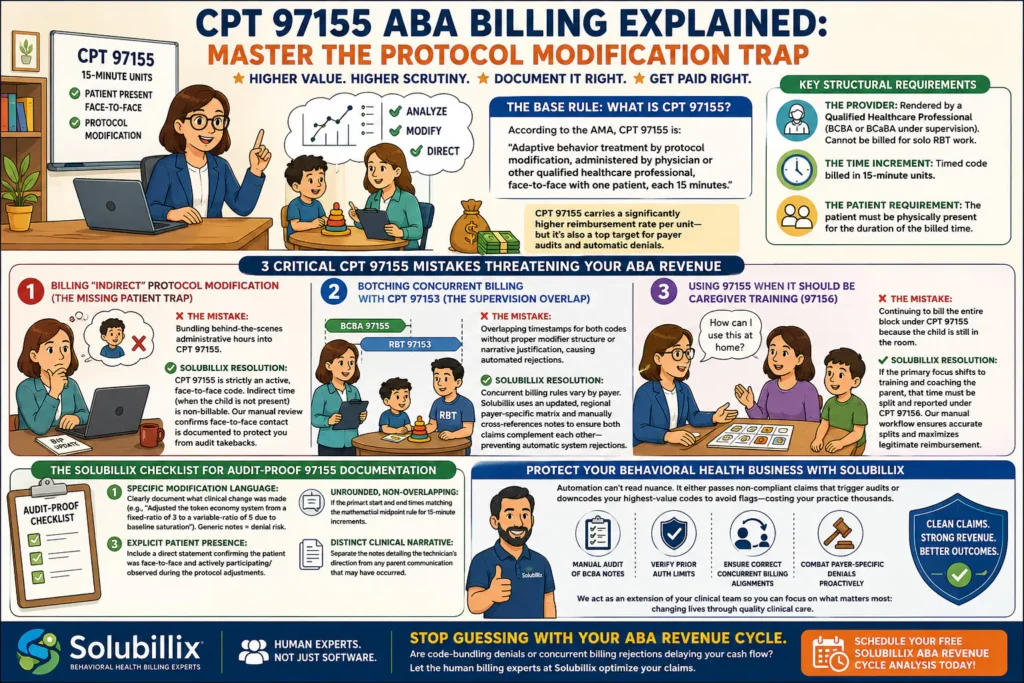
In Applied Behavior Analysis (ABA) therapy, if CPT 97153 is the code that drives everyday treatment volume, then CPT 97155 is the code that drives clinical direction. Representing the specialized work performed by a Board Certified Behavior Analyst (BCBA) to analyze data, modify protocols, and direct technicians, CPT 97155 carries a significantly higher reimbursement rate per unit.
However, because it is a higher-value code involving overlapping clinical scenarios, it is also a massive magnet for insurance payer audits and automatic denials.
Many behavioral health practices trust generic billing software or basic clearinghouses to manage these claims. Unfortunately, standard automation cannot read the nuances of a clinical note to determine if a patient was present, or if concurrent technician time was documented correctly. The result is thousands of dollars in lost revenue from code-bundling errors and unexpected insurance clawbacks.
At Solubillix, we take a hands-on approach. Our New York-based behavioral health billing specialists utilize meticulous, manual claim audits instead of rigid software algorithms. We examine the exact structure of your BCBA logs to ensure your protocol modifications meet strict payer criteria before submission.
Below is our expert guide to understanding CPT 97155, avoiding common billing traps, and keeping your revenue cycle secure.
The Base Rule: What Exactly is CPT 97155?
According to the American Medical Association (AMA) guidelines, CPT 97155 is defined as:
Adaptive behavior treatment by protocol modification, administered by physician or other qualified healthcare professional, face-to-face with one patient, each 15 minutes.
Key Structural Requirements:
- The Provider: This code must be rendered by a Qualified Healthcare Professional (QHP), typically a BCBA or a highly trained BCaBA under strict supervision. It cannot be billed for solo RBT work.
- The Time Increment: It is a timed code billed in 15-minute units.
- The Patient Requirement: The patient must be physically present for the duration of the billed time, even if the BCBA is primarily observing or adjusting materials.
3 Critical CPT 97155 Mistakes Threatening Your ABA Revenue
1. Billing “Indirect” Protocol Modification (The Missing Patient Trap)
BCBAs spend hours outside of direct sessions analyzing graphs, updating behavior intervention plans (BIPs), and crafting data sheets.
- The Mistake: Bundling these behind-the-scenes administrative hours into CPT 97155.
- The Solubillix Resolution: CPT 97155 is strictly an active, face-to-face code. If the BCBA modifies a treatment plan at their desk without the child present, that time is considered indirect and is fundamentally non-billable under commercial insurance models. Our manual review team checks your BCBA session logs to confirm that face-to-face contact is explicitly documented, protecting your practice from devastating post-payment audit takebacks.
2. Botching Concurrent Billing with CPT 97153 (The Supervision Overlap)
A frequent clinical scenario involves a BCBA stepping into a live session to observe an RBT (who is billing 97153) and modify the child’s protocol in real-time.
- The Mistake: Submitting overlapping timestamps for both codes without proper modifier structuring or narrative justification, causing automated clearinghouses to reject the claim as a duplicate.
- The Solubillix Resolution: Depending on the specific insurance payer (e.g., commercial vs. state Medicaid), concurrent billing rules vary wildly. Some require specific modifiers, while others limit how many hours can overlap per week. Solubillix maintains an updated, regional payer-specific matrix. We manually cross-reference the RBT’s notes with the BCBA’s protocol modification notes to ensure both claims complement each other perfectly, preventing automatic system rejections.
3. Using 97155 When It Should Be Caregiver Training (97156)
During a live session, a parent may step into the room to ask the BCBA questions, leading the BCBA to shift their focus toward instructing the caregiver on how to implement a protocol at home.
- The Mistake: Continuing to bill the entire block under CPT 97155 because the child is still technically in the room.
- The Solubillix Resolution: If the primary clinical objective shifts from modifying the protocol with the patient to actively training and coaching the parent, that specific time block must be split and reported under CPT 97156 (Family Adaptive Behavior Treatment Guidance). Our specialized manual workflow reviews the clinical narrative of the shift, splitting the time increments accurately to guarantee compliance and maximize legitimate reimbursement streams.
The Solubillix Checklist for Audit-Proof 97155 Documentation
To withstand insurance audits and secure clean payouts, ensure your BCBAs include these core components in every single 97155 note:
- Specific Modification Language: Clearly document what clinical change was made (e.g., “Adjusted the token economy system from a fixed-ratio of 3 to a variable-ratio of 5 due to baseline saturation”). Generic phrases like “observed session and supervised RBT” will lead to a denial.
- Unrounded, Non-Overlapping Timestamps: Record exact start and end times matching the mathematical midpoint rule for 15-minute increments.
- Explicit Patient Presence: Include a direct statement confirming the patient was face-to-face and actively participating/observed during the protocol adjustments.
- Distinct Clinical Narrative: Separate the notes detailing the technician’s direction from any parent communication that may have occurred.
Protect Your Behavioral Health Business with Solubillix
Because ABA clinics handle thousands of 15-minute increments monthly, automated billing programs regularly drop the ball on complex multi-provider overlaps. They either pass through non-compliant claims that trigger future audits, or they automatically downcode your highest-value codes to avoid flags—costing your practice thousands of dollars in legitimate revenue.
At Solubillix, we act as an extension of your clinical team. We don’t rely on AI or impersonal automation to manage your specialized behavioral health revenue cycle. Our experienced billing experts manually audit your BCBA notes, verify prior authorization limits, ensure correct concurrent billing alignments, and combat payer-specific denials proactively. Let us handle the administrative stress of the billing cycle so you can focus on what matters most: changing lives through quality clinical care.
Stop Guessing with Your ABA Revenue Cycle
Are code-bundling denials or concurrent billing rejections delaying your cash flow? Let the human billing experts at Solubillix optimize your claims. [Schedule Your Free Solubillix ABA Revenue Cycle Analysis Today]