
In the realm of Applied Behavior Analysis (ABA) therapy, CPT 97153 is the indisputable workhorse of the revenue cycle. Representing face-to-face, one-on-one adaptive behavior treatment delivered by a Registered Behavior Technician (RBT) or line therapist under the direction of a BCBA, this code accounts for the vast majority of an ABA practice’s monthly cash flow.
Yet, because of its high frequency, it is also the most frequently denied and audited code in behavioral health billing.
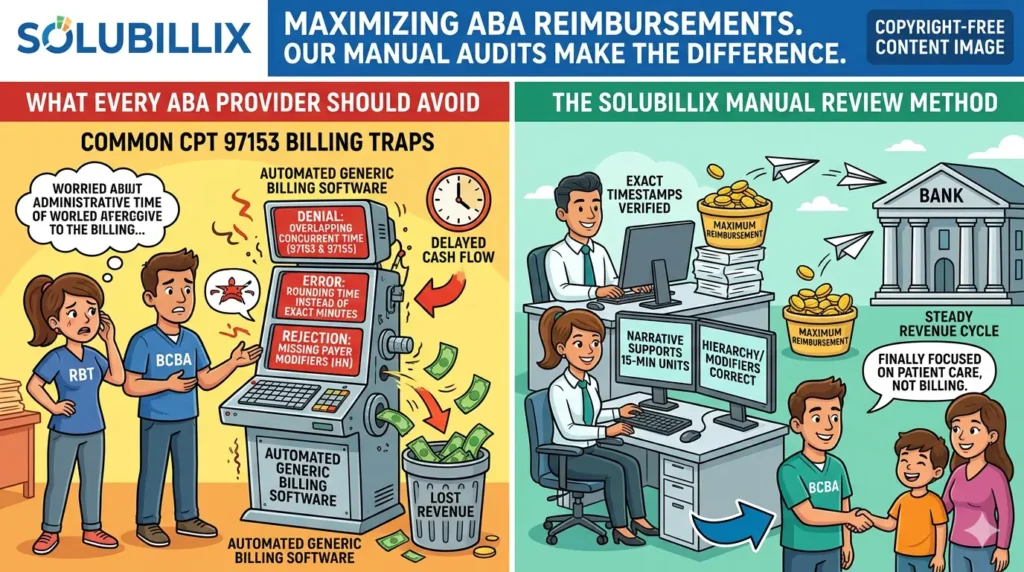
Many ABA practice managers erroneously assume that broad, generalized billing software or EHR clearingshouses will safely scrub these codes. However, standard automated filters lack the contextual intelligence required to audit complex clinical narratives, timestamp constraints, and cascading local payer rules. The result? Millions of dollars lost annually to insurance rejections, downstream downcoding, and catastrophic post-payment recoupment notices.
At Solubillix, we reject the hands-off, automated approach. Our dedicated team of behavioral health billing specialists performs exhaustive, manual claim reviews. By verifying that your documentation completely supports every 15-minute unit, we eliminate administrative bottlenecks before your claims are ever submitted.
Below is an analytical breakdown of the top CPT 97153 billing errors our team catches and how our manual intervention safeguards your ABA practice’s bottom line.
The Mechanics of the Code: CPT 97153 at a Glance
To successfully manage your revenue cycle, your administrative team must rigidly adhere to the precise structural definitions set by the American Medical Association (AMA) and state Medicaid/commercial payers:
- Service Definition: Adaptive behavior treatment by protocol.
- Format Constraints: Strictly one-on-one, face-to-face direct clinical delivery.
- Time Increments: Timed code billed in 15-minute units.
- The 8-Minute Rule Threshold: ABA codes follow the standard medical midpoint convention. To bill a specific number of units, the actual rendered face-to-face time must cross into the corresponding mathematical midpoint bracket.
Unit Calculation Reference:
• 1 Unit: 8 mins to 22 mins
• 2 Units: 23 mins to 37 mins
• 3 Units: 38 mins to 52 mins
• 4 Units: 53 mins to 67 mins
4 Costly CPT 97153 Mistakes Threatening Your Practice’s Capital
1. Overlapping Concurrent Time Blocks (The “Double-Billing” Trap)
Concurrent time billing occurs when two separate time-based ABA codes are mistakenly generated for the exact same patient during an identical time block.
- The Mistake: An RBT is delivering direct therapy under CPT 97153 while a supervising BCBA is conducting a protocol modification or direct supervision session under CPT 97155. If the billing platform submits the full hours for both codes overlapping exactly without specifying distinct clinical actions, the claim is rejected as a duplicate encounter.
- The Solubillix Resolution: Our manual auditors meticulously review the timestamp data on the RBT’s session logs alongside the BCBA’s supervisory notes. We ensure that concurrent billing is structured flawlessly to prove that distinct, non-overlapping services were rendered, preventing automated denials.
2. Scope-of-Service Bloat (Billing Non-Rendered and Non-ABA Time)
Insurance companies run strict data analytics to cross-examine the actual narrative of the text against the total minutes billed.
- The Mistake: Including non-billable administrative and non-direct tasks within the CPT 97153-time block. This includes rounding up scheduled hours instead of actual rendered face-to-face time, billing for travel time, materials setup, note-writing time, or parental conversations. Additionally, adding details about generic Activities of Daily Living (ADLs) or classroom dynamics outside of targeted ABA goals is an automatic red flag.
- The Solubillix Resolution: We clean your claims data at the root. Our specialists evaluate the specific behavioral descriptions in the session records, removing unallowable operational time blocks so your claims remain purely compliant and audit-proof.
3. Confusing 97153 with Caregiver Training (CPT 97156) or Group Treatment (CPT 97154)
A common pitfall occurs when an RBT or provider shifts the clinical delivery format mid-session without updating the corresponding code item.
- The Mistake: Using CPT 97153 to report a session where a parent or guardian was heavily educated on treatment plan protocols, or when a second peer joined the environment.
- The Solubillix Resolution: If a peer enters the session, it must immediately transition to CPT 97154 (Group Adaptive Behavior Treatment). If the focus shifts exclusively to educating parents, it belongs under CPT 97156 (Caregiver Training). Our specialized manual workflow reviews clinical documentation to guarantee that changes in setting or formatting match their precise clinical codes.
4. Failing Payor-Specific Modifier Matrices
Modifier guidelines are incredibly localized and vary dramatically from one commercial payer to another, as well as between different state Medicaid programs.
- The Mistake: Submitting CPT 97153 without required informational modifiers, such as Modifier HN (identifying service delivery by a non-physician behavior technician or RBT), causing immediate electronic rejections.
- The Solubillix Resolution: We actively manage a localized payer-by-payer modifier matrix. Our manual billing verification checks each line item against the exact insurance policy rules tied to your specific region, removing the guesswork out of compliance.
The Solubillix Compliance Checklist for ABA Notes
To guarantee maximum reimbursement, our clinical audit experts recommend ensuring that every single RBT session note contains these non-negotiable details:
- [ ] Unrounded Timestamps: Exact, real-world start and end times (e.g., 09:02 AM to 11:14 AM).
- [ ] Measurable Data: Clear records tracking target behaviors, trial successes, and prompts used, rather than subjective summaries like “the client had a great day”.
- [ ] Objective Focus: Verification of at least 4 individual behavioral goals addressed per clinical hour.
- [ ] Clear Credentials: The exact printed name, credentials, and digital signature of the rendering technician.
Protect Your ABA Practice Revenue with Solubillix
Relying on rigid billing software algorithms to manage your high-volume CPT 97153 codes leaves your practice highly vulnerable to insurance clawbacks and systemic denials. Behavioral health claims require human insight to confirm that the clinical reality of your therapy matches the strict financial language of the claim form.
At Solubillix, we provide high-knowledge, human-driven revenue cycle management. We manually track your prior authorizations, manage utilization thresholds, check modifier accuracy, and eliminate code overlaps. Let us eliminate the operational complexity of behavioral health billing so your clinical team can focus entirely on helping individuals develop life-changing skills.
Secure Your ABA Practice’s Financial Health
Don’t allow automated software glitches to delay your hard-earned reimbursements. Let the human experts at Solubillix optimize your revenue cycle.