
Occupational & Speech Therapy Medical Billing Specialists
Cognitive-communication therapy can create billing challenges for speech-language pathologists because the patient’s treatment may involve both communication and cognitive functions.
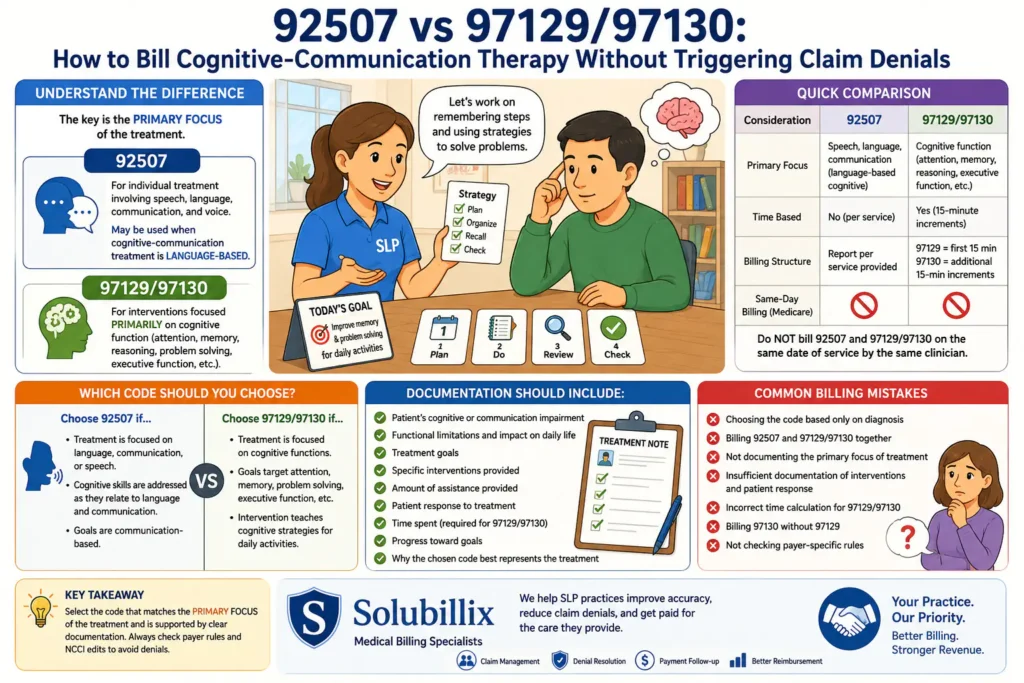
One of the most important coding questions is whether the service is appropriately reported using CPT 92507 or CPT 97129/97130.
The answer depends largely on the primary focus of the treatment, the goals being addressed, the clinical documentation, and the requirements of the patient’s payer.
At Solubillix, we understand that accurate SLP billing requires more than selecting a CPT code. The clinical service, documentation, diagnosis, payer policy, units, and claim submission all need to work together.
This guide explains the key differences between 92507 and 97129/97130 and how SLP practices can reduce common billing problems.
What Is the Difference Between 92507 and 97129/97130?
The simplest way to understand the distinction is to look at the primary purpose of the treatment.
92507
CPT 92507 is used for individual treatment involving areas such as:
- Speech
- Language
- Voice
- Communication
- Auditory processing
According to ASHA, 92507 may also be appropriate when cognitive-communication treatment is language-based.
97129 and 97130
CPT 97129 and 97130 are used for therapeutic interventions focused primarily on cognitive function, including areas such as:
- Attention
- Memory
- Reasoning
- Executive function
- Problem solving
- Pragmatic functioning
- Compensatory strategies used to manage functional activities
97129 represents the initial 15 minutes, while 97130 is an add-on code for additional 15-minute increments. ASHA notes that 97129 is reported only once per day and 97130 is reported with 97129 when additional qualifying time is provided.
The Practical Difference
A useful question for the billing team is:
Is the primary treatment focus language/communication, or is it primarily cognitive function?
If the cognitive-communication treatment is fundamentally language-based, 92507 may be appropriate.
If the treatment is primarily directed toward cognitive functions such as memory, attention, reasoning, or executive function, 97129/97130 may be more appropriate, subject to payer requirements.
92507 vs 97129/97130: Quick Comparison
| Billing Consideration | 92507 | 97129/97130 |
| Primary focus | Speech, language, communication and related treatment | Cognitive function |
| Cognitive-communication | May apply when treatment is language-based | Applies when primarily cognitive |
| Billing structure | Individual treatment code | 97129 initial + 97130 additional time |
| Time-based? | Current 92507 is not structured as a 15-minute timed code | Yes |
| Documentation | Must support the communication/language treatment | Must support cognitive intervention |
| Medicare same-day billing | Cannot generally be billed with 97129/97130 by the same clinician | Cannot generally be billed with 92507 by the same clinician |
The Medicare same-day restriction is particularly important. CMS’s 2026 NCCI policy states that a single practitioner should not report 92507 and 97129/97130 on the same date of service.
When Is 92507 Appropriate for Cognitive-Communication Treatment?
Cognitive-communication problems can affect language and communication in complex ways.
For example, an SLP may work with a patient on:
- Organizing verbal information
- Understanding and expressing language
- Functional communication
- Word retrieval
- Discourse
- Communication strategies
- Language-based problem solving
When the treatment is primarily addressing language-based cognitive-communication deficits, 92507 may be appropriate depending on the payer’s rules.
ASHA specifically notes that 92507 can be used when cognitive-communication treatment is language-based.
The documentation should make that clinical focus clear.
When Are 97129 and 97130 More Appropriate?
When treatment primarily addresses cognitive function, 97129/97130 may be appropriate.
Examples can include interventions targeting:
- Attention
- Memory
- Reasoning
- Executive functioning
- Organization
- Sequencing
- Problem solving
- Compensatory cognitive strategies
CMS describes 97129/97130 as cognitive-function interventions requiring direct, one-on-one contact and indicates that documentation should support the cognitive impairment, functional abilities, interventions performed, assistance provided, and patient response.
The important point is that the actual treatment provided should match the code selected.
A Common Billing Mistake: Choosing the Code From the Diagnosis
A diagnosis by itself should not determine whether the SLP bills 92507 or 97129/97130.
For example, a patient may have a diagnosis associated with a neurological condition and receive cognitive-communication therapy.
That does not automatically mean the SLP should use 97129/97130.
The billing team should look at:
Diagnosis → treatment goals → intervention provided → primary treatment focus → documentation → payer requirements
The clinical service—not simply the diagnosis—should drive the coding decision.
Another Common Mistake: Billing 92507 and 97129/97130 Together
For Medicare Part B, this is a particularly important issue.
A single SLP should not report 92507 and 97129/97130 on the same date of service for the same patient under the applicable NCCI edit. CMS’s 2026 NCCI Policy Manual specifically identifies this code-pair restriction.
ASHA similarly explains that Medicare Part B does not allow the same clinician to report 92507 and 97129/97130 on the same day.
This means the billing team should not simply add both codes to a claim because the session involved both communication and cognitive activities.
Instead, determine the appropriate reporting based on the services actually performed and the applicable payer rules.
What About 97129 and 97130 Units?
Unlike the current 92507 structure, 97129 and 97130 are time-based codes.
Under Medicare’s methodology:
- 97129 is the initial 15-minute code.
- 97130 is reported for additional 15-minute increments.
- 97129 is reported only once per day.
- 97130 is an add-on code and should not be reported by itself.
ASHA explains that Medicare’s 8-minute methodology applies to these timed cognitive-treatment codes. For example, 8–22 minutes can support one unit of 97129, while 23–37 minutes can support 97129 plus one unit of 97130.
This makes accurate time documentation especially important when reporting 97129/97130.
Documentation That Supports Cognitive-Communication Billing
Strong documentation is one of the best defenses against avoidable billing problems.
The clinical record should clearly explain:
- The patient’s cognitive or communication impairment
- Functional limitations
- Skilled need for SLP intervention
- Treatment goals
- Specific interventions performed
- Amount of assistance provided
- Patient response
- Progress toward goals
- Treatment time when required
- Why the selected service accurately represents the treatment provided
CMS specifically identifies documentation elements for 97129/97130, including objective assessment of cognitive impairment and functional abilities, prognosis, compensatory strategies, specific cognitive activities, assistance provided, and patient response.
A strong note should allow a reviewer to understand why the treatment was necessary and why the selected code accurately describes the service.
Example: Language-Based Cognitive-Communication Treatment
Suppose an SLP is treating a patient who has difficulty organizing verbal information and expressing thoughts effectively.
The treatment focuses on:
- Language organization
- Verbal expression
- Functional communication
- Word retrieval
- Communication strategies
The primary focus is language-based cognitive-communication treatment.
Depending on the patient’s coverage and payer rules, 92507 may be appropriate.
The documentation should clearly describe the language and communication components being treated.
Example: Primarily Cognitive Treatment
Now consider a patient whose treatment primarily focuses on:
- Sustained attention
- Memory strategies
- Executive functioning
- Sequencing
- Problem solving
- Compensatory strategies for completing daily activities
Here, the treatment is primarily directed toward cognitive function.
Subject to payer requirements, 97129/97130 may be appropriate.
The documentation should support the cognitive impairment, functional impact, interventions performed, and treatment time.
How to Reduce 92507 and 97129/97130 Claim Denials
Before submitting the claim, Solubillix recommends reviewing several key questions:
1. What was the primary treatment focus?
Was it primarily speech/language/communication or cognitive function?
2. Does the documentation support the selected code?
The note should explain what was actually treated.
3. Is the diagnosis consistent with the medical necessity of the service?
CMS notes that cognitive-treatment claims should include diagnoses reflecting the underlying condition and/or manifestations requiring treatment.
4. Are the units supported?
For 97129/97130, verify the actual qualifying treatment time.
5. Is there an NCCI edit?
Check applicable code-pair edits before submitting multiple services on the same date.
6. Does the payer have additional requirements?
Commercial insurance, Medicare Advantage, Medicaid, and other payers may have their own policies.
92507 and 97129/97130: A Practical Billing Checklist
Before submitting a cognitive-communication claim, verify:
- Primary treatment focus identified
- Correct CPT code selected
- Diagnosis supports medical necessity
- Treatment goals support the service
- Documentation supports the treatment provided
- Direct treatment time documented when applicable
- 97129 is billed as the initial unit when applicable
- 97130 is not billed as a stand-alone code
- 92507 and 97129/97130 are not improperly reported together
- Current payer requirements have been checked
- Claim information matches the clinical record
Important 2027 CPT Update for SLP Practices
There is another reason SLP practices should pay attention to this topic.
CPT 92507 remains in effect through December 31, 2026. Beginning January 1, 2027, ASHA reports that 92507 will be replaced by a new family of 10 SLP treatment codes. The new structure will provide more specific reporting by clinical service and direct treatment time.
This means SLP practices should prepare for changes in:
- CPT code selection
- Time-based reporting
- Charge capture
- Documentation
- Billing systems
- Payer implementation
- Staff education
Solubillix can help practices review their billing workflows as these changes approach.
How Solubillix Helps SLP Practices
Speech-language pathology billing requires a careful connection between clinical services, CPT coding, documentation, payer rules, claims, and reimbursement.
At Solubillix, we help SLP practices manage the revenue-cycle process, including:
- SLP claim submission
- Coding review
- Eligibility and benefits verification
- Authorization support
- Denial management
- Corrected claims
- Insurance follow-up
- Payment posting
- Accounts receivable management
- Payer follow-up
Our objective is straightforward:
Help SLP practices reduce avoidable billing problems and improve the reliability of their reimbursement process.
Need Help With SLP Billing?
If your practice is experiencing recurring claim denials, coding questions, delayed payments, or growing accounts receivable, Solubillix can help review your billing process and identify opportunities for improvement.
Contact Solubillix to discuss your speech-language pathology billing needs.
Frequently Asked Questions
Is 92507 the same as 97129?
No. They describe different types of treatment. 92507 is used for individual speech, language, voice, communication, and related treatment, while 97129/97130 are used for interventions focused primarily on cognitive function. ASHA notes that 92507 may be appropriate for language-based cognitive-communication treatment.
Can an SLP bill 92507 and 97129 on the same day?
For Medicare Part B, the same clinician generally cannot report 92507 and 97129/97130 on the same date of service. CMS’s 2026 NCCI Policy Manual identifies the code-pair restriction.
Is 97130 billed without 97129?
No. 97130 is an add-on code and is reported in conjunction with 97129 when appropriate.
Is 97129 a timed code?
Yes. 97129 represents the initial 15 minutes of cognitive-function intervention, with 97130 used for additional 15-minute increments.
Can 92507 be used for cognitive-communication therapy?
Yes, when the treatment is language-based cognitive-communication treatment, according to ASHA. When the treatment is primarily cognitive, 97129/97130 may be appropriate, subject to payer requirements.
Is 92507 changing in 2027?
Yes. ASHA reports that 92507 will remain in effect through December 31, 2026, with a new family of SLP treatment codes taking effect January 1, 2027. Practices should verify payer implementation requirements as the transition approaches.
Final Takeaway
The question isn’t simply:
“Should I bill 92507 or 97129?”
The better question is:
“What was the primary treatment focus, what service was actually provided, and does the documentation support the code?”
For language-based cognitive-communication treatment, 92507 may be appropriate. For treatment primarily focused on cognitive function, 97129/97130 may be appropriate, subject to the payer’s rules.
For Medicare, providers must also pay close attention to NCCI edits and the prohibition on reporting 92507 and 97129/97130 together by the same practitioner on the same date of service.
At Solubillix, we understand the details behind SLP billing and revenue-cycle management. Our goal is to help providers submit cleaner claims, address billing problems efficiently, and protect the reimbursement they have earned.
Solubillix — Medical Billing & Revenue Cycle Support for Healthcare Providers.