
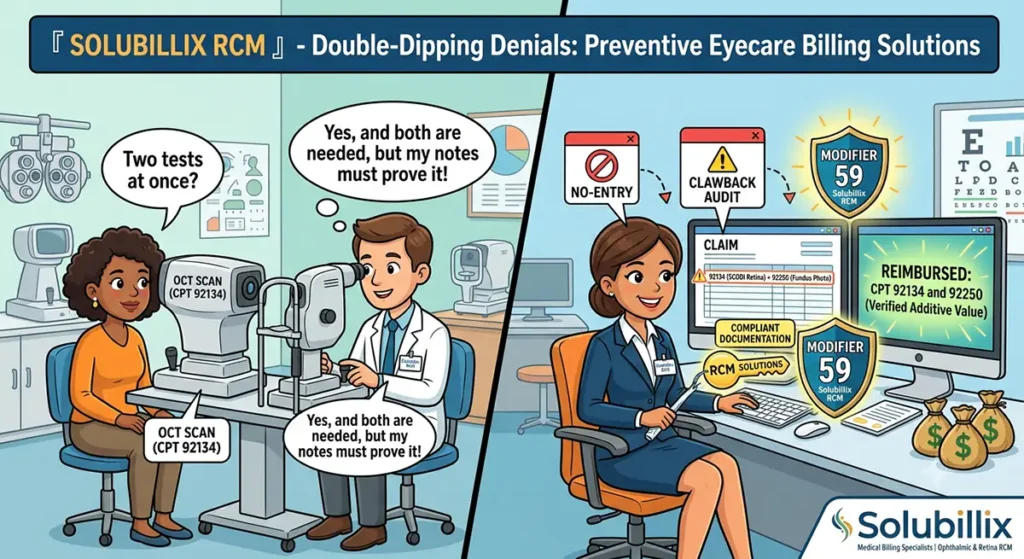
In high-volume retina practices and comprehensive ophthalmology centers, diagnostic imaging is the engine that drives clinical decision-making. Technologies like Optical Coherence Tomography (OCT) and advanced fundus photography have transformed how eyecare professionals track pathologies like age-related macular degeneration (AMD), diabetic retinopathy, and retinal vein occlusions.
However, because these two distinct imaging tests are often executed during the exact same patient visit, they represent one of the most volatile billing combinations in the entire eyecare industry.
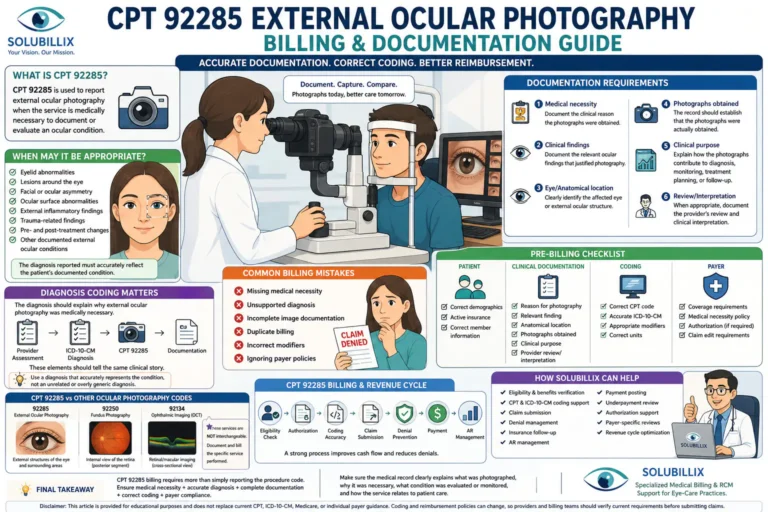
Every week, clinics nationwide encounter immediate line-item rejections or trigger post-payment audits because they concurrently bill CPT 92134 (Scanning Computerized Ophthalmic Diagnostic Imaging [SCODI], posterior segment; retina) and CPT 92250 (Fundus photography with interpretation and report).
Insurance payers routinely view this pairing as “double-dipping” or billing for duplicative services. For your practice to secure maximum reimbursement without exposing itself to aggressive clawback audits, your revenue cycle management (RCM) team must understand the strict mechanics governing these codes.
The Root of the Problem: The NCCI Bundling History
The operational friction between OCT and fundus photography is strictly enforced by Medicare’s National Correct Coding Initiative (NCCI) edits.
The Centers for Medicare & Medicaid Services (CMS) developed these edits explicitly to stop providers from billing separate codes for overlapping diagnostic data.
- The 2000 Baseline: The NCCI originally bundled the early legacy SCODI code (92135) with fundus photography (92250).
- The 2011 Overhaul: When the AMA introduced the modern, highly specific retinal imaging standard CPT 92134, the NCCI instantly clamped down, establishing a permanent structural bundle with CPT 92250.
Under standard claim-processing rules, if a biller submits both codes on a single claim form for the same date of service, the automated system will instantly pay the column 1 code and issue a hard denial for the column 2 code. Frequently, the payer simply reimburses whichever line has the lower allowable fee structure, causing the practice to instantly lose its higher-value imaging revenue.
The Modifier 59 Mirage: Why It Triggers Audits
The NCCI edit table assigns a modifier indicator of “1” to the 92134/92250 code pair. Technically, an indicator of “1” signals to the clearinghouse that the bundle can be bypassed, or “unbundled,” by appending an appropriate modifier—most commonly Modifier 59 (Distinct Procedural Service).
This has created a dangerous, systemic habit among internal billing departments: appending Modifier 59 to every 92250 claim whenever an OCT is performed on the same day just to force the claim through.
This is the exact behavior that triggers immediate payer audits.
According to official CMS guidelines, Modifier 59 requires that the two diagnostic tests be completely independent, non-overlapping, or performed during entirely separate patient encounters. Crucially, the NCCI Policy Manual explicitly states:
“Treatment of posterior segment structures in the eye constitutes treatment of a single anatomic site.”
Because the retina, macula, and optic nerve all belong to that single posterior pole structure, a different diagnosis code is not sufficient justification to break the NCCI edit. If a chart review reveals that both tests were completed during the same sitting to evaluate the same underlying posterior condition, the use of Modifier 59 is considered non-compliant. The insurance company can retrospectively demand full repayment for those claims.
The Compliant Exceptions: When Can You Bill Both?
Can you ever legally bill 92134 and 92250 on the same date? Yes, but only under highly specific, clearly documented clinical circumstances where the tests are additive rather than duplicative.
┌────────────────────────────────────────────────────────┐
│ ARE BOTH 92134 & 92250 REIMBURSABLE ON THE SAME DAY? │
└───────────────────────────┬────────────────────────────┘
│
Is there written payer policy allowing it?
│
┌───────────────────┴───────────────────┐
▼ YES ▼ NO
┌───────────────────────────┐ ┌───────────────────────────┐
│ Check for Additive Value │ │ BILL HIGHER-VALUE CODE │
└─────────────┬─────────────┘ │ (Usually 92134) │
│ └───────────────────────────┘
Does the Fundus Photo find distinct,
visible info that the OCT cannot map?
│
┌──────────────┴──────────────┐
▼ YES ▼ NO
┌─────────────────────────────┐┌─────────────────────────────┐
│ BILL BOTH + MODIFIER 59 ││ BILL HIGHER-VALUE CODE │
│ (Airtight unique orders & ││ (Do not unbundle) │
│ distinct interpretations) │└─────────────────────────────┘
└─────────────────────────────┘
To withstand an audit, your medical records must satisfy these three rigorous benchmarks:
1. Unique, Written Medical Orders
The physician must document a separate, distinct order for each test before they are taken. A generic note stating “Perform imaging” will fail an audit. The records must state exactly why both paths are required (e.g., “Order OCT 92134 to track cross-sectional macular edema thickness; order fundus photography 92250 to visually track the baseline geographic margins of a new preretinal hemorrhage”).
2. Additive, Non-Duplicative Visual Data
Reimbursement depends entirely on finding different information.
- The OCT (92134) provides structural, cross-sectional, micron-level measurements of retinal layers and fluid accumulation.
- The Fundus Photo (92250) must be used to track widefield surface pathology, such as vascular shifts, pigmentary changes, or expanding lesions that cross-sectional scans cannot contextually display.
If your OCT device automatically captures a baseline fundus surface image as part of its cross-sectional rendering, you cannot bill 92250 separately. The photo must add clinical value beyond what the scanning laser already produced.
3. Isolated Interpretation & Reports
The physician must write two separate interpretation and report narratives in the patient chart. Blending the findings into a single sentence like “OCT and fundus photos show stable wet AMD” constitutes an incomplete report for 92250, ensuring an automatic denial upon manual review.
Safeguard Your Eyecare Revenue with Solubillix
Ophthalmic compliance shifts rapidly, and generalist billing networks simply do not possess the granular expertise needed to manage NCCI frequency edits and diagnostic unbundling thresholds. Allowing unmonitored modifiers to slip through your clearinghouses places an enormous financial target on your practice’s back.
At Solubillix, based right here in New York, we deploy dedicated ophthalmology and retina revenue cycle management experts. We install custom, rigid front-end scrubbing rules tailored to specific commercial and Medicare Local Coverage Determinations (LCDs). We review documentation accuracy before claims are batched, ensuring that modifiers are only utilized when legally compliant, and preventing costly retrospective payer clawbacks. We secure your clinical revenue so you can focus entirely on preserving your patients’ vision.
Stop risking your practice’s imaging revenue on automated modifier traps. Contact Solubillix today for a rigorous, complimentary audit of your recent diagnostic imaging claims.