
How Accurate Colonoscopy Coding Helps Gastroenterology Practices Reduce Denials, Protect Revenue, and Improve Compliance
Published by Solubillix | Medical Billing & Revenue Cycle Management Experts
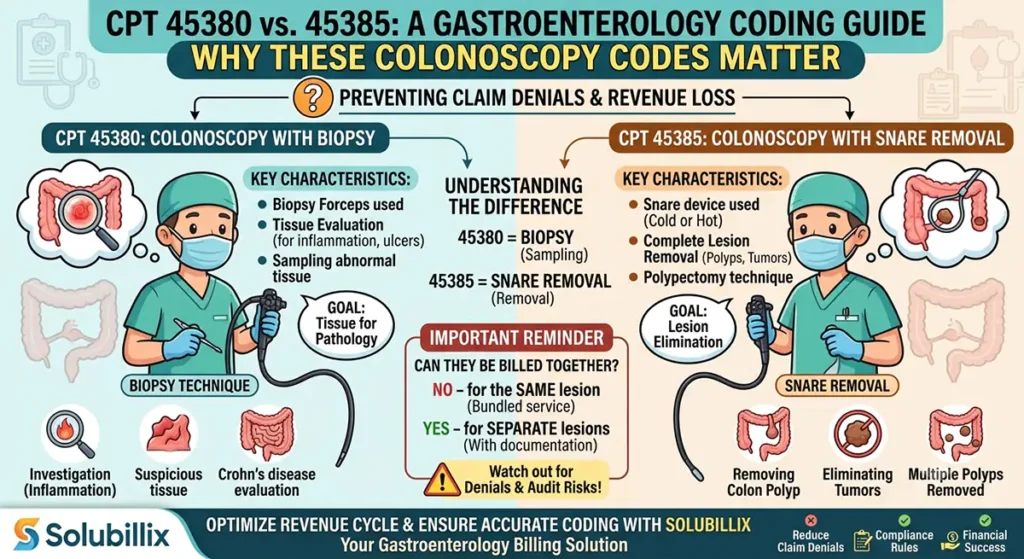
Gastroenterology practices depend heavily on accurate procedure coding to ensure proper reimbursement and maintain a healthy revenue cycle. Among the most frequently billed colonoscopy procedures, CPT 45380 and CPT 45385 are two codes that create significant confusion for providers, coders, and billing teams.
Although both codes involve removing or evaluating tissue during a colonoscopy, they represent completely different services.
- CPT 45380 is used when a physician performs a colonoscopy with biopsy.
- CPT 45385 is used when a physician removes a polyp, tumor, or lesion using a snare technique.
The difference may seem simple, but incorrect reporting can lead to:
- Insurance claim denials
- Incorrect reimbursement
- Compliance risks
- Audit exposure
- Revenue leakage
For GI practices performing hundreds or thousands of colonoscopies annually, even small coding mistakes can create substantial financial losses.
At Solubillix, we help healthcare providers improve reimbursement accuracy, reduce claim denials, and optimize their revenue cycle through specialized medical billing solutions.
Understanding CPT 45380: Colonoscopy With Biopsy
What Does CPT 45380 Represent?
CPT 45380 describes:
Colonoscopy, flexible; with biopsy, single or multiple.
This code is reported when the physician uses biopsy techniques to obtain tissue samples from the colon or rectum during a colonoscopy.
The purpose of a biopsy is generally to evaluate abnormal tissue rather than remove a complete lesion.
A biopsy may be performed to investigate:
- Inflammation
- Abnormal mucosal appearance
- Suspicious tissue
- Ulcers
- Possible cancerous changes
- Microscopic colitis
- Crohn’s disease
- Other gastrointestinal conditions
Common Clinical Examples for CPT 45380
Example 1: Colon Inflammation Evaluation
A patient undergoes colonoscopy due to chronic abdominal symptoms. During the procedure, the physician identifies inflamed mucosa and obtains tissue samples for pathology.
Correct CPT code:
45380 – Colonoscopy with biopsy
Example 2: Random Colon Biopsies
A patient presents with persistent diarrhea. The gastroenterologist performs random biopsies throughout the colon to evaluate microscopic colitis.
Correct CPT code:
45380
Example 3: Suspicious Tissue Sampling
A physician identifies abnormal tissue during colonoscopy and collects samples for laboratory analysis.
Correct CPT code:
45380
Understanding CPT 45385: Colonoscopy With Snare Removal
What Does CPT 45385 Represent?
CPT 45385 describes:
Colonoscopy, flexible; with removal of tumor(s), polyp(s), or other lesion(s) by snare technique.
This code applies when the physician removes a lesion using a snare device.
Snare techniques include:
- Cold snare polypectomy
- Hot snare polypectomy
- Snare excision
The primary purpose is complete removal of a lesion rather than only obtaining a tissue sample.
Common Clinical Examples for CPT 45385
Example 1: Removal of Colon Polyp
During colonoscopy, the physician identifies a 6 mm colon polyp and removes it using a cold snare.
Correct CPT code:
45385
Example 2: Multiple Polyps Removed
The physician identifies multiple polyps in different areas of the colon and removes them using snare technique.
Correct CPT code:
45385
CPT 45380 vs. 45385: Key Differences
Understanding the difference between biopsy and removal is essential for accurate coding.
| Category | CPT 45380 | CPT 45385 |
| Procedure Type | Biopsy | Snare removal |
| Main Purpose | Tissue evaluation | Complete lesion removal |
| Common Use | Diagnostic evaluation | Polypectomy |
| Technique | Biopsy forceps | Snare device |
| Example | Taking samples from abnormal tissue | Removing colon polyp |
Can CPT 45380 and CPT 45385 Be Billed Together?
Yes, but only when documentation supports that separate services were performed on separate lesions.
This is one of the most common areas where GI practices experience denials.
Incorrect Billing Scenario
During colonoscopy:
- Physician identifies one polyp.
- Biopsy is taken from that same polyp.
- The same polyp is then removed using a snare.
Reporting:
- CPT 45380
- CPT 45385
may result in a denial because the biopsy is considered part of the removal procedure.
Correct Billing Scenario
During colonoscopy:
- Lesion #1: Abnormal tissue biopsied.
- Lesion #2: Separate polyp removed using snare.
In this situation, reporting both procedures may be appropriate if documentation clearly supports separate services.
Documentation should include:
- Location of each lesion
- Size of lesion
- Procedure performed
- Removal technique
- Medical necessity
Common Colonoscopy Coding Mistakes That Cost GI Practices Money
Mistake #1: Reporting Biopsy and Snare Removal for the Same Lesion
This is one of the most frequent errors.
A biopsy performed before removing the same polyp is generally considered part of the removal procedure.
How to Avoid It:
Review operative notes carefully and confirm whether separate lesions were treated.
Mistake #2: Poor Procedure Documentation
Incomplete documentation creates coding uncertainty.
A colonoscopy report should clearly state:
- Findings
- Lesion locations
- Number of polyps
- Size of polyps
- Removal technique
- Specimen collection details
Weak documentation can lead to:
- Downcoding
- Delays
- Medical necessity issues
- Payer disputes
Mistake #3: Incorrect Modifier Usage
Many GI practices struggle with modifier selection when multiple procedures are performed.
Common modifiers involved include:
Modifier 59
Modifier 59 indicates that a procedure represents a distinct procedural service.
It may be needed when:
- Separate lesions are treated
- Procedures are performed independently
- NCCI edits require additional clarification
Modifier XS
Modifier XS identifies a separate structure or organ.
Some payers prefer XS instead of Modifier 59 when reporting procedures involving different sites.
Always verify payer-specific requirements.
Screening Colonoscopy vs Diagnostic Colonoscopy: Another Major Billing Challenge
A common situation occurs when a patient schedules a preventive screening colonoscopy, but during the procedure the physician discovers and removes polyps.
This changes the billing scenario.
For Medicare patients:
- Modifier PT may be required when a screening colonoscopy becomes therapeutic.
For commercial payers:
- Modifier 33 may apply depending on payer policies.
Incorrect handling can cause:
- Patient balance issues
- Incorrect claim processing
- Increased complaints
GI billing teams must understand the difference between:
- Screening procedure
- Diagnostic procedure
- Therapeutic procedure
Documentation Checklist for CPT 45380 and 45385
Before submitting a colonoscopy claim, verify:
Procedure Documentation
✔ Colonoscopy performed
✔ Scope advancement documented
✔ Findings recorded
✔ Lesion location documented
✔ Removal method documented
For Biopsy (45380)
✔ Tissue sampled
✔ Biopsy technique documented
✔ Specimen submitted for pathology
For Snare Removal (45385)
✔ Polyp or lesion identified
✔ Snare technique documented
✔ Removal completed
How GI Practices Can Reduce Colonoscopy Claim Denials
1. Perform Coding Audits Regularly
Routine audits help identify:
- Incorrect CPT selection
- Modifier errors
- Documentation gaps
- Repeated denial patterns
2. Train Providers on Documentation Requirements
Providers should understand that documentation directly impacts reimbursement.
A complete procedure note supports:
- Correct coding
- Faster claim payment
- Reduced payer questions
3. Analyze Denial Trends
Common denial reasons include:
- Incorrect procedure coding
- Missing modifiers
- Lack of medical necessity
- Bundled procedure conflicts
- Documentation inconsistencies
A strong denial management process can recover lost revenue.
Why Gastroenterology Practices Choose Solubillix
Colonoscopy billing requires more than submitting claims. It requires expertise in:
- CPT coding accuracy
- Insurance requirements
- Modifier rules
- Denial prevention
- Revenue cycle optimization
At Solubillix, we provide specialized medical billing and revenue cycle management services designed for healthcare providers.
Our team helps GI practices:
✔ Reduce claim denials
✔ Improve reimbursement accuracy
✔ Identify revenue leakage
✔ Manage insurance follow-up
✔ Improve accounts receivable performance
✔ Maintain billing compliance
We understand the complexity of gastroenterology billing and help providers focus more on patient care while we focus on maximizing revenue.
Frequently Asked Questions (FAQs)
What is the difference between CPT 45380 and 45385?
CPT 45380 is used for colonoscopy with biopsy, while CPT 45385 is used for removal of polyps or lesions using a snare technique.
Can CPT 45380 and 45385 be billed together?
Yes, when separate lesions are treated and documentation supports both procedures. They should not be reported separately for the same lesion.
Is polyp removal coded as 45385?
Yes. When a physician removes a colon polyp using a snare technique, CPT 45385 is typically reported.
Does taking a biopsy from a removed polyp require CPT 45380?
Usually no. A biopsy performed on the same lesion that is removed by snare is generally included in the removal procedure.
Why are colonoscopy claims denied?
Common reasons include incorrect CPT coding, missing modifiers, insufficient documentation, and incorrect screening versus diagnostic coding.
Conclusion: Accurate Colonoscopy Coding Protects GI Practice Revenue
CPT 45380 and CPT 45385 may represent common colonoscopy procedures, but the coding details behind them are complex. A small mistake in selecting codes, applying modifiers, or documenting procedures can create unnecessary denials and revenue loss.
GI practices that prioritize accurate documentation, ongoing coding education, and professional billing support can significantly improve financial performance.
With expert gastroenterology billing support from Solubillix, providers can reduce administrative challenges, improve reimbursement, and build a stronger revenue cycle.
Focus on patient care. Let Solubillix handle your billing success.
About Solubillix
Solubillix is a healthcare revenue cycle management company specializing in medical billing, coding support, denial management, and insurance follow-up services for healthcare providers across the United States. Our mission is to help practices increase revenue, reduce billing stress, and achieve better financial outcomes.