
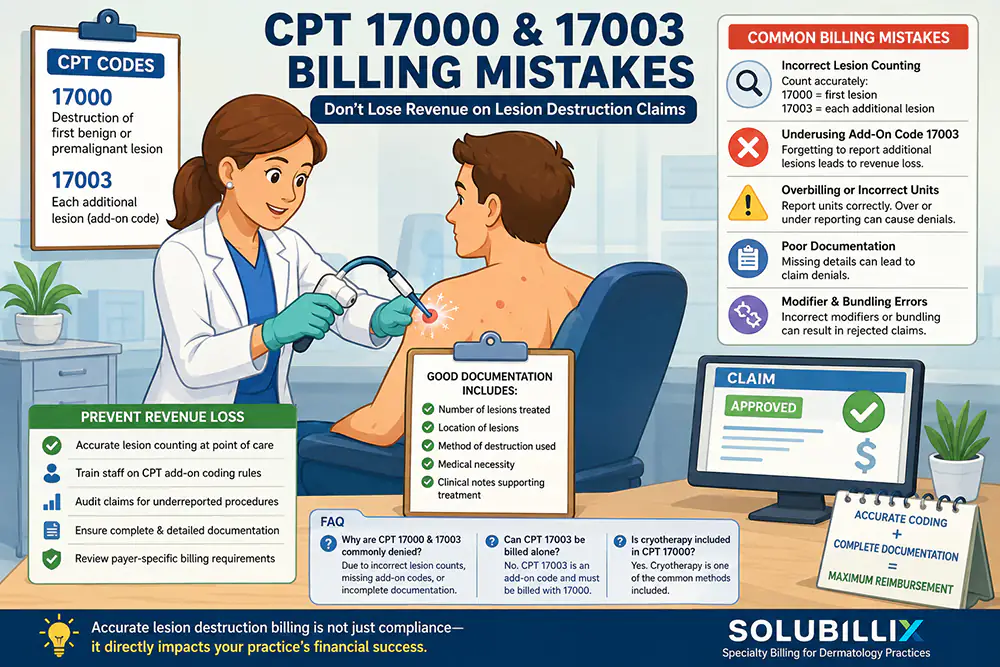
Lesion destruction procedures are among the most frequently performed services in dermatology, yet they are also one of the most commonly misbilled categories. CPT codes 17000 and 17003 are essential for reporting destruction of benign or premalignant lesions, but small coding errors can lead to significant revenue leakage.
At Solubillix, we regularly see dermatology practices losing reimbursement due to incorrect unit reporting, misunderstanding add-on codes, and incomplete documentation. Since these procedures are high-volume, even small mistakes can multiply into major financial losses.
Understanding how CPT 17000 and 17003 work is critical for accurate billing, clean claims, and maximum reimbursement.
What Are CPT 17000 and 17003?
CPT 17000 is used for the destruction of the first benign or premalignant lesion using methods such as:
- Cryotherapy
- Laser destruction
- Electrosurgery
- Other physical destruction techniques
CPT 17003 is an add-on code used for each additional lesion beyond the first one during the same session.
This means proper lesion counting and correct unit reporting are essential for accurate reimbursement.
Incorrect use of add-on coding is one of the biggest causes of dermatology revenue loss.
Who Can Bill CPT 17000 and 17003?
These codes can be billed by qualified healthcare professionals who perform lesion destruction procedures within their clinical scope, including:
- Dermatologists
- Physicians
- Qualified mid-level providers (depending on payer rules)
However, reimbursement policies may vary depending on insurance carriers, making payer-specific verification important before claim submission.
Common CPT 17000 and 17003 Billing Mistakes
Dermatology practices frequently make preventable errors that lead to underpayment or denials.
1. Incorrect Lesion Counting
One of the most common mistakes is miscounting lesions.
- CPT 17000 = first lesion
- CPT 17003 = each additional lesion
Failing to correctly document the number of lesions treated results in underbilling or claim rejection.
2. Underusing Add-On Code 17003
Many clinics only bill CPT 17000 and forget to report 17003 for additional lesions.
This leads to significant revenue loss over time, especially in high-volume dermatology settings.
3. Overbilling or Incorrect Units
Another major issue is incorrect unit reporting for CPT 17003.
Each additional lesion must be reported correctly as per CPT guidelines. Overreporting or underreporting units can trigger audits or denials.
4. Poor Procedure Documentation
Insufficient documentation often leads to claim denial even when the procedure was performed correctly.
Medical records should clearly include:
- Number of lesions treated
- Location of lesions
- Method of destruction used
- Medical necessity
- Clinical notes supporting treatment decision
5. Modifier and Bundling Errors
Incorrect modifier usage or misunderstanding bundled services can result in claim rejection.
Some dermatology practices mistakenly assume all lesion treatments are separately payable, which is not always true under payer rules.
AMA and CMS Guidance Overview
The American Medical Association (AMA) defines CPT 17000 and 17003 based on lesion destruction technique and unit reporting rules.
CMS and payer policies emphasize:
- Accurate lesion counting
- Proper use of add-on codes
- Medical necessity documentation
- Avoiding duplicate or unbundled billing
Because payer rules may differ, dermatology practices should always verify coverage guidelines before claim submission to avoid denials.
How Dermatology Practices Can Prevent Revenue Loss
Reducing billing errors requires structured coding and billing workflows.
Key strategies include:
- Accurate lesion counting at point of care
- Training staff on CPT add-on coding rules
- Auditing claims for underreported procedures
- Ensuring complete and detailed documentation
- Reviewing payer-specific billing requirements
Small improvements in coding accuracy can significantly increase reimbursement in dermatology practices.
Frequently Asked Questions
Why are CPT 17000 and 17003 commonly denied?
Most denials occur due to incorrect lesion counts, missing add-on codes, or incomplete documentation.
Can CPT 17003 be billed alone?
No. CPT 17003 is an add-on code and must be billed with CPT 17000.
Is cryotherapy included in CPT 17000?
Yes. Cryotherapy is one of the common methods included under lesion destruction reporting.
Final Thoughts
CPT 17000 and 17003 are essential dermatology billing codes, but they are also frequently misused. Even small mistakes in lesion counting or documentation can lead to major revenue loss over time.
With proper coding accuracy, documentation discipline, and payer awareness, dermatology practices can significantly improve reimbursement outcomes.
At Solubillix, we specialize in helping dermatology practices optimize billing performance, reduce denials, and improve revenue cycle efficiency through specialty-focused medical billing solutions.
Accurate lesion destruction billing is not just compliance—it is a direct impact on your practice’s financial success.