
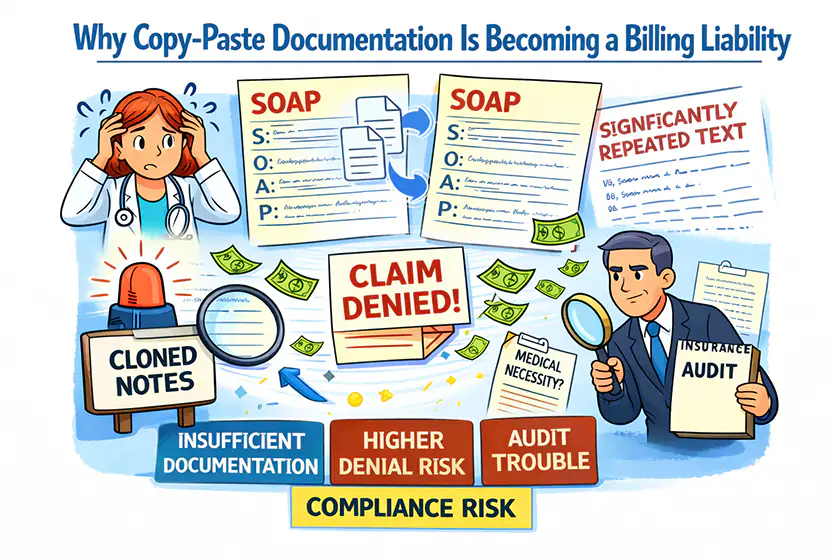
Copy-paste documentation was once seen as a time-saving shortcut for busy healthcare providers. Today, it has become one of the fastest ways to trigger claim denials, audits, and payment delays.
Insurance companies are no longer just reviewing whether a service was billed — they are scrutinizing how it was documented. At Solubillix, we consistently see otherwise valid claims rejected or recouped because documentation appears cloned, repetitive, or non-specific.
What feels efficient at the clinical level often turns into a serious billing and compliance liability.
What Is Copy-Paste Documentation?
Copy-paste documentation occurs when providers reuse previous visit notes, templates, or auto-populated EHR text without meaningful updates for the current encounter.
This includes:
- Identical SOAP notes across multiple visits
- Reused assessments with no change in clinical status
- Auto-generated plans that don’t reflect actual care provided
- Notes that look the same for different patients
While EHR systems make this easy, insurance companies have become highly effective at detecting it.
Why Insurance Companies Are Cracking Down on Cloned Notes
Payers are under pressure to prevent overbilling, improper payments, and fraud. As a result, they use advanced analytics and audits to identify documentation patterns that don’t support billed services.
Red flags include:
- Repeated language across visits
- No documented progression or change in condition
- High-level E/M codes with minimal visit-specific detail
- Notes that don’t match the frequency or intensity of services billed
When these patterns appear, claims are often denied — or worse, previously paid claims are recouped.
How Copy-Paste Documentation Leads to Billing Problems
1. Medical Necessity Is Not Clearly Supported
Even if a service was appropriate, insurance companies require proof that it was necessary for that specific visit. Reused notes fail to demonstrate why the encounter required the level of care billed.
Result: Denials for lack of medical necessity.
2. E/M Levels Become Difficult to Defend
Evaluation and Management (E/M) codes rely heavily on documentation. If the note doesn’t clearly show visit complexity, decision-making, or updated findings, payers may downcode or deny the claim.
Result: Reduced reimbursement or payment reversal.
3. Increased Audit and Recoupment Risk
During audits, payers compare notes across multiple dates of service. Cloned documentation suggests services may not have been distinct or fully performed.
Result: Post-payment audits and refund demands.
4. Behavioral Health and Telehealth Are Especially Vulnerable
Specialties with frequent visits — such as behavioral health, mental health, and telehealth — are under heightened scrutiny. Repetitive documentation in these areas is a common audit trigger.
Result: Higher denial rates and payer monitoring.
5. Compliance and Legal Exposure
Copy-paste documentation can be interpreted as inaccurate or misleading record-keeping. Even unintentional patterns may raise compliance concerns.
Result: Regulatory risk beyond billing issues.
Why This Problem Is Growing — Not Shrinking
Several trends are accelerating this issue:
- Increased use of EHR templates
- Higher visit volumes and provider burnout
- Expanded payer audits and AI-driven review systems
- Stricter CMS and commercial payer guidelines
What passed unnoticed years ago is now actively flagged.
How Solubillix Helps Providers Reduce Documentation-Related Risk
At Solubillix, we don’t just process claims — we focus on protecting provider revenue before claims go out.
Documentation Review Before Billing
We identify cloned or insufficient documentation that may not support the billed service and flag issues early, reducing denials and audit exposure.
Coding Based on What’s Documented — Not Assumed
Our coding approach strictly follows documented content. This prevents overcoding, downcoding, and payer disputes.
Denial Pattern Analysis
If denials occur, we analyze whether documentation patterns — including repetitive notes — are contributing factors and correct them at the workflow level.
Specialty-Aware Billing Support
We understand that documentation expectations vary by specialty. Our billing strategies align with payer requirements for:
- Behavioral health
- Primary care
- Telehealth
- Office-based practices
Compliance-Focused Billing Strategy
We help providers stay audit-ready by aligning documentation, coding, and billing with current payer standards.
The Real Cost of Ignoring Copy-Paste Risks
Unchecked documentation issues lead to:
- Increasing claim denials
- Delayed cash flow
- Higher AR days
- Stressful audits
- Loss of payer trust
These problems compound over time and are far more expensive to fix after denials occur.
Efficient documentation should support billing — not sabotage it.
Why Providers Trust Solubillix
Providers partner with Solubillix because we understand the real connection between documentation, compliance, and reimbursement. We don’t rely on shortcuts, assumptions, or automated guesswork.
We focus on:
- Accuracy
- Prevention
- Compliance
- Long-term revenue stability
Get a Free Documentation & Billing Review
If your practice is experiencing unexplained denials or payer scrutiny, documentation patterns — including copy-paste notes — may be the cause.
Solubillix offers a free billing and documentation review to identify risks before they become costly problems.
Contact Solubillix today and protect your revenue with billing practices built for today’s payer environment.