
In today’s complex healthcare environment, accurate billing for eye care services is no longer optional—it’s essential for maintaining profitability and compliance. Yet, many optometry and ophthalmology practices across the U.S. continue to lose revenue due to coding errors, claim denials, and insurance confusion.
At Solubillix, we specialize in helping eye care practices streamline their billing processes, reduce denials, and maximize reimbursements. In this guide, we break down exactly how to bill for glaucoma, cataract, and diabetic eye exams correctly—so you can get paid faster and more accurately.
Why Accurate Eye Care Billing Matters
Billing errors in eye care practices often lead to:
- ❌ Claim denials and delays
- ❌ Revenue leakage
- ❌ Audit risks and compliance issues
- ❌ Increased administrative burden
The good news? With the right billing strategy, you can improve collections by up to 20–30% without increasing patient volume.
1. How to Bill for Glaucoma Exams Correctly
Glaucoma billing can be tricky because it often involves ongoing management, diagnostic testing, and medical necessity documentation.
✅Common CPT Codes for Glaucoma
- 92083 – Visual field testing (extended)
- 92133 / 92134 – OCT (optic nerve vs retina)
- 76514 – Pachymetry
- 99213–99215 – E/M visits (if medically necessary)
✅ ICD-10 Codes (Examples)
- H40.11X1–H40.11X4 – Primary open-angle glaucoma (stage-based)
- H40.9 – Unspecified glaucoma
⚠️ Key Billing Tips
- Always document glaucoma stage (mild, moderate, severe)
- Use medical diagnosis codes, not routine vision codes
- Ensure test justification (e.g., OCT must support diagnosis)
- Avoid unbundling services incorrectly
👉 Pro Tip from Solubillix: Many practices lose revenue by undercoding glaucoma severity. Proper staging can significantly impact reimbursement.
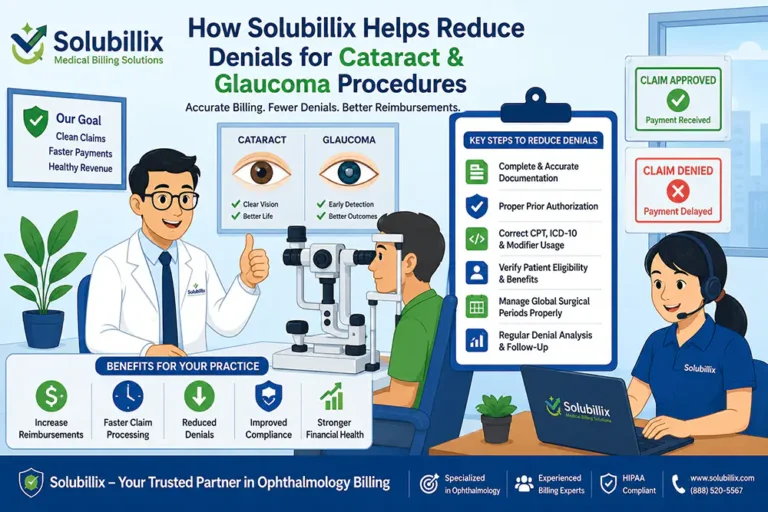
2. How to Bill for Cataract Exams Correctly
Cataract billing depends heavily on whether the visit is routine or medically necessary.
✅ Common CPT Codes
- 92004 / 92014 – Comprehensive eye exam
- 99202–99215 – E/M codes (if medical decision-making applies)
- 92136 – Biometry for lens calculation
✅ ICD-10 Codes
- H25.9 – Age-related cataract, unspecified
- H25.13 – Nuclear cataract, bilateral
⚠️ Key Billing Rules
- If the patient has visual complaints affecting daily life, bill as medical
- If it’s just a routine check, it may fall under vision insurance
- Document impact on vision (e.g., glare, night driving difficulty)
👉 Common Mistake: Billing cataract exams as routine vision visits when they qualify for medical necessity—this leads to lost revenue.
3. How to Bill for Diabetic Eye Exams Correctly
Diabetic eye exams are one of the most highly audited services, making accuracy critical.
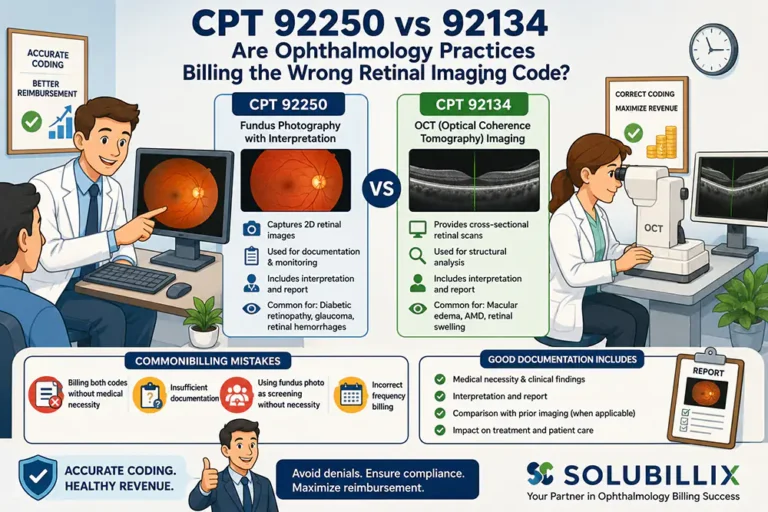
✅ CPT Codes
- 92250 – Fundus photography
- 92134 – OCT retina
- 92014 / 99214 – Exam codes
✅ ICD-10 Codes
- E11.9 – Type 2 diabetes without complications
- E11.319 – Diabetic retinopathy without macular edema
- E11.351–E11.359 – With macular edema
⚠️ Critical Billing Guidelines
- Always link diabetes diagnosis to eye findings
- Clearly document whether retinopathy is present or absent
- Use combination codes when applicable
- Ensure proper HEDIS compliance documentation
👉 Solubillix Insight: Incorrect diabetic coding is one of the top reasons for claim denials in eye care practices.
Medical vs Vision Billing: The #1 Confusion
Understanding the difference is crucial:
| Scenario | Billing Type |
| Routine eye exam, no complaints | Vision insurance |
| Glaucoma, cataract, diabetic condition | Medical insurance |
| Symptoms affecting vision | Medical billing |
👉 Rule: If there is a medical condition or complaint, always bill medical first.
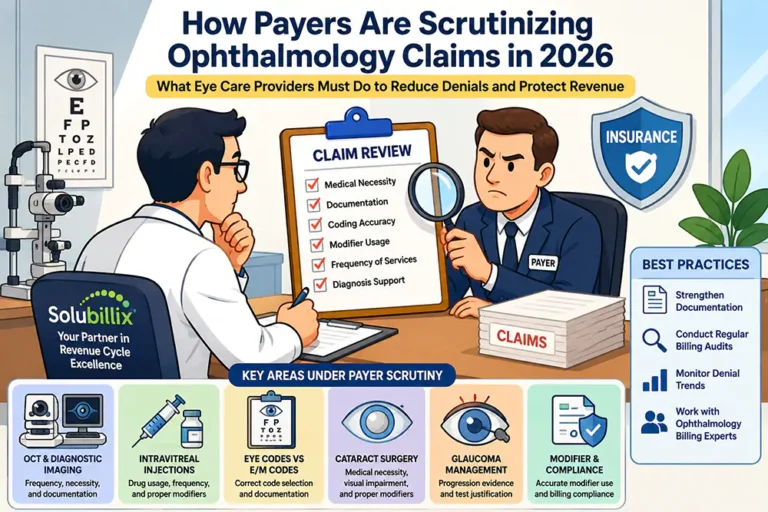
Top Billing Mistakes Eye Care Practices Must Avoid
- ❌ Using routine codes for medical conditions
- ❌ Missing documentation for medical necessity
- ❌ Incorrect modifier usage (25, 59)
- ❌ Not linking CPT and ICD codes properly
- ❌ Underutilizing diagnostic testing codes
How Solubillix Helps Eye Care Practices Succeed
At Solubillix, we go beyond basic billing. We help optometry and ophthalmology practices:
✅ Reduce claim denials by up to 30%
✅ Improve cash flow and faster reimbursements
✅ Ensure full coding compliance (ICD-10, CPT, modifiers)
✅ Handle complex vision vs medical billing
✅ Optimize revenue cycle management
Final Thoughts
Billing for glaucoma, cataract, and diabetic eye exams doesn’t have to be overwhelming—but it does require accuracy, expertise, and constant updates.
Practices that invest in proper billing strategies (or partner with experts like Solubillix) are seeing:
- Higher reimbursements
- Fewer denials
- Better operational efficiency