
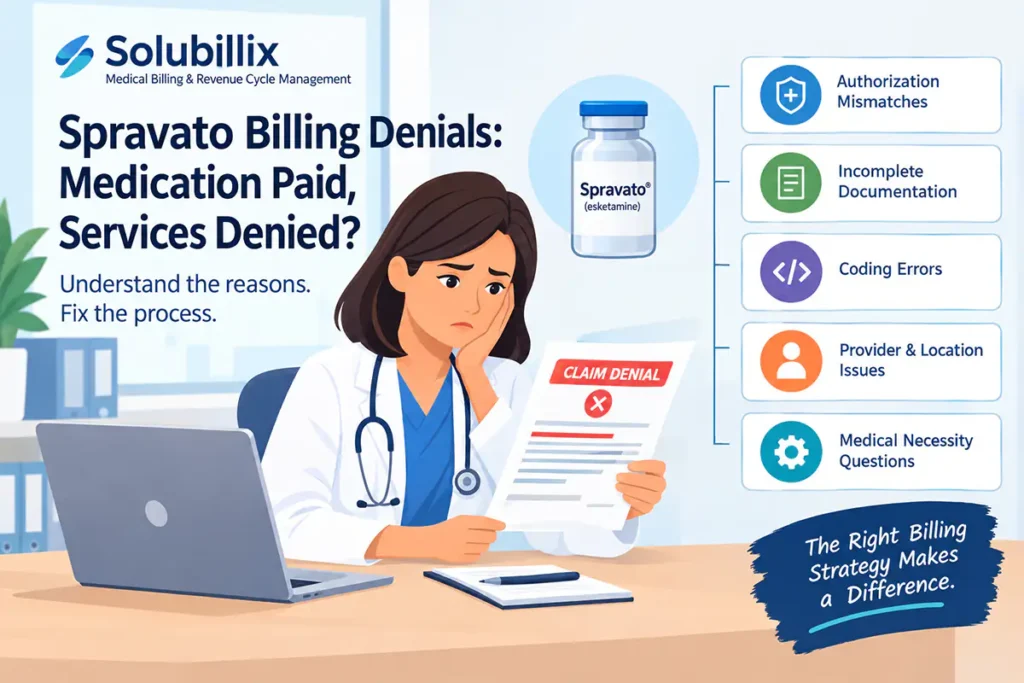
Getting insurance approval for Spravato (esketamine) is an important step in treatment—but it does not guarantee that every related claim will be paid.
Mental health practices can encounter a frustrating situation: the insurance plan covers the medication, the patient receives treatment, and the medication claim is paid, yet the administration or associated service claim is denied.
Why does this happen?
Spravato billing involves more than confirming medication coverage. Providers must also consider authorization requirements, medical necessity, claim coding, documentation, provider and facility requirements, and the individual payer’s reimbursement policies.
For practices offering Spravato treatment, understanding these distinctions can help prevent avoidable billing errors, reduce administrative rework, and improve revenue cycle management.
At Solubillix, we recognize that specialty medication billing requires careful coordination between clinical documentation, payer requirements, and claims management. Here’s what providers should review when Spravato claims are denied despite medication coverage.
1. Medication Coverage Does Not Guarantee Payment for Administration
One of the most common misunderstandings in specialty medication billing is assuming that coverage for the drug automatically includes payment for every service associated with its administration.
These are separate reimbursement questions.
Depending on the patient’s plan and the applicable billing arrangement, the medication and the services associated with treatment may be subject to different coverage rules, authorization requirements, coding guidelines, and payment policies.
For example, a practice may receive payment for the Spravato medication while the administration-related claim remains unpaid because the payer requires additional documentation or does not consider the submitted service separately payable under the circumstances.
How to fix it:
- Review the explanation of benefits (EOB) or electronic remittance advice (ERA) for each claim line.
- Determine whether the denial applies to the medication, the administration service, or another billed service.
- Check the patient’s plan benefits and the payer’s applicable billing policy.
- Confirm that each submitted code accurately represents the service performed.
- Verify whether the services are separately payable under the specific payer’s rules.
Avoid automatically resubmitting the entire claim. First, identify exactly which line was denied and why.
2. Prior Authorization May Not Cover Every Claim Detail
A prior authorization confirms that a service or treatment has met the payer’s authorization requirements within the approval’s stated terms. However, authorization is not necessarily a guarantee of payment.
Problems can arise when the authorization does not match the actual claim.
Examples include:
- The authorization covers a different date range.
- The approved treatment frequency differs from the billed service.
- The authorization references the wrong provider or treatment location.
- The claim contains information that does not match the approved request.
- The payer requires additional authorization or documentation for a particular service.
How to fix it:
Before submitting the claim, compare the authorization record against the actual date of service, rendering provider, treatment location, approved service, and any applicable limits.
Maintain a centralized authorization tracker that records approval numbers, effective dates, authorized services, remaining visits where applicable, and expiration dates.
If the claim is denied despite a valid authorization, contact the payer to determine the precise discrepancy before submitting a corrected claim or appeal.
3. Medical Necessity Documentation May Be Insufficient
Even when a medication is covered, the payer may review whether the treatment meets its medical necessity requirements.
Documentation that is incomplete, inconsistent, or insufficient to support the billed service can lead to denials or requests for additional information.
Depending on the applicable requirements, the medical record may need to support the patient’s diagnosis, treatment rationale, relevant clinical history, and the service provided.
For Spravato, the documentation should also accurately reflect the treatment session and applicable monitoring requirements.
How to fix it:
Establish a documentation review process that checks:
- The diagnosis and clinical rationale supporting treatment.
- The treatment date and medication administered.
- The prescribed dose and documented administration.
- Required monitoring and relevant clinical observations.
- The provider’s documentation and signature, as applicable.
- Any additional records specifically required by the payer.
The documentation must reflect what actually occurred. Billing staff should not add unsupported clinical information to make a claim appear payable.
4. Incorrect CPT or HCPCS Coding Can Trigger Denials
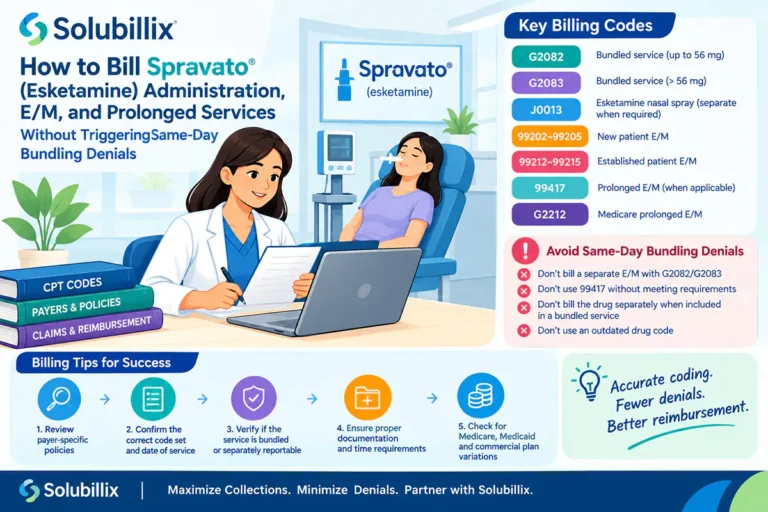
Spravato claims can become complicated when practices use an incorrect code, an inappropriate modifier, an inaccurate unit quantity, or a code that does not match the service performed.
Drug billing and administration-related services must be evaluated separately according to the applicable coding and payer rules.
For Medicare, the Centers for Medicare & Medicaid Services (CMS) publishes specific billing and coding guidance for esketamine. That guidance is important because code assignment alone does not establish coverage.
Commercial insurers and other payers may apply different requirements.
How to fix it:
Before submitting a Spravato claim:
- Verify the applicable HCPCS and CPT codes for the date of service.
- Confirm that the billed units accurately reflect the service or drug quantity under the relevant code descriptor and payer instructions.
- Review modifier requirements and any applicable claim edits.
- Confirm that the diagnosis supports the service under the payer’s policy.
- Check for duplicate billing, inconsistent units, and mismatched claim details.
- Verify whether the payer requires additional documentation or specific claim-submission instructions.
Do not rely exclusively on an old billing template. Coding guidance and payer policies can change, so verify the requirements applicable to the actual date of service.
5. REMS and Treatment Documentation Must Be Managed Properly
Spravato is subject to the FDA’s Risk Evaluation and Mitigation Strategy (REMS). Its requirements include certified healthcare settings and supervised administration, along with patient monitoring requirements.
The FDA prescribing information specifies monitoring for at least two hours after administration, including assessment of relevant safety concerns.
Although REMS compliance and insurance reimbursement are not the same thing, gaps in required treatment documentation can create operational and audit risks. A payer may also request records to support the billed service.
How to fix it:
Develop a consistent treatment-session workflow that ensures the practice:
- Maintains the required REMS certification and processes.
- Documents the treatment session accurately.
- Records applicable administration and monitoring details.
- Maintains required patient and treatment records.
- Submits claims that accurately reflect the services performed.
Use the current FDA prescribing information and applicable REMS materials to confirm the requirements. Do not assume that completing REMS documentation automatically satisfies every insurer’s billing requirements.
6. Provider, Location, and Claim Information May Not Match
Another potential cause of denial is a mismatch between the claim and the provider or location information recognized by the payer.
Examples include an incorrect rendering provider, an outdated practice address, inconsistent billing information, or a discrepancy between the authorization and the submitted claim.
These problems can be especially disruptive for practices that have multiple locations or recently updated their enrollment information.
How to fix it:
Verify the billing and rendering provider information, applicable NPI details, service location, payer enrollment status, and authorization information.
Compare the submitted claim against the payer’s records rather than assuming that previously accepted claims establish that the current information is correct.
When necessary, contact the payer to determine whether an enrollment update, corrected claim, or another action is appropriate.
7. The Claim May Need Correction, Additional Information, or an Appeal
A denial should trigger an investigation—not an automatic resubmission.
The correct response depends on the reason stated on the EOB or ERA and the payer’s claim-processing rules.
For example:
- Incorrect claim information: Determine whether a corrected claim is appropriate.
- Missing documentation: Identify the exact records requested and submit them through the accepted process.
- Authorization discrepancy: Confirm the approval details and ask the payer how the mismatch should be resolved.
- Medical necessity denial: Review the policy and clinical documentation before determining whether an appeal is supported.
- Coding or reimbursement dispute: Verify the applicable billing guidance and request clarification where necessary.
Document payer reference numbers, submission dates, appeal deadlines, and follow-up actions. Monitor the claim until a final resolution is recorded.
Timely filing and appeal deadlines vary by payer, plan, claim type, and circumstances. Check the applicable requirements promptly to protect the practice’s opportunity to pursue reimbursement.
A Practical Spravato Denial-Prevention Checklist
Before submitting a Spravato claim, your billing team should verify the following:
Patient eligibility and applicable benefits have been checked.
Required authorization is valid for the treatment being billed.
Provider and service-location information is accurate.
The medication and administration-related services have been reviewed separately.
Coding, units, modifiers, and diagnosis information have been verified.
Required clinical and treatment-session documentation is complete.
Applicable REMS requirements are being followed.
The claim has been checked for inconsistencies and duplicate billing.
Denials and outstanding balances are tracked for timely follow-up.
This checklist can help standardize your workflow, although it cannot guarantee claim approval. Each payer’s requirements must still be verified.
How Solubillix Helps Practices Manage Spravato Billing Challenges
Spravato billing requires coordination between authorization management, accurate claim submission, documentation review, payment posting, and denial follow-up.
When these activities are handled inconsistently, practices may spend valuable administrative time investigating preventable errors and managing outstanding receivables.
Solubillix provides medical billing and revenue cycle management support designed to help healthcare practices manage complex billing workflows.
Our approach can include:
- Insurance eligibility and authorization verification.
- Claim preparation and submission.
- Review of coding and documentation discrepancies.
- Denial investigation and appeal support.
- Insurance accounts receivable follow-up.
- Payment posting and reconciliation.
- Identification of recurring billing issues that warrant workflow improvements.
The objective is to help practices improve billing accuracy, strengthen follow-up processes, and gain better visibility into unresolved claims—without promising outcomes that depend on payer decisions.
If your practice is experiencing repeated Spravato denials even when medication coverage has been confirmed, reviewing the complete claim workflow may help identify where the process is breaking down.
Final Thoughts
A paid Spravato medication claim does not necessarily mean that the associated administration or other billed services will also be reimbursed.
The key is to identify the exact denial reason, verify the applicable payer requirements, confirm that the coding and documentation support the services performed, and take the appropriate corrective action.
A structured denial-management process can help practices reduce avoidable rework and manage outstanding claims more effectively.
Need support with Spravato billing or denial management?
Contact Solubillix to discuss your practice’s medical billing workflow and identify opportunities to strengthen your revenue cycle management process.
Solubillix — Medical Billing & Revenue Cycle Management
Disclaimer: This article is for general educational purposes and is not a guarantee of coverage or reimbursement. Billing requirements vary by payer, plan, provider, date of service, and clinical circumstances. Verify current coding guidance, coverage policies, authorization requirements, and applicable regulations before submitting claims.
References
- Centers for Medicare & Medicaid Services (CMS), Billing and Coding: Esketamine. https://www.cms.gov/medicare-coverage-database/view/article.aspx?articleId=59249
- U.S. Food and Drug Administration (FDA), Spravato Prescribing Information. https://www.accessdata.fda.gov/drugsatfda_docs/label/2025/211243s016lbl.pdf
- Centers for Medicare & Medicaid Services (CMS), Medicare Claims Processing Manual. https://www.cms.gov/regulations-and-guidance/guidance/manuals/internet-only-manuals-ioms-items/cms018912
Content author: Solubillix Medical Billing Team
Review these references and applicable payer policies before publication, and update the article whenever relevant coding or coverage guidance changes.