
For mental health practices offering Spravato (esketamine) treatment, choosing the right medication procurement and billing workflow can significantly affect day-to-day operations and financial planning.
Two approaches commonly discussed in specialty medication management are Buy-and-Bill and specialty pharmacy fulfillment. Each has different implications for medication purchasing, cash flow, inventory management, claims processing, and coordination with payers.
However, choosing between these models involves more than comparing reimbursement amounts. Practices must also understand their insurance contracts, patient benefits, pharmacy arrangements, and the requirements of the SPRAVATO Risk Evaluation and Mitigation Strategy (REMS).
At Solubillix, we understand that specialty medication billing requires coordination between clinical operations, payer requirements, and revenue cycle management. This guide explains the differences between these approaches and how practices can evaluate their workflows to support more predictable financial operations.
1. What Is Spravato Buy-and-Bill?
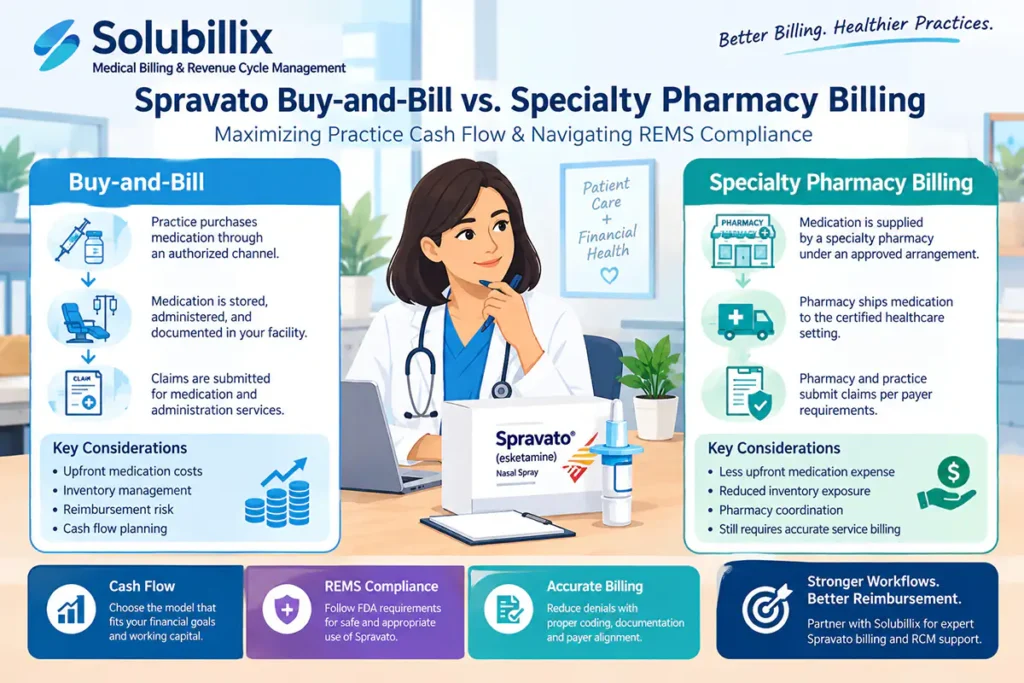
Under a traditional Buy-and-Bill arrangement, a healthcare practice purchases an eligible medication through an appropriate supply channel, maintains inventory, administers the medication in the clinical setting, and submits claims according to the applicable payer requirements.
For Spravato, the practice must use an authorized procurement arrangement that complies with the product’s restricted distribution requirements and applicable REMS rules.
How the workflow typically operates
- The practice confirms the patient’s coverage and applicable authorization requirements.
- The practice obtains the medication through an appropriate authorized channel.
- The medication is received and managed according to applicable handling and inventory procedures.
- The patient receives treatment in the appropriate certified healthcare setting.
- The practice documents the treatment and submits the applicable claims.
- The billing team monitors adjudication, payment posting, denials, and outstanding balances.
Potential advantages
Greater control over procurement and inventory: Depending on the arrangement, the practice may have more control over ordering, inventory planning, and treatment scheduling.
An integrated billing workflow: The practice can coordinate medication records, treatment documentation, claim submission, and payment reconciliation within its own operational processes.
Potential financial flexibility: If acquisition costs, payer reimbursement terms, and operational expenses are favorable, the model may support an acceptable financial return.
Potential challenges
The main consideration is the financial exposure created by purchasing medication before receiving reimbursement.
Practices must account for:
- Upfront medication acquisition costs.
- Delays between purchasing medication and receiving payer payment.
- Denials, underpayments, and recoupments.
- Inventory management and unused inventory risks.
- Authorization changes and cancellations.
- Contractual reimbursement terms and applicable patient cost-sharing.
A practice can experience cash-flow pressure even when most claims are ultimately paid, simply because medication expenses occur before reimbursement arrives.
Key takeaway: Buy-and-Bill can offer operational control, but its financial suitability depends on working capital, procurement terms, payer contracts, and effective claims management.
2. What Is Specialty Pharmacy Billing for Spravato?
Under a specialty pharmacy arrangement, an authorized specialty pharmacy supplies the medication under an applicable dispensing and distribution arrangement. Depending on the agreement, the pharmacy may bill the relevant prescription benefit while the healthcare provider bills separately for eligible professional or administration-related services.
The precise arrangement depends on the payer, benefit design, pharmacy contract, and applicable billing rules.
For Spravato, specialty pharmacy fulfillment must follow the restricted distribution requirements. The medication is supplied to an appropriately certified healthcare setting, not dispensed directly to the patient for home use.
How the workflow typically operates
- The practice verifies the patient’s pharmacy and medical benefits, as applicable.
- The practice determines whether the payer requires a particular specialty pharmacy.
- Any required prescription, authorization, and pharmacy coordination steps are completed.
- The medication is shipped to the appropriate certified healthcare setting under the applicable arrangement.
- The practice coordinates delivery, scheduling, treatment documentation, and monitoring.
- The appropriate party submits its claims under the applicable benefit and contractual rules.
Potential advantages
Reduced medication inventory exposure: When the pharmacy supplies the medication for the scheduled treatment, the practice may avoid purchasing and holding the same level of inventory.
Less upfront medication spending: Depending on the arrangement, the practice may not need to fund the full medication acquisition cost before each treatment.
Pharmacy support: The specialty pharmacy may coordinate prescription processing, dispensing, shipping, and related communications.
Potential challenges
Specialty pharmacy fulfillment does not eliminate administrative work or guarantee payment for the practice’s services.
Common operational challenges include:
- Delays in authorization or pharmacy processing.
- Shipment delays and missed treatment appointments.
- Incomplete communication between the practice and pharmacy.
- Unclear responsibility for resolving billing discrepancies.
- Separate claim requirements for medication and professional services.
- Payer restrictions on pharmacy selection or benefit routing.
Key takeaway: Specialty pharmacy fulfillment may reduce medication inventory exposure, but practices still need an effective authorization, scheduling, documentation, and billing process.
3. Buy-and-Bill vs. Specialty Pharmacy: A Practical Comparison
| Consideration | Buy-and-Bill | Specialty pharmacy fulfillment |
| Medication acquisition | Practice purchases medication through an appropriate channel | Pharmacy supplies medication under the applicable arrangement |
| Upfront medication expense | Generally higher for the practice | May be lower, depending on the arrangement |
| Inventory responsibility | Typically managed by the practice | Depends on the dispensing and delivery arrangement |
| Medication reimbursement risk | Practice may bear acquisition and reimbursement exposure | Medication billing may be handled by the pharmacy, subject to contract terms |
| Professional service billing | Practice bills eligible services under applicable rules | Practice generally remains responsible for its own eligible service claims |
| Scheduling coordination | Requires inventory and authorization coordination | Requires pharmacy delivery and scheduling coordination |
| Administrative workload | Procurement, inventory, billing, and reconciliation | Pharmacy coordination, authorization, service billing, and reconciliation |
| Cash-flow considerations | Acquisition expense may precede payer reimbursement | Medication acquisition exposure may be reduced, but service-payment delays remain possible |
Neither model is automatically better for every practice. The appropriate choice depends on the payer’s requirements, available procurement arrangements, the practice’s financial position, and its ability to manage the associated workflows.
4. How to Evaluate the Cash-Flow Impact
A common mistake is evaluating a medication billing model solely by comparing the billed amount with the expected reimbursement.
A more useful approach is to assess the complete financial picture.
Understand the difference between revenue and cash flow
Revenue reflects the amount earned under the applicable accounting method. Cash flow reflects when money actually enters and leaves the business.
A practice may have an apparently profitable treatment program but still experience financial pressure when medication purchases and operating expenses occur well before payer payments arrive.
Consider a hypothetical example.
Suppose a practice incurs $1,000 in medication acquisition costs for a treatment cycle. The associated claims are submitted promptly, but reimbursement is delayed by several weeks.
The practice must finance the $1,000 expense during that interval, even if the claims are ultimately paid.
Under a specialty pharmacy arrangement, the practice might avoid that particular upfront medication expense. However, it would still need to evaluate its service reimbursement, contractual obligations, staffing costs, and administrative expenses.
This example is illustrative only. It does not represent an actual Spravato acquisition cost, reimbursement rate, or expected financial result.
Five financial indicators to monitor
1. Medication acquisition exposure
Track the amount of money committed to medication inventory and the length of time that capital remains tied up.
2. Days in accounts receivable
Measure how long eligible claims remain outstanding before payment or final resolution.
3. Denial rate
Monitor denied claims as a percentage of submitted claims, while distinguishing initial denials from final unpaid claims.
4. Underpayment rate
Identify claims paid below the amount expected under the applicable contract or reimbursement methodology.
5. Net contribution per treatment
Evaluate collected revenue against medication costs where applicable, staff time, facility expenses, administrative costs, and other relevant operating expenses.
These measures help practices compare procurement arrangements using their own financial and operational data rather than relying on generalized claims about which model produces the greatest profit.
5. Why REMS Compliance Matters in Either Model
The SPRAVATO REMS is a restricted program designed to support safe use of the medication because of risks including sedation, dissociation, respiratory depression, abuse, and misuse.
The FDA-approved program establishes requirements for participating healthcare settings and pharmacies.
Under the applicable REMS requirements, Spravato must be administered in a certified healthcare setting under direct healthcare professional supervision. Patients must be monitored for at least two hours after administration, and the medication must not be dispensed directly to patients for use at home.
These requirements apply regardless of whether the practice uses a Buy-and-Bill arrangement or receives medication through a specialty pharmacy.
Important REMS considerations for practices
Healthcare setting certification: Confirm that the treatment setting satisfies the applicable certification requirements.
Pharmacy coordination: Ensure that medication is obtained through an authorized distribution arrangement and supplied to an appropriately certified healthcare setting.
Treatment documentation: Maintain accurate records of the medication administered, treatment date, and applicable monitoring activities.
Staff responsibilities: Define who manages pharmacy communication, medication receipt, treatment documentation, and compliance-related records.
Operational readiness: Coordinate medication availability with scheduling so that shipment delays or authorization issues are identified promptly.
Ongoing review: Refer to the current official SPRAVATO REMS requirements and prescribing information rather than relying exclusively on older internal procedures.
REMS compliance and insurance reimbursement are separate matters. Meeting REMS requirements does not independently guarantee that a payer will cover or reimburse a particular claim.
6. How Medical Billing Errors Can Disrupt Both Models
Even when a practice has selected an appropriate procurement arrangement, billing errors can delay payment and increase administrative costs.
Common issues include:
- Authorization information that does not match the treatment billed.
- Incorrect provider or service-location information.
- Coding or unit discrepancies.
- Documentation that does not support the billed service.
- Confusion about which party is responsible for the medication claim.
- Unresolved differences between expected and actual reimbursement.
- Delayed denial follow-up and missed filing deadlines.
A practical billing workflow
A structured process can help practices identify these issues earlier.
Before treatment
Verify benefits, applicable authorization requirements, the medication supply arrangement, and the expected responsibilities of the practice and pharmacy.
During treatment
Ensure that the clinical team records the treatment accurately and follows applicable REMS requirements.
After treatment
Review the services performed, verify coding and claim information, and submit claims according to the applicable payer instructions.
During payment follow-up
Post payments accurately, investigate denials and underpayments, document payer communications, and track outstanding claims until resolution.
This process can help practices reduce avoidable administrative rework and improve visibility into their outstanding revenue.
7. How Solubillix Helps Practices Strengthen Spravato Revenue Cycle Management
Selecting a medication procurement model is only one part of managing a successful Spravato treatment program. Practices also need a consistent process for benefit verification, authorization, claims submission, payment reconciliation, and denial follow-up.
Solubillix provides medical billing and revenue cycle management support for healthcare practices seeking to improve their billing workflows.
Our services can support practices with:
- Insurance eligibility and benefits verification.
- Authorization workflow coordination.
- Claim preparation and submission.
- Billing discrepancy investigation.
- Denial management and appeal support.
- Insurance accounts receivable follow-up.
- Payment posting and reconciliation.
- Reporting to identify recurring claim and reimbursement issues.
For practices offering Spravato, these activities can help clarify where billing processes are breaking down and where operational improvements may be needed.
Our focus is on helping providers manage their revenue cycle with greater consistency, visibility, and attention to payer requirements—not promising guaranteed reimbursement.
Considering Buy-and-Bill or specialty pharmacy fulfillment for your Spravato program?
Contact Solubillix to discuss your billing workflow, denial-management challenges, and revenue cycle priorities.
Conclusion
Spravato Buy-and-Bill and specialty pharmacy fulfillment involve different approaches to medication procurement, inventory exposure, and administrative coordination.
Buy-and-Bill may provide greater control over inventory and procurement, but it can require more upfront working capital and expose the practice to medication-related financial risk.
Specialty pharmacy fulfillment may reduce the practice’s direct medication purchasing exposure, but it introduces coordination requirements and does not eliminate the need to bill eligible professional services correctly.
The right approach depends on payer requirements, contractual arrangements, financial capacity, operational readiness, and the practice’s ability to manage billing accurately.
By evaluating the complete financial workflow, maintaining REMS compliance, and monitoring claims through final resolution, practices can make better-informed decisions about their Spravato programs.
Need help managing Spravato billing and revenue cycle operations? Contact Solubillix to discuss a billing assessment tailored to your practice.
References
- SPRAVATO REMS — Healthcare Professional Information: https://www.spravatohcp.com/spravato-rems/
- U.S. Food and Drug Administration — SPRAVATO Drug Information: https://www.accessdata.fda.gov/scripts/cder/daf/
- Centers for Medicare & Medicaid Services — Medicare Coverage Database: https://www.cms.gov/medicare-coverage-database/
Author: Solubillix Medical Billing Team
Editorial note: Review the article against current official requirements and relevant payer contracts before publication. Update it when material billing or regulatory guidance changes.