
Speech-language pathology practices often face a challenging revenue cycle issue: treatment continues, but the patient’s approved visits have already been used.
A patient may need additional speech therapy to address communication difficulties, language delays, swallowing dysfunction, or cognitive-communication impairments. However, the insurance authorization may cover only a limited number of visits or a specific period. If the practice fails to monitor those limits, services may be delivered before additional approval is obtained, potentially leading to denied claims and unexpected patient balances.
The problem is not always a lack of clinical planning. In many practices, authorization information is maintained separately from the appointment schedule, clinical documentation, and billing system. Without a reliable process connecting these functions, staff may not recognize that an approval is about to expire or that the authorized visit count has been exhausted.
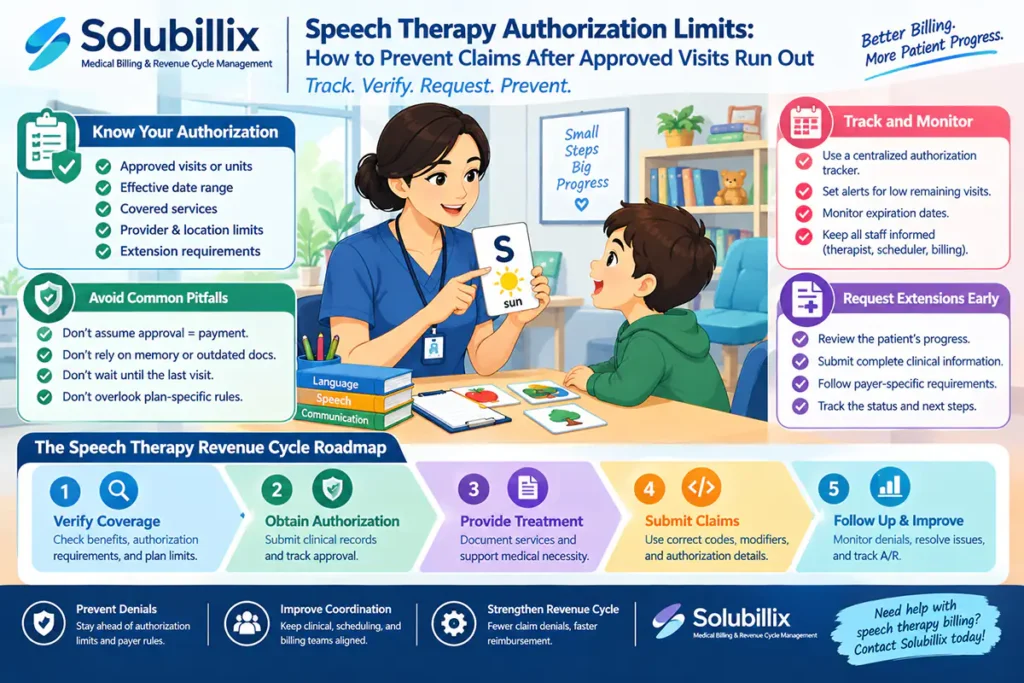
The most effective prevention strategy is to connect authorization tracking with scheduling, clinical planning, and claim submission.
In this guide, the Solubillix Medical Billing Team explains how speech therapy practices can monitor authorization limits, request additional visits, handle pending approvals, and reduce preventable claim denials.
1. Why Speech Therapy Authorization Limits Cause Claim Denials
Insurance plans may establish authorization requirements for speech therapy evaluations, treatment sessions, or additional services. The details depend on the payer, plan, service, and care setting.
An approval may specify a maximum number of visits, a number of units, an effective date range, particular services, or conditions for continued treatment.
Common problems include:
- Approved visits exhausted: The patient has used all visits available under the current authorization.
- Authorization expired: Treatment occurs outside the approved date range.
- Extension not requested: Staff do not initiate the next authorization request early enough.
- Pending request misunderstood: The team assumes that a submitted request means additional visits have been approved.
- Incorrect visit count: The authorization tracker does not reflect completed visits, cancellations, or the payer’s definition of a billable visit.
- Authorization mismatch: The approval does not cover the service, provider, location, or date being billed.
- Communication breakdown: The therapist, scheduler, authorization team, and billing department are working from different information.
These problems can create a chain reaction. A missed authorization alert may lead to an appointment being scheduled, treatment being delivered, a claim being submitted, and a denial being received weeks later.
A well-designed workflow identifies the risk before the next appointment whenever possible.
2. Understand What the Authorization Actually Approves
Before tracking visits, the practice must understand the terms of the approval.
An authorization number by itself is not enough. Staff should review the approval document or payer portal and record the applicable limits.
Key authorization details to capture
| Field | What the practice should verify |
| Patient and insurance plan | Correct member, payer, and plan |
| Authorization number | Exact reference assigned by the payer |
| Effective date range | Beginning and ending dates of approval |
| Approved visits | Number of visits authorized, when specified |
| Approved units | Unit limits, if the approval uses units |
| Covered services | Evaluations, treatment, or other specified services |
| Provider and location | Any restrictions listed in the approval |
| Extension requirements | How and when continued treatment must be requested |
| Status | Approved, pending, denied, modified, or expired |
Do not assume that all payers count visits and units in the same way. A visit-based approval may not operate like a unit-based approval, and some approvals may have both quantity and date restrictions.
For example, an approval might allow 12 treatment visits within a specified period. Even if the patient has not used all 12 visits, the date range may still expire. Conversely, the approved dates may remain valid after the permitted visit count has been exhausted.
Both conditions need to be monitored.
3. Create an Authorization Tracker That Prevents Oversight
A centralized authorization tracker is one of the most useful tools for preventing avoidable denials.
The tracker should be accessible to the staff responsible for scheduling, authorization follow-up, clinical coordination, and billing. It should be updated whenever the payer changes the approval or a visit is completed.
Recommended tracking fields
Include:
- Patient identifier in the approved internal system.
- Insurance payer and plan.
- Authorization number.
- Approved service or procedure.
- Authorization start and end dates.
- Total approved visits or units.
- Visits or units used.
- Remaining visits or units.
- Date of the most recent authorization verification.
- Extension request date.
- Request reference number.
- Current extension status.
- Staff member responsible for follow-up.
- Next action and follow-up deadline.
For example, if an authorization covers 12 visits and 9 have been completed, the tracker should show 3 remaining visits. The system should then prompt staff to review whether an extension is needed.
Use the payer’s definition of a visit or unit when updating the tracker. Do not automatically count a canceled appointment, an evaluation, or a particular service as a consumed visit unless the applicable approval rules support that treatment.
Use automated alerts
A practice can establish internal alerts for:
- Approvals approaching their end date.
- A low remaining visit balance.
- Extension requests awaiting a payer decision.
- Requests that require additional clinical information.
- Denied or modified authorization requests.
For example, a clinic might create alerts when five visits remain, three visits remain, and one visit remains. These are suggested internal thresholds, not universal insurance requirements.
The appropriate thresholds should reflect the clinic’s appointment frequency, payer turnaround times, and authorization procedures.
4. Request Additional Visits Before the Current Approval Runs Out
Waiting until the final approved visit to begin the extension process creates unnecessary risk.
A better approach is to review authorization status during treatment planning and before the remaining visits are exhausted.
Step 1: Review the patient’s progress
The treating speech-language pathologist should assess whether additional skilled treatment is clinically appropriate.
The clinical review may include:
- Progress toward established goals.
- Remaining functional limitations.
- Current communication, language, cognitive-communication, or swallowing needs.
- Patient response to treatment.
- Changes in the treatment approach.
- The rationale for continued skilled intervention.
- Proposed frequency and duration of additional treatment.
The request should reflect the patient’s actual clinical status rather than simply repeating the previous treatment plan.
Step 2: Prepare the extension request
Follow the payer’s instructions for requesting additional visits. Depending on the plan, the request may require:
- Current evaluation or progress documentation.
- Relevant treatment notes.
- Updated goals and measurable outcomes.
- The number of additional visits or units requested.
- Proposed treatment frequency and duration.
- Clinical justification for continued services.
- Other forms or records specified by the payer.
Incomplete submissions may lead to requests for more information or delays in review.
Step 3: Submit the request and retain proof
Record the submission date, reference number, requested quantity, supporting documents, and expected follow-up date.
If the payer provides a portal confirmation or fax transmission receipt, retain it according to the practice’s documentation procedures.
Step 4: Follow up before the last approved visit
Do not treat a submitted extension request as an approval. Until the payer confirms the decision, the practice should continue to monitor the existing authorization and follow its applicable rules.
If the decision is delayed, contact the payer through its designated process and document the response.
Important: A pending request does not automatically extend the existing approval. Verify whether the plan permits any continuation of services while the request is under review.
5. Coordinate Therapists, Schedulers, and Billing Staff
Authorization tracking works only when the people responsible for patient care and billing share accurate information.
A common operational problem occurs when the billing team knows that authorization is exhausted, but the scheduling team continues booking visits without receiving an alert.
The reverse can also happen: a therapist recommends additional treatment, but the authorization team does not receive the updated clinical information needed for a timely extension request.
Establish clear responsibilities
Treating therapist
- Documents the patient’s progress and continued treatment needs.
- Alerts the designated team when additional visits may be necessary.
- Supplies requested clinical information promptly.
Authorization coordinator
- Verifies payer requirements and approval details.
- Tracks remaining visits and effective dates.
- Submits extension requests and follows up.
- Communicates status changes to the relevant staff.
Scheduling team
- Checks authorization status before scheduling visits when required by the clinic’s workflow.
- Follows alerts and escalation instructions.
- Avoids representing pending approval as confirmed coverage.
Billing team
- Confirms that claim details align with the applicable authorization.
- Reviews authorization-related denials.
- Identifies services potentially affected by exhausted limits.
- Communicates discrepancies to the authorization team.
One designated owner should be accountable for every open extension request. Shared responsibility without clear ownership often leads to missed follow-ups.
6. What Should You Do When Approved Visits Are Exhausted?
When the authorized quantity has been used, the practice should avoid assuming that the next claim will be paid.
The correct response depends on the patient’s clinical needs, the payer’s rules, the status of any extension request, and applicable legal and contractual obligations.
Use the following workflow.
Step 1: Confirm the remaining authorization balance
Review the approval, completed visits, submitted claims, and payer records. Determine whether the limit has actually been reached or whether the tracker contains an error.
Step 2: Confirm the payer’s next-step requirements
Determine whether the payer allows additional treatment after a new authorization, requires a medical review, offers an appeal process, or applies another procedure.
Do not assume that an authorization can be obtained retroactively. Ask the payer whether retrospective review is available and document its answer.
Step 3: Escalate the issue before the next appointment
Notify the therapist, scheduler, and appropriate administrative staff that the current authorization may no longer cover the planned service.
The clinical team should determine the appropriate treatment plan, while the administrative team follows the payer’s approval process. Clinical decisions should not be made solely to accommodate billing convenience.
Step 4: Document the decision
Record the authorization status, payer response, extension submission, clinical communication, and next steps.
If the payer denies additional visits, review the reason and determine whether a reconsideration or appeal is appropriate.
Step 5: Handle claims according to the actual facts
If a service has already been delivered, do not alter the service date, fabricate approval, or change the clinical record to make the claim appear authorized.
Instead:
- Review the applicable policy and provider agreement.
- Confirm whether the denial is appealable.
- Submit supporting documentation when appropriate.
- Correct administrative errors when the records support correction.
- Follow applicable patient-notification and financial-responsibility requirements.
A patient should not automatically be billed for a denied service. Patient responsibility depends on the plan, contract, applicable law, and required notices.
7. Authorization Limits and Medicare: Do Not Apply One Rule to Every Payer
Commercial insurance plans, Medicaid programs, Medicare Advantage plans, and Original Medicare do not necessarily follow the same authorization procedures or visit limitations.
This distinction matters because a practice can create billing errors by treating an internal visit counter as though it represents a universal Medicare or insurance limit.
Commercial insurance
Commercial plans may require authorization for a specified number of speech therapy visits or a defined treatment period. The practice should check the member’s specific benefit documents and the payer’s current policies.
Medicaid
Medicaid requirements can vary by state, managed care organization, benefit category, and service setting. Verify the applicable state program and plan rules rather than relying on a generic authorization threshold.
Medicare Advantage
Medicare Advantage plans may use prior authorization and utilization management processes subject to applicable Medicare requirements. Practices should check the specific plan’s rules and current guidance.
Original Medicare
Do not assume that a commercial-style authorization visit count applies to every Original Medicare outpatient speech therapy claim.
Original Medicare has its own coverage, plan-of-care, documentation, certification, and claims requirements. Applicable financial thresholds or medical review processes are not automatically equivalent to a plan authorizing a fixed number of visits.
Review the current CMS Medicare Benefit Policy Manual and applicable Medicare Administrative Contractor guidance before determining whether a Medicare claim requires a particular action.
References:
- CMS Medicare Benefit Policy Manual
- CMS Medicare Coverage Database: Speech-Language Pathology Billing and Coding
- ASHA: Appealing Health Insurance Denials
8. Common Authorization Management Mistakes to Avoid
| Mistake | Why it creates risk | Better practice |
| Tracking only the authorization end date | Visits may run out before the approval expires | Track both quantity and dates |
| Requesting extensions too late | The decision may not arrive before the next appointment | Use internal alerts and assigned follow-up deadlines |
| Assuming a pending request is approved | Services may not meet the plan’s authorization requirements | Record the actual decision status |
| Relying on memory or spreadsheets that are not updated | Staff may schedule or bill against outdated information | Use one controlled, regularly updated tracker |
| Failing to share authorization changes | Therapists, schedulers, and billers may act on different information | Establish a notification process |
| Automatically billing the patient after denial | Patient responsibility may not be established | Review the contract, applicable law, and notice requirements |
| Reusing old clinical justification | The request may not reflect current treatment needs | Submit current, patient-specific documentation |
| Assuming every payer has identical rules | Claims may be handled incorrectly | Maintain payer-specific procedures |
9. Measure Authorization Performance to Find Revenue Cycle Gaps
A practice cannot reliably improve its authorization process without measuring the results.
Consider monitoring the following indicators:
- Authorization-related denial rate: The percentage of claims denied for authorization-related reasons.
- Visits delivered after authorization exhaustion: The number of encounters identified as occurring after the applicable approved quantity was used.
- Extension submission lead time: How far in advance the practice submits requests before the current approval runs out.
- Pending request aging: The time extension requests remain unresolved.
- Authorization mismatch rate: The frequency of discrepancies involving dates, services, providers, locations, or approved quantities.
- Authorization-related A/R: Outstanding balances associated with authorization problems.
Define each metric consistently and review it by payer, location, provider, and service type. The purpose is to identify process weaknesses and assign corrective actions, not to penalize clinicians for appropriate treatment recommendations.
For example, if one payer consistently generates last-minute extension requests, the practice may need earlier alerts, better tracking of appointment frequency, or a revised documentation submission workflow.
10. How Solubillix Helps Speech Therapy Practices Manage Authorization Risk
Authorization management is not a one-time verification task. It requires ongoing communication between the clinical team, administrative staff, and billing department.
Solubillix Medical Billing Team supports medical billing and revenue cycle workflows that help practices organize payer requirements, monitor outstanding claims, and address authorization-related billing problems.
Depending on the practice’s needs, services may include:
- Insurance eligibility and benefits verification.
- Prior authorization tracking and follow-up.
- Extension request coordination and status monitoring.
- Claim preparation and submission.
- Denial investigation and appeals support.
- Insurance A/R follow-up.
- Payment posting and reconciliation.
- Denial trend analysis and workflow improvement.
A consistent process helps practices identify authorization risks earlier, maintain clearer records, and reduce avoidable billing rework.
Are exhausted authorizations creating denied claims or delays for your speech therapy practice? Contact Solubillix to discuss your authorization workflow, claim management, and insurance A/R needs.
Conclusion
Speech therapy authorization limits can create significant revenue cycle problems when visit counts, approval dates, and extension requests are not managed together.
Practices can reduce avoidable risk by maintaining an accurate authorization tracker, setting early alerts, submitting complete extension requests, assigning clear staff responsibilities, and checking authorization status before claims are released.
When an approval is exhausted or pending, the practice should verify the applicable payer requirements, coordinate clinical and administrative decisions, and document every step. No single authorization rule applies to every payer, so accurate plan-specific procedures remain essential.
Solubillix helps healthcare practices strengthen their billing workflows and manage payer follow-up so that preventable authorization issues are identified earlier in the revenue cycle.
Disclaimer
This article provides general educational information and is not a guarantee of reimbursement. Authorization requirements, visit limits, retrospective review policies, patient financial responsibility, and appeal procedures vary by payer, plan, jurisdiction, service setting, and date of service. Verify current plan documents, provider agreements, applicable law, and official program guidance before making billing or patient-financial decisions.
References
- American Speech-Language-Hearing Association (ASHA), Appealing Health Insurance Denials.
- Centers for Medicare & Medicaid Services (CMS), Medicare Benefit Policy Manual.
- CMS, Speech-Language Pathology Billing and Coding.
- CMS, Medicare Coverage Database.