
Occupational therapy billing involves more than selecting the correct CPT code. For time-based services, the number of units billed must also reflect the qualifying treatment time, the services actually provided, and the rules of the payer processing the claim.
A therapist may deliver several interventions during one session, including therapeutic exercise, neuromuscular reeducation, therapeutic activities, and self-care training. Although each service may be clinically appropriate, billing the wrong number of units—or documenting time unclearly—can result in denials, payment reductions, audits, or recoupment requests.
One of the most common sources of confusion is the difference between Medicare’s 8-minute rule and other payers’ timed-code calculation methods. Practices must also distinguish timed services from untimed services, document skilled treatment accurately, and apply relevant modifiers.
In this guide, Solubillix explains how occupational therapy (OT) timed codes work, how to calculate units, what documentation should support a claim, and which payer-specific rules deserve attention before submission.
1. What Are Occupational Therapy Timed Codes?
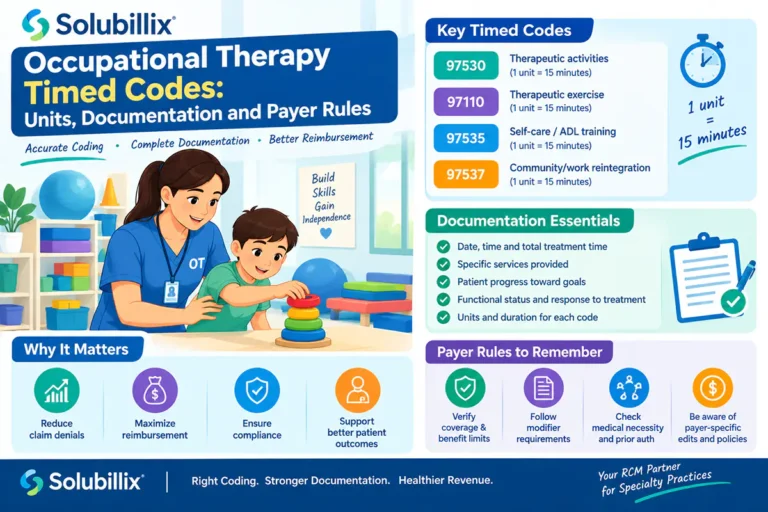
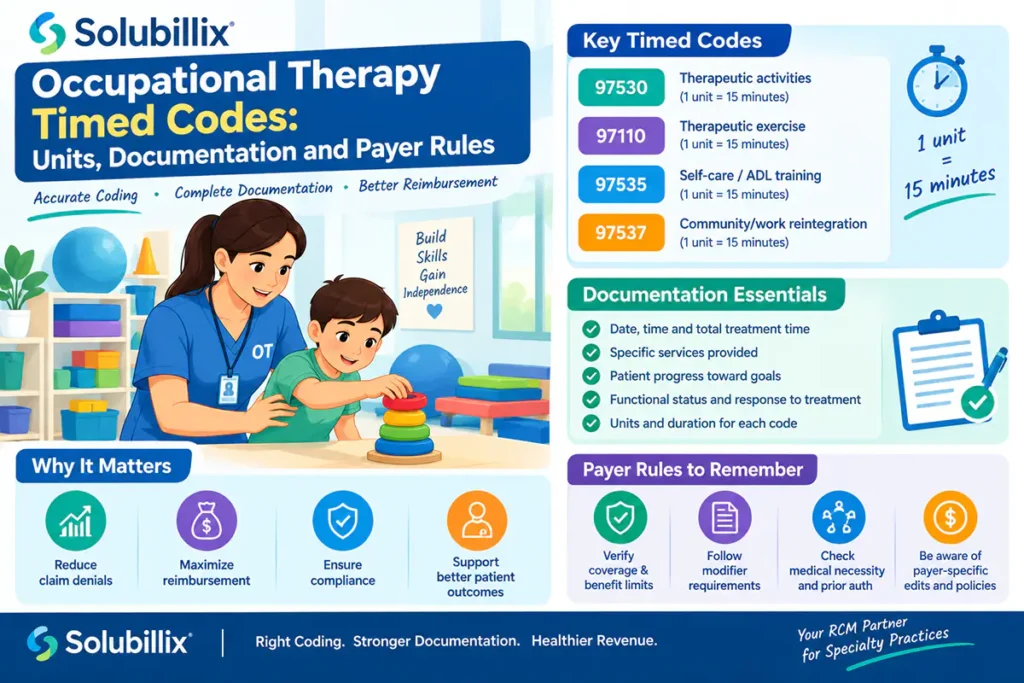
Timed CPT codes describe services for which the amount of qualifying treatment time affects the number of billable units. Many outpatient therapy codes are reported in 15-minute increments, although the applicable code descriptor and payer rules must always be checked.
Common examples include:
| CPT code | General service description | Billing consideration |
| 97110 | Therapeutic exercise | Record the qualifying time spent providing the skilled intervention |
| 97112 | Neuromuscular reeducation | Document the intervention and the skilled treatment provided |
| 97140 | Manual therapy techniques | Record the qualifying treatment time and service details |
| 97530 | Therapeutic activities | Document the functional activities performed and their skilled purpose |
| 97535 | Self-care/home management training | Describe the training or intervention and the patient’s functional needs |
| 97537 | Community/work reintegration training | Verify the code descriptor, payer coverage, and applicable time rules |
These are examples, not a complete code list. Verify current CPT descriptors, code-specific instructions, coverage, and payer requirements before billing.
Important: Not every OT-related code is timed in 15-minute increments. Some evaluations, procedures, and other services are untimed or follow different reporting instructions. Do not apply the 8-minute rule to a code simply because it appears on a therapy claim.
2. Medicare’s 8-Minute Rule Explained
Medicare Part B generally uses the 8-minute rule to determine the number of units for applicable 15-minute timed therapy services.
The calculation begins with the total qualifying timed treatment minutes furnished during the encounter for the same discipline on the same date of service. For occupational therapy, this means combining the qualifying minutes from the applicable timed OT services before determining the total units supported.
The total is then used to establish the number of units that may be reported, subject to the applicable code instructions and Medicare requirements.
Medicare timed-unit reference table
| Total qualifying timed minutes | Maximum units supported |
| 0–7 minutes | 0 |
| 8–22 minutes | 1 |
| 23–37 minutes | 2 |
| 38–52 minutes | 3 |
| 53–67 minutes | 4 |
| 68–82 minutes | 5 |
| 83–97 minutes | 6 |
| 98–112 minutes | 7 |
| 113–127 minutes | 8 |
The table applies to qualifying 15-minute timed services under the Medicare 8-minute methodology. Code-specific requirements and the rules governing allocation of units to individual services still apply.
For example, 40 qualifying timed treatment minutes generally support three total units under this methodology. That does not mean the practice may automatically bill three units of any one CPT code. The units must be assigned to the actual services provided and supported by the record.
The Centers for Medicare & Medicaid Services (CMS) provides therapy billing guidance and related annual updates on its Therapy Services webpage.
3. How to Calculate OT Units When Multiple Services Are Provided
When a patient receives more than one timed intervention during the same OT session, the practice must calculate the total units supported and allocate them appropriately among the individual codes.
Example 1: Two services with 20 minutes each
A patient receives:
- Therapeutic exercise (97110): 20 minutes
- Self-care/home management training (97535): 20 minutes
Total qualifying timed treatment: 40 minutes
Under Medicare’s 8-minute rule, 40 minutes generally supports three total timed units.
The record supports one full 15-minute increment for each service, with additional qualifying time remaining. The billing team must allocate the supported units according to the actual time spent on each service and the applicable coding instructions. The total number of units must not exceed what the documented treatment supports.
Example 2: One service lasting 15 minutes and another lasting 8 minutes
A patient receives:
- Therapeutic activities (97530): 15 minutes
- Neuromuscular reeducation (97112): 8 minutes
Total qualifying timed treatment: 23 minutes
Under the Medicare 8-minute methodology, 23 minutes generally supports two total units. The documentation should establish that the two interventions were distinct, medically necessary, and actually provided for the recorded times.
The billing team must also confirm that the payer’s code-pair and modifier requirements are satisfied before submitting both services.
Example 3: Two services lasting 8 minutes each
A patient receives:
- Therapeutic exercise (97110): 8 minutes
- Manual therapy (97140): 8 minutes
Total qualifying timed treatment: 16 minutes
Under Medicare’s methodology, 16 total qualifying minutes generally supports one unit—not two.
This is a common area of confusion. Each service may have lasted at least eight minutes, but the combined total does not support two units under the Medicare daily timed-unit calculation.
The single supported unit must be allocated to the appropriate service based on the actual treatment and applicable billing rules. Do not automatically bill one unit for each code.
Example 4: Total session time versus timed treatment time
A patient attends a 50-minute appointment. The documentation shows:
- OT evaluation: 30 minutes
- Therapeutic exercise: 10 minutes
- Self-care training: 10 minutes
The appointment lasted 50 minutes, but only 20 minutes were recorded as qualifying timed treatment in this example.
The evaluation time cannot simply be added to the timed treatment minutes to increase the units for the timed codes. The evaluation and treatment must be reported according to their own code requirements, and the timed-unit calculation must use only qualifying timed treatment.
These examples illustrate the calculation method. Always verify the payer’s requirements and current code instructions.
4. Medicare’s 8-Minute Rule vs. Other Payer Rules
Not all insurance plans use the same method to calculate therapy units.
The American Occupational Therapy Association (AOTA) explains that Medicare’s 8-minute rule and the CPT midpoint rule are different approaches, and the applicable payer determines which method governs payment.
Medicare 8-minute rule
Under the applicable Medicare methodology, the total qualifying timed treatment minutes determine the number of units supported for the encounter. The units must then be assigned appropriately to the services furnished.
CPT midpoint rule
Some commercial payers use a midpoint-based approach for applicable 15-minute services. Under this approach, the time for each service may be evaluated against the midpoint of its time increment rather than simply applying Medicare’s combined daily calculation.
However, the CPT midpoint rule is not universal. Code-specific instructions, payer policy, and special requirements can affect the result.
What the billing team should do
Before processing claims for a new or existing payer, confirm:
- Which timed-unit calculation method the plan follows.
- Whether the payer has special instructions for individual CPT codes.
- Whether the payer requires particular modifiers.
- Whether the plan applies multiple-procedure reductions or bundling edits.
- Whether the policy differs for commercial, Medicare Advantage, Medicaid, or other products.
Do not assume that a calculation accepted by Medicare will necessarily be accepted by a commercial insurer—or that every commercial insurer follows the same alternative rule.
For additional background, review AOTA’s Timed CPT Codes guidance and CMS’s therapy billing guidance.
5. Documentation Requirements for Timed OT Codes
Correct unit calculation depends on accurate documentation. A claim may contain the right CPT codes but still be difficult to defend if the record does not clearly establish what was performed and how much qualifying treatment time was provided.
A strong OT treatment note should support both the clinical service and the units billed.
Record the actual treatment time
Document the minutes spent providing each timed intervention. The note should allow a reviewer to understand how the therapist arrived at the total timed treatment minutes.
For example:
| Intervention | CPT code | Documented treatment time |
| Therapeutic exercise | 97110 | 18 minutes |
| Neuromuscular reeducation | 97112 | 15 minutes |
| Self-care training | 97535 | 10 minutes |
| Total timed treatment | 43 minutes |
This example records 43 qualifying timed minutes. Under Medicare’s 8-minute rule, that total generally supports three units. The individual services and unit allocation must still be reviewed before billing.
Describe the skilled intervention
Avoid documenting only a code name or a generic phrase such as “therapeutic exercise completed.”
The record should explain the intervention performed, its relevance to the patient’s functional limitations, and the skilled role of the occupational therapist.
Depending on the service, relevant details may include:
- The activity, exercise, or training performed.
- The functional goal or limitation addressed.
- The level of assistance, cueing, adaptation, or skilled instruction required.
- The patient’s response to treatment.
- Any clinically relevant progress, difficulty, or modification.
Documentation should reflect the care actually provided, not language added solely to justify a billing unit.
Separate timed treatment from other time
A treatment note should distinguish qualifying timed treatment minutes from the overall appointment duration.
Do not automatically count:
- Time spent waiting for the therapist.
- Time spent preparing the room or equipment before treatment.
- Unrelated administrative work.
- Non-treatment breaks or periods when skilled treatment was not being delivered.
- Time attributed to an untimed service when calculating timed-code units.
CMS guidance discusses the importance of recording actual treatment minutes and excluding non-treatment time from the timed-code calculation.
Avoid overlapping time
If two interventions are recorded as occurring simultaneously, the practice must ensure that the same minutes are not counted twice when calculating timed units.
When services are delivered sequentially, the record should make the treatment sequence and duration clear enough to support the services billed.
6. Timed Codes, Untimed Codes, and Total Treatment Time
One frequent billing error is treating the patient’s total time in the clinic as the total billable timed treatment time.
These are different measurements.
Total treatment time describes the broader duration of the therapy encounter, as appropriate to the record.
Timed Code Treatment Minutes represent the qualifying minutes used to calculate units for applicable timed services.
An untimed evaluation may be separately reportable when coverage and coding requirements are met, but its duration should not be added to the timed-treatment total simply to create additional units for other services.
The same principle applies to untimed modalities and other services that have separate reporting instructions.
Before submitting the claim, verify that the documented timed minutes, untimed services, and total session duration are internally consistent.
7. OT Modifiers: GO, CO, KX, and 59
Modifiers can affect how a payer interprets a service, whether a claim line meets a billing requirement, and how payment is calculated. The correct modifier depends on the service, provider, payer, and circumstances.
Modifier GO: Occupational therapy plan of care
Modifier GO identifies services furnished under an outpatient occupational therapy plan of care when required by the applicable billing rules.
For Medicare outpatient therapy claims, the relevant discipline modifier requirements must be followed. Confirm the payer’s requirements for each plan and claim type.
Modifier CO: Occupational therapy assistant services
Modifier CO identifies applicable outpatient occupational therapy services furnished in whole or in part by an occupational therapy assistant (OTA).
For Medicare, CO requirements interact with the applicable assistant-payment policy and de minimis rules. The practice must determine whether the OTA’s contribution meets the criteria requiring the modifier for the service or unit.
Do not decide whether CO applies solely from the total minutes in the session. Review how the OT and OTA furnished the specific service and the applicable CMS policy.
CMS provides detailed examples in its Billing Examples Using CQ/CO Modifiers.
Modifier KX: Medicare therapy threshold
Modifier KX is used when applicable Medicare therapy services exceed the relevant annual threshold and the required medical-necessity conditions are met.
Exceeding a threshold does not by itself establish that continued treatment is medically necessary. Documentation must support the applicable coverage requirements, and the modifier should be reported according to current Medicare instructions.
Check the current calendar-year threshold and applicable discipline-specific rules rather than relying on an old internal reference.
Modifier 59: Distinct procedural service
Modifier 59 may be appropriate in certain circumstances when services that would otherwise be subject to a bundling edit are genuinely distinct and the applicable coding rules permit the modifier.
It should not be used automatically to bypass an edit or increase reimbursement. Confirm the relevant code pair, payer policy, documentation, and any more specific modifier requirements before applying it.
A modifier does not replace the need to establish that both services were separately reportable.
8. Common OT Timed-Code Billing Errors
Error 1: Applying Medicare’s rule to every payer
Why it matters: Different plans may use different timed-unit calculation methods.
How to prevent it: Maintain payer-specific billing guidance and confirm the current method before calculating units.
Error 2: Billing units based on appointment duration
Why it matters: Total time in the clinic may include evaluations, breaks, preparation, or other nonqualifying time.
How to prevent it: Record qualifying minutes for each timed intervention and calculate units from the appropriate total.
Error 3: Billing every service for a separate unit
Why it matters: Under Medicare’s 8-minute rule, the total qualifying minutes determine the total units supported. Two services of eight minutes each do not automatically support two units.
How to prevent it: Calculate the total units first, then allocate them appropriately to the individual services.
Error 4: Missing service-level documentation
Why it matters: The record may not support the duration, clinical purpose, or distinct nature of the service billed.
How to prevent it: Document the intervention, actual treatment time, skilled need, and patient response.
Error 5: Counting the same minutes twice
Why it matters: Overlapping treatment time can lead to unsupported units and compliance concerns.
How to prevent it: Ensure the record clearly distinguishes treatment activities and does not double-count minutes.
Error 6: Misapplying CO or other modifiers
Why it matters: Incorrect modifier reporting may affect payment or trigger a claim rejection.
How to prevent it: Review current CMS requirements and payer-specific modifier rules before submission.
Error 7: Ignoring bundling edits
Why it matters: Two correctly documented services may still be subject to a code-pair edit or payer-specific payment rule.
How to prevent it: Check current edits, documentation, and modifier requirements. Do not add modifier 59 without a supported basis.
9. A Practical OT Timed-Code Billing Workflow
A repeatable process helps the billing team identify discrepancies before claims are submitted.
Step 1 — Review the treatment note. Confirm the services performed, treatment times, clinical rationale, and provider details.
Step 2 — Identify timed and untimed codes. Use current code descriptors and applicable reporting instructions.
Step 3 — Total qualifying timed minutes. Exclude time that does not qualify under the applicable rules.
Step 4 — Apply the payer’s calculation method. Use the Medicare 8-minute rule where applicable, or the payer’s required alternative method.
Step 5 — Allocate units to each code. Confirm that the number of units billed is supported by the actual time spent on each service.
Step 6 — Check modifiers and edits. Verify GO, CO, KX, 59, or other modifiers when relevant and required.
Step 7 — Confirm coverage and authorization. Review applicable plan limits, medical-necessity requirements, and authorization details.
Step 8 — Submit and monitor the claim. Review rejections, denials, and payment adjustments for recurring issues.
Step 9 — Audit variances. Compare the claim, documentation, and remittance advice when payment differs from expectations.
10. OT Timed-Code Audit Checklist
Before submitting or auditing an OT claim, confirm:
The billed CPT codes match the services actually performed.
Each timed service has documented qualifying treatment minutes.
Timed and untimed services are distinguished correctly.
Total qualifying timed minutes are calculated accurately.
The correct payer-specific unit calculation method is used.
Units are allocated appropriately to the individual services.
Overlapping minutes have not been counted twice.
Documentation supports the skilled intervention and medical necessity.
Applicable GO, CO, KX, and other modifiers are reviewed.
Bundling edits and code-pair requirements are checked.
Authorization and benefit requirements are satisfied.
- The final claim is consistent with the medical record and current payer instructions.
How Solubillix Supports Occupational Therapy Billing
Occupational therapy billing requires coordination between clinical documentation, coding, unit calculation, payer rules, and payment follow-up. Even a small recurring error can affect reimbursement across a high volume of claims.
Solubillix supports medical billing and revenue-cycle workflows, including claim review, denial management, A/R follow-up, payment reconciliation, and reimbursement discrepancy investigation.
A consistent OT billing workflow can help a practice identify preventable errors, improve documentation-to-claim consistency, and investigate payment issues more efficiently.
Need help reviewing your occupational therapy billing workflow? Contact Solubillix to discuss your practice’s billing challenges and revenue-cycle support needs.
This article is for educational purposes and does not replace current CPT instructions, payer contracts, coverage policies, or professional coding guidance. Actual billing requirements vary by payer, plan, code, and service circumstances.
Frequently Asked Questions
How many minutes are required to bill one OT timed-code unit under Medicare?
For applicable 15-minute timed therapy codes, Medicare’s 8-minute rule generally supports one unit when the total qualifying timed treatment is 8–22 minutes. The applicable code instructions and unit-allocation requirements must also be followed.
Does every insurance payer use the Medicare 8-minute rule?
No. Some payers use a different time-calculation methodology, including a midpoint-based approach for applicable services. Verify the specific payer’s current policy.
Can I bill two OT timed codes when each service lasts eight minutes?
Not automatically. Under Medicare’s 8-minute rule, 8 minutes for each of two services produces 16 total qualifying minutes, which generally supports one total unit. The unit must be allocated to the appropriate service under the applicable rules.
Does evaluation time count toward OT timed-code units?
An evaluation’s duration should not simply be added to timed-treatment minutes to increase units for other services. Evaluation codes and timed treatment codes must be reported according to their own instructions.
What documentation is important for OT timed-code billing?
The record should identify the intervention, qualifying treatment time, skilled services provided, clinical purpose, and relevant patient response. It should also distinguish timed treatment from non-treatment time and untimed services.
When is modifier CO required?
For applicable Medicare outpatient OT claims, CO identifies services furnished in whole or in part by an OTA when the relevant CMS criteria are met. The practice should review the service-level facts and current de minimis rules.
Can modifier 59 be used to avoid an OT bundling denial?
Only when the services are genuinely distinct and the applicable coding and payer rules support the modifier. It should not be used solely to bypass an edit.
References and Further Reading
- Centers for Medicare & Medicaid Services (CMS): Therapy Services — Current Medicare therapy billing guidance, annual updates, and therapy-related policies.
- CMS Medicare Coverage Database: Billing and Coding: Outpatient Physical and Occupational Therapy Services — Timed treatment minutes, unit calculation, and documentation guidance. Verify that the applicable article and revision are current for the claim being reviewed.
- American Occupational Therapy Association (AOTA): Timed CPT Codes — Explanation of Medicare’s 8-minute rule and the CPT midpoint approach.
- CMS: Billing Examples Using CQ/CO Modifiers — Medicare requirements for therapy assistant modifiers and related examples.
- CMS Medicare Learning Network: Complying with Outpatient Rehabilitation Therapy Documentation Requirements — Documentation and billing considerations for outpatient rehabilitation therapy.