
A medical claim can be marked as paid without being reimbursed correctly.
For specialty practices, this distinction matters. A payer may process a claim, issue an electronic remittance advice (ERA), and transfer funds to the provider while still paying less than the amount required by the applicable contract or reimbursement policy.
These discrepancies can arise from incorrect fee schedule calculations, outdated payer rates, missing modifiers, incorrect units, multiple-procedure reductions, bundling edits, authorization issues, or payment posting errors. Some differences are legitimate contractual adjustments, while others may represent recoverable underpayments.
Without a consistent audit process, these small variances can remain hidden in accounts receivable (A/R), accumulate across hundreds of claims, and reduce a practice’s net collections.
A medical claim underpayment audit compares the reimbursement a practice should have received with the payment and adjustments actually applied to the claim. The goal is to identify valid discrepancies, document the evidence, pursue appropriate corrections, and prevent recurring errors.
In this guide, Solubillix explains how specialty practices can build a practical underpayment audit process, from selecting claims to reconciling recovered payments.
What Is a Medical Claim Underpayment?
An underpayment occurs when an insurance payer reimburses a provider less than the amount due under the applicable contract, fee schedule, benefit terms, or payment policy, after accounting for legitimate adjustments.
For example, suppose a specialty practice expects an insurance payment of $125 for a service under its applicable contracted rate. The payer allows $125 but pays only $105, with no documented reason that explains the $20 difference.
That variance deserves investigation.
However, if the payer allows $105 under the correct contract and the practice expected $125 based on an outdated fee schedule, the claim is not necessarily underpaid. The problem may instead be an internal reimbursement-estimation error.
The audit must establish the correct expected reimbursement before determining whether money is actually owed.
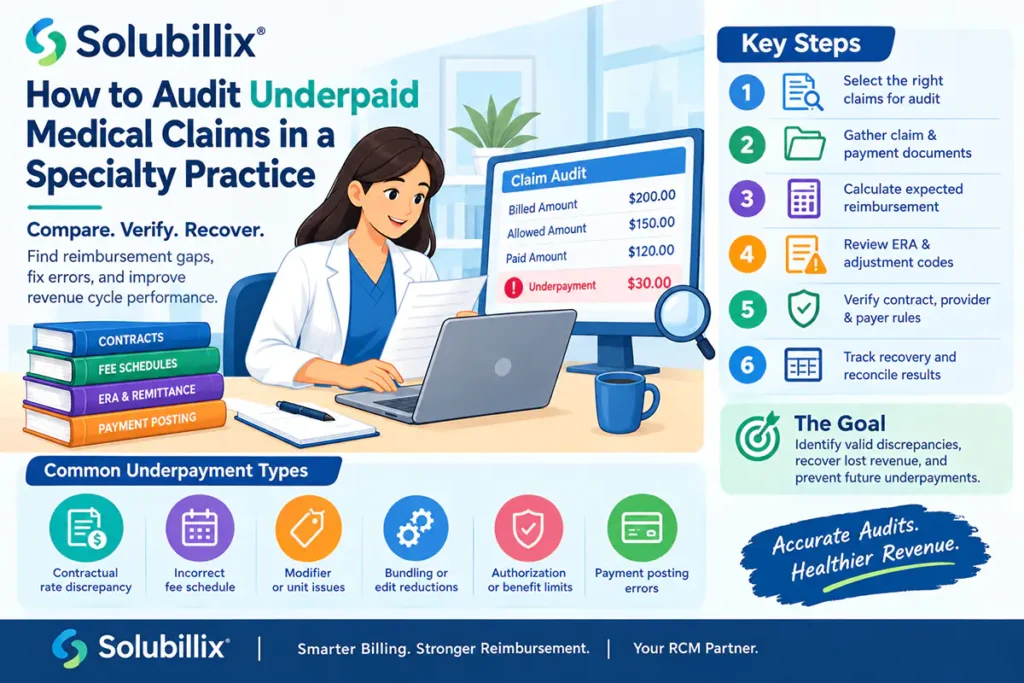
Common Types of Underpayment
| Underpayment type | What to investigate |
| Contractual rate discrepancy | Did the payer apply the correct contracted rate for the date of service? |
| Incorrect fee schedule | Was the expected rate based on an outdated or incorrect schedule? |
| Modifier-related reduction | Was the modifier submitted correctly and recognized under the payer’s policy? |
| Incorrect units | Were the billed and paid units consistent with documentation and coding rules? |
| Multiple-procedure reduction | Was the reduction required under the applicable payment methodology? |
| Bundling or edit issue | Was a separately payable service incorrectly bundled, or was the adjustment appropriate? |
| Authorization or benefit limitation | Did the plan’s authorization, coverage, or visit limits affect payment? |
| Payment posting discrepancy | Was the payer’s actual payment posted correctly to the patient account and service line? |
| Provider or location mismatch | Did the payer use the correct rendering provider, billing entity, network status, and place of service? |
Not every low payment is an underpayment. Accurate classification is essential before a practice requests additional reimbursement.
Why Specialty Practices Need a Dedicated Underpayment Audit
Specialty practices often have reimbursement patterns that make payment variance analysis more complicated than simply comparing billed charges with deposits.
A physical therapy clinic may bill timed units and multiple procedures on the same date. A behavioral health practice may bill psychotherapy, evaluation and management services, or prolonged services under different payer rules. A TMS or Spravato practice may have separate professional-service, medication, and administration reimbursement considerations depending on the payer and drug-supply arrangement.
Other specialties may encounter procedure-specific fee schedules, multiple-procedure reductions, assistant-surgeon rules, drug reimbursement methodologies, or payer-specific authorization requirements.
A general payment-posting review may not detect these differences consistently.
A dedicated audit helps practices:
- Identify recurring reimbursement discrepancies by payer and procedure.
- Validate whether contractual adjustments are accurate.
- Detect underpayments that remain open after initial claim adjudication.
- Improve the accuracy of expected reimbursement calculations.
- Prioritize recovery efforts based on financial impact and filing deadlines.
- Correct recurring billing, contract-loading, and payment-posting problems.
The value is not limited to recovering individual claims. A well-designed audit can reveal systemic issues that affect future reimbursement.
Step 1: Select the Right Claims for Audit
Reviewing every paid claim manually may be impractical for a busy specialty practice. Start by identifying claims with a higher likelihood of a payment discrepancy.
Claims worth prioritizing
1. Claims with unexpected allowed amounts
Compare the payer’s allowed amount against the contracted rate or validated expected reimbursement for the service.
2. Claims with unexplained reductions
Review claims where the payer reduced a service line or applied an adjustment that does not appear consistent with the contract, policy, or submitted claim.
3. Claims involving high-volume CPT or HCPCS codes
A small recurring discrepancy on a frequently billed procedure can have a substantial cumulative impact.
4. Claims affected by recent contract or fee schedule changes
Confirm that new rates were loaded and applied to the correct effective dates.
5. Claims with multiple services or modifiers
Investigate whether modifiers, units, bundling edits, or multiple-procedure payment rules affected reimbursement.
6. Claims from high-volume or high-value payers
Prioritize based on the potential recovery, frequency of discrepancies, available evidence, and remaining time to appeal or request reconsideration.
7. Claims with unusual payment patterns
Compare payments for the same payer, procedure, provider, and relevant billing circumstances. An unexplained change may warrant a closer review, although differences can also result from legitimate contract, benefit, or claim-specific factors.
Recommended audit sample
For an initial review, a practice might select a sample of 30–50 paid claims across its highest-volume payers and procedures. This is a practical starting point, not a statistically representative sample for every practice.
Include different dates of service, rendering providers, locations, and claim types where relevant. Expand the sample when the initial review identifies a recurring pattern.
Step 2: Gather the Required Claim and Payment Documents
An underpayment audit is only as reliable as the information used to calculate expected reimbursement.
Collect the following records for each selected claim:
- Original submitted claim or claim-image data.
- Payer ERA or paper remittance advice.
- EOB, when applicable and available.
- EFT or check details for payment reconciliation.
- Applicable payer contract, fee schedule, and amendments.
- Relevant payer reimbursement policies.
- Eligibility, authorization, and referral information, when applicable.
- Documentation supporting the billed service, units, and modifiers.
- Claim status, corrected-claim history, and appeal correspondence.
- Payment-posting records from the practice management system.
The ERA is particularly important because it reports claim and service-line adjudication information, including adjustments and standardized reason codes. CMS explains the roles of claim adjustment group codes, claim adjustment reason codes (CARCs), and remittance advice remark codes (RARCs) in its guidance on Health Care Payment and Remittance Advice.
Important: A bank deposit alone does not establish how much was paid on a particular claim. One EFT may cover multiple claims, and remittance-level adjustments can affect the amount transferred. Reconcile the ERA, EFT or check, and posting records rather than relying only on the deposit total.
Step 3: Calculate the Correct Expected Reimbursement
This is the most important step in the audit.
Do not automatically treat the billed charge as the amount the payer owes. The expected reimbursement should be based on the applicable contract and payment rules.
For a simple professional claim, the basic calculation is:
Expected payer payment = Contractual allowed amount − applicable payer-responsibility reductions
This simplified formula must be adapted to the payer’s actual reimbursement methodology. Deductibles, copayments, coinsurance, coordination of benefits, sequestration, multiple-procedure reductions, withholds, and other adjustments may affect the final payment.
For more complex claims, calculate the expected amount at the service-line level before reconciling the total claim.
Example: A potential contractual underpayment
Assume a specialty practice has verified the following amounts for one service line:
| Audit item | Amount |
| Billed charge | $200.00 |
| Verified contracted allowed amount | $125.00 |
| Applicable patient responsibility | $25.00 |
| Expected payer payment | $100.00 |
| Actual payer payment | $80.00 |
| Potential underpayment | $20.00 |
The potential underpayment is calculated as:
$100 expected payer payment − $80 actual payer payment = $20
The $20 should not be reported as a confirmed recovery until the auditor verifies that no other legitimate adjustment, secondary-payer payment, recoupment, or claim-specific rule explains the difference.
What if the payer allowed less than the contract rate?
Suppose the contract indicates an allowed amount of $125, but the ERA shows an allowed amount of $110.
Investigate whether:
- The correct contract and rate effective on the date of service were used.
- The payer applied the correct provider, location, network, and procedure details.
- A multiple-procedure or other payment reduction applies.
- The service was subject to a special reimbursement policy.
- The practice’s contract interpretation or fee schedule was incorrect.
A variance between expected and actual reimbursement is a signal to investigate, not automatic proof that the payer owes money.
Step 4: Review the ERA and Adjustment Codes
Once expected reimbursement has been established, review the ERA at the claim and service-line levels.
Focus on three key elements:
- Claim Adjustment Group Code: Indicates the general category of financial responsibility.
- Claim Adjustment Reason Code (CARC): Explains why a payment or charge was adjusted.
- Remittance Advice Remark Code (RARC): May provide additional information about the adjustment.
For example, a contractual-obligation adjustment may be appropriate when the payer applies the correct contracted rate. A patient-responsibility adjustment may be appropriate when the benefit terms place the amount on the patient. A bundling or noncovered-service adjustment may require review of the applicable policy and claim circumstances.
The code alone does not establish whether the payment is correct. Read the complete adjustment information and compare it with the contract, benefit terms, coding rules, and supporting documentation.
Use the current official code descriptions rather than relying solely on old internal notes or a static code list. The CMS remittance advice guidance explains how these codes communicate adjudication decisions.
Step 5: Verify the Contract, Provider, and Payer Rules
Before opening a payer dispute, confirm that the expected rate is valid for the specific claim.
Review the following:
Contract and rate details
- Contracted rate and effective date.
- Contract amendments and renewal terms.
- Applicable procedure code and modifiers.
- Provider and location participation status.
- Whether the rate is based on a fee schedule, percentage of a reference rate, case rate, or another methodology.
- Any contractually permitted reductions or payment conditions.
Claim-specific details
- Date of service.
- Billing and rendering provider identifiers.
- Place of service.
- Procedure code, modifiers, and units.
- Authorization or referral requirements.
- Coverage and benefit limitations.
- Whether another payer processed the claim first.
Payer-specific policies
Some services may be subject to reimbursement rules that vary by payer or product. Medicare, Medicaid, and commercial plans may apply different payment methodologies, and policies can change over time.
For Medicare claims, use the relevant official CMS guidance and applicable Medicare Administrative Contractor information. For commercial claims, use the provider contract, current payer policies, and plan-specific reimbursement terms.
Do not assume that one payer’s payment rule applies to another payer simply because the same procedure code was billed.
Step 6: Build an Underpayment Audit Worksheet
A structured worksheet helps the billing team track findings, assign follow-up responsibility, and reconcile recovered amounts.
Recommended fields include:
| Field | Purpose |
| Patient account or internal claim ID | Identify the claim securely |
| Payer and plan | Group discrepancies by payer |
| Date of service | Match the claim to the applicable rate and policy |
| CPT/HCPCS code and modifiers | Identify the service being audited |
| Units | Verify billed and paid service quantity |
| Billed charge | Record the original charge |
| Expected allowed amount | Document the validated contract calculation |
| Expected payer payment | Calculate the expected payment after applicable adjustments |
| Actual allowed amount | Record the payer’s adjudicated allowed amount |
| Actual payer payment | Record the amount attributed to the claim or service line |
| Adjustment codes | Document the payer’s explanation |
| Potential variance | Calculate the amount requiring investigation |
| Audit finding | Classify as confirmed underpayment, legitimate adjustment, posting error, or unresolved |
| Evidence and source | Record the contract section, fee schedule, policy, or ERA details |
| Action taken | Track corrected claim, reconsideration, appeal, or other follow-up |
| Deadline | Record the applicable payer deadline |
| Recovery amount and date | Reconcile additional payments |
Privacy reminder: Store patient information only in approved systems with appropriate access controls. For shared audit reports, use internal claim identifiers instead of unnecessary patient details.
Step 7: Identify Patterns Across Payers and Procedures
Individual discrepancies are important, but recurring patterns may reveal larger revenue-cycle problems.
After reviewing the sample, summarize findings by payer, procedure code, provider, location, and month of service.
For example, a practice may discover that:
- One payer consistently applies an outdated rate to a high-volume procedure.
- A new fee schedule was loaded incorrectly in the practice management system.
- A modifier is being omitted from a subset of claims.
- Payment-posting staff are applying an adjustment to the wrong service line.
- A payer’s reduction is legitimate, but the practice’s expected reimbursement model does not account for it.
- A recurring claim edit is reducing reimbursement because of a documentation or coding issue.
These findings require different solutions. A payer contract discrepancy may need escalation to provider relations, while an internal posting error may require a correction in the practice management system and staff retraining.
Avoid assuming that every repeated variance is a payer error. Confirm the underlying cause before launching a large-scale recovery effort.
Step 8: Request Reconsideration or Appeal When Appropriate
When the audit confirms a likely underpayment, prepare a clear, evidence-based request.
A useful submission generally includes:
- Claim number and date of service.
- Procedure code, modifiers, and units in dispute.
- Expected reimbursement and the basis for the calculation.
- Actual reimbursement shown on the remittance advice.
- The specific contractual or policy provision supporting the request.
- Relevant ERA details and supporting documents.
- The exact correction or additional payment requested.
Use the payer’s designated process. Depending on the issue, the appropriate route may be a payment inquiry, provider-service escalation, contractual reimbursement review, corrected claim, reconsideration, or formal appeal.
Do not submit a corrected claim automatically if the original claim was accurate and the problem is the payer’s adjudication. Likewise, do not file a formal appeal when the payer requires a different process for correcting a claim-data error.
Example: Underpayment dispute summary
Subject: Request for Review of Potential Contractual Underpayment
The practice is requesting a review of the payment issued for the claim identified below. Our audit indicates that the reimbursement may not match the applicable contracted rate for the date of service.
- Claim number: [Claim Number]
- Date of service: [DOS]
- Procedure code: [CPT/HCPCS]
- Expected payer payment: [$Amount]
- Actual payer payment: [$Amount]
- Potential variance: [$Amount]
Based on the applicable contract or fee schedule, the expected reimbursement is [explain calculation]. The remittance advice reflects [summarize relevant adjudication or adjustment details].
Please review the claim, confirm the applicable reimbursement methodology, and issue any additional payment due under the contract. Supporting documentation is available for review.
Thank you.
Customize this language to the payer’s process and the facts of the individual claim. Do not describe a variance as a confirmed contractual violation unless the evidence supports that conclusion.
Step 9: Track Recovery and Reconcile the Final Outcome
Submitting a dispute does not mean the underpayment has been recovered.
Maintain a follow-up log that tracks:
- Date the inquiry or appeal was submitted.
- Submission method and confirmation number.
- Payer representative and reference number, if applicable.
- Supporting documents submitted.
- Expected response or follow-up date.
- Payer’s decision.
- Additional payment received, if any.
- Posting and reconciliation status.
- Reason for closure if no recovery occurred.
When additional payment is received, reconcile it to the corresponding claim and service line. Confirm that the payment was posted correctly and that any related adjustment or patient balance was updated appropriately.
If the payer upholds the original payment, document the explanation. Determine whether the denial or reduction was correct, whether additional evidence is available, and whether another review level is permitted within the applicable deadline.
For Medicare fee-for-service claims, the applicable redetermination process and deadline should be checked against current CMS guidance. CMS describes the first-level redetermination process and supporting documentation requirements on its Medicare redetermination page. Commercial and Medicaid deadlines and procedures vary by payer, contract, and jurisdiction.
Step 10: Measure the Results of the Audit
A successful audit should measure more than the total dollar amount submitted for review.
Track the following indicators:
Potential underpayment identified: The total variance flagged for investigation.
Confirmed underpayment: The portion supported by contract and claim evidence.
Amount recovered: Additional reimbursement actually received and reconciled.
Recovery rate: The amount recovered divided by the confirmed underpayment amount eligible for recovery, using a clearly defined reporting period.
Average time to resolution: The average number of days from initial identification to final resolution.
Recurring variance rate: The proportion of audited claims showing the same confirmed discrepancy.
Unresolved audit balance: Confirmed or suspected variances still awaiting payer action.
Separate confirmed underpayments from suspected discrepancies. Otherwise, a practice may overstate its recovery opportunity by including legitimate adjustments or unsupported estimates.
Use the results to prioritize high-impact payers and procedures, update internal fee schedules, and correct the processes responsible for repeated discrepancies.
Common Mistakes to Avoid During an Underpayment Audit
1. Comparing the payment with the billed charge
Billed charges are not necessarily the amount the payer owes. Use the applicable contractual or policy-based reimbursement calculation.
2. Treating every adjustment as an error
A contractual adjustment, patient-responsibility amount, bundling edit, or benefit limitation may be correct. Verify the reason before disputing it.
3. Using an outdated fee schedule
Rates may change because of contract amendments, effective dates, or payer policy updates. Preserve the source and version used for each calculation.
4. Ignoring claim-level and provider-level adjustments
Some adjustments may apply at the claim or provider level rather than to a single service line. Reconcile the complete remittance and associated payment before calculating the variance.
5. Failing to check the dispute deadline
A valid payment dispute may become difficult or impossible to pursue if the applicable contractual or regulatory deadline is missed. Track deadlines from the appropriate source.
6. Submitting disputes without evidence
A request that simply states “payment is incorrect” is less useful than one showing the expected calculation, actual adjudication, and supporting contract or policy provision.
7. Closing the task after submitting an appeal
Follow the dispute through the payer’s response, any additional payment, and final posting. An unresolved follow-up item is not a completed recovery.
8. Failing to fix the root cause
If the same error continues to occur, claim-by-claim appeals alone will not solve the underlying problem. Correct the fee schedule, billing configuration, coding workflow, or payment-posting process where appropriate.
A Practical Underpayment Audit Checklist
Use this checklist before closing an audited claim:
- The claim and service-line payment were identified correctly.
- The applicable contract and rate effective on the date of service were verified.
- The billed code, modifiers, units, provider, and place of service were reviewed.
- The ERA adjustment codes and explanations were reviewed.
- Legitimate contractual and patient-responsibility adjustments were accounted for.
- Expected reimbursement was recalculated using a documented method.
- The potential variance was classified accurately.
- Supporting evidence was saved in an approved system.
- The correct payer inquiry or appeal route was selected.
- Applicable submission and follow-up deadlines were recorded.
- Any additional payment was received, posted, and reconciled—or the final denial rationale was documented.
- Recurring issues were reported to the appropriate billing, contracting, or operations team.
How Solubillix Can Help Specialty Practices Identify Revenue Leakage
A specialty practice can have accurate charge entry and timely claim submission while still losing revenue through payment discrepancies that remain undetected.
An effective underpayment audit connects the payer’s remittance, the applicable reimbursement terms, the original claim, and the final payment posting. This helps distinguish genuine recovery opportunities from legitimate adjustments and internal process errors.
Solubillix supports medical billing and revenue-cycle workflows, including payment review, A/R follow-up, denial management, and reimbursement discrepancy investigation. A structured review can help practices identify recurring issues, organize payer follow-up, and improve visibility into unresolved reimbursement variances.
Concerned that your practice may be receiving less than it is owed? Contact Solubillix to discuss your specialty’s billing workflow and potential underpayment review needs.
The appropriate audit method depends on the provider contract, payer, plan, specialty, claim details, and applicable rules. This article is for educational purposes and is not a guarantee of reimbursement or legal advice.
Frequently Asked Questions
What is an underpayment audit in medical billing?
An underpayment audit compares expected reimbursement with the payment actually adjudicated and received for a claim. It reviews contracts, fee schedules, remittance details, and claim information to determine whether a payment discrepancy is valid and recoverable.
How do I know whether an insurance claim was underpaid?
Verify the applicable reimbursement terms for the date of service, calculate the expected payer payment, and compare it with the adjudicated amount. Review all relevant adjustments and claim-specific rules before classifying the difference as an underpayment.
Can I use the billed charge to calculate the underpayment?
Not by itself. The billed charge may be higher than the contracted allowed amount. Expected reimbursement should be based on the applicable contract, fee schedule, payment methodology, and legitimate adjustments.
Which documents are needed for an underpayment audit?
Commonly required records include the original claim, ERA or remittance advice, EFT or check details, applicable contract and fee schedule, relevant payer policies, and documentation supporting the billed services. Authorization and claim-history records may also be necessary.
Should every underpayment be appealed?
No. First determine whether the variance is actually an underpayment and identify the payer’s required correction or dispute process. Some issues require a payment inquiry or corrected claim rather than a formal appeal.
How often should a specialty practice conduct an underpayment audit?
The frequency depends on claim volume, payer mix, reimbursement complexity, and available staff. Practices may begin with a recurring sample review and increase the frequency when they identify material or repeated discrepancies. High-risk procedures and recent contract changes may justify more frequent checks.
What is the difference between an underpayment audit and an A/R follow-up?
A/R follow-up generally focuses on outstanding balances and obtaining claim resolution. An underpayment audit specifically tests whether the amount adjudicated and paid was correct, including claims that already appear paid in the billing system.
What should a practice do after discovering a recurring underpayment?
Confirm the pattern using multiple claims, document the applicable contract or policy, and pursue the payer’s appropriate review process. Then investigate whether a contract-loading, claim-submission, or payment-posting issue is contributing to the discrepancy.
References and Further Reading
- Centers for Medicare & Medicaid Services (CMS) — Health Care Payment and Remittance Advice. Guidance on ERAs, remittance adjustments, CARCs, RARCs, and provider-level adjustments.
- Centers for Medicare & Medicaid Services (CMS) — First Level of Appeal: Redetermination by a Medicare Contractor. Medicare fee-for-service redetermination procedures and supporting information.
- Centers for Medicare & Medicaid Services (CMS) — Operating Rules: EFT and Remittance Advice. Information on electronic funds transfers, remittance advice, and payment reconciliation.
Editorial note: Before publication, confirm that the Solubillix contact page and relevant service pages are linked in the CTA. Review any specialty-specific examples against current payer contracts and policies, and have a qualified billing or coding professional validate any claims intended to describe a particular payer’s reimbursement rules.