
Spravato® (esketamine) has created new opportunities for behavioral health practices treating eligible patients, but the financial side of treatment can be significantly more complicated than simply ordering the medication and submitting a claim.
One of the most important decisions a Spravato treatment center must make is how the medication will be obtained and billed.
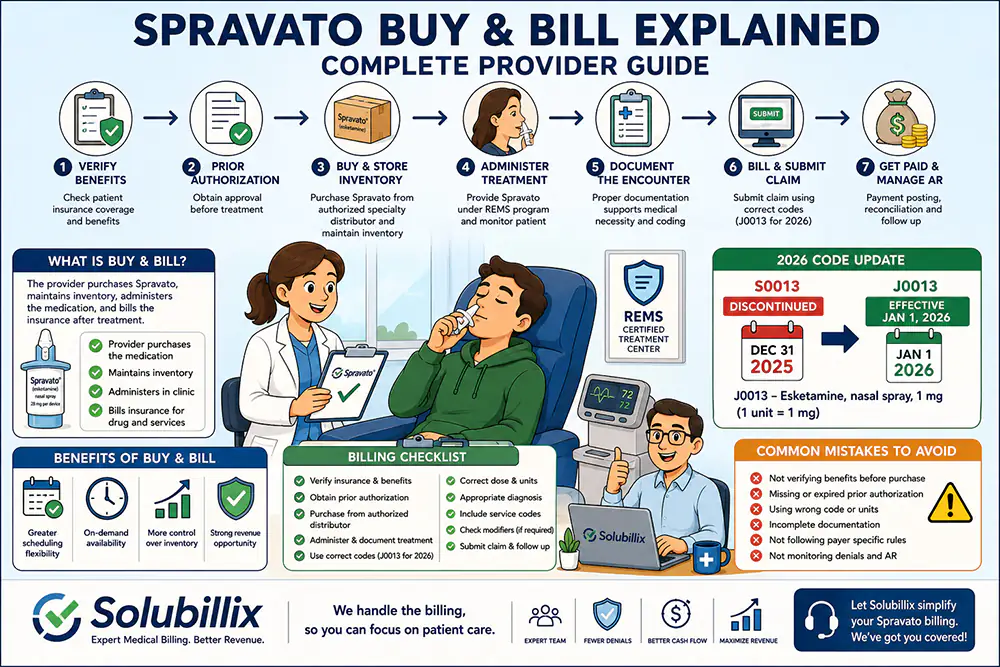
For patients whose coverage supports the medical-benefit pathway, a treatment center may use a buy-and-bill model. Under this approach, the provider purchases Spravato from an authorized specialty distributor, maintains the product as inventory, administers the medication in accordance with applicable requirements, and submits a claim for the drug and associated healthcare services after treatment.
For providers, buy-and-bill can provide greater control over inventory and treatment scheduling. However, it also places additional responsibility on the practice for authorization, procurement, inventory management, documentation, coding, claim submission, reimbursement, and denial follow-up.
At Solubillix, we help healthcare practices navigate complex medical billing and revenue cycle challenges. This guide explains the Spravato buy-and-bill process and the billing considerations providers should understand in 2026.
What Is Spravato Buy & Bill?
Spravato buy-and-bill is a healthcare drug procurement and reimbursement model in which the treatment center purchases the medication before treatment and later bills the applicable payer after the medication has been administered.
In a typical buy-and-bill workflow:
Provider purchases Spravato → Stores inventory → Verifies patient coverage → Obtains authorization → Administers treatment → Documents treatment → Submits claim → Receives reimbursement
The model is generally associated with medical-benefit coverage, although the patient’s specific benefit design and payer policy determine whether buy-and-bill is available.
The official Spravato provider guidance states that buy-and-bill allows a treatment center to acquire product through an authorized specialty distributor and submit a reimbursement claim after the product has been administered.
How Does Spravato Buy & Bill Work?
A successful buy-and-bill process requires coordination between the clinical and billing sides of the practice.
Step 1: Determine the Patient’s Benefit Design
Before purchasing medication, the practice should determine whether Spravato is covered under the patient’s:
- Medical benefit
- Pharmacy benefit
- Both benefits
- Neither benefit
The patient’s benefit design can determine which acquisition and billing pathway is appropriate.
This step is critical because a practice should not assume that every insurance plan allows the provider to purchase and bill the medication.
Step 2: Verify Eligibility and Benefits
The billing team should perform a detailed benefits investigation before treatment.
Important questions include:
- Is Spravato covered?
- Is it covered under the medical benefit?
- Is prior authorization required?
- Is there a site-of-care restriction?
- Is the provider in network?
- Is the drug subject to deductible or coinsurance?
- Does the payer require specific coding?
- Is buy-and-bill permitted?
- Is there a specialty pharmacy requirement?
- Are there frequency or treatment limitations?
Obtaining a patient’s insurance card alone is not enough to determine whether the treatment will be reimbursed.
Step 3: Obtain Prior Authorization
Many Spravato treatment workflows require authorization before treatment.
The practice should confirm:
- Authorization number
- Effective date
- Expiration date
- Approved number of treatments
- Approved dose or treatment frequency, when applicable
- Authorized provider
- Authorized location
- Applicable drug/service codes
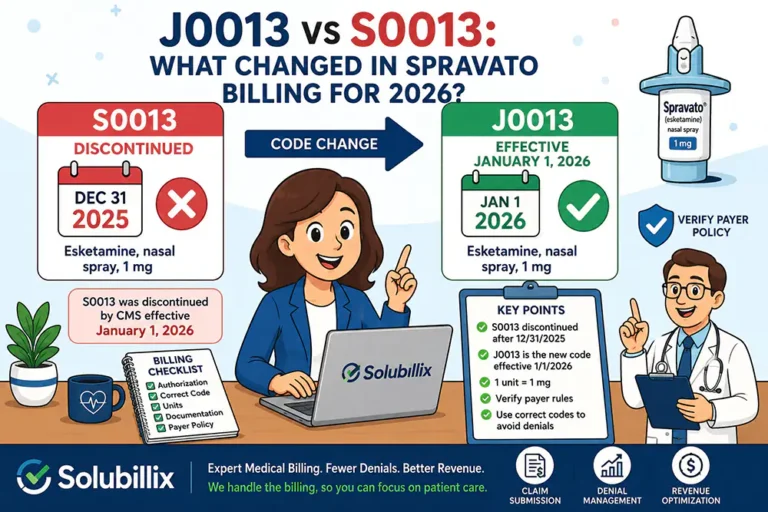
A particularly important 2026 consideration is the transition from S0013 to J0013.
J0013 vs. S0013 in 2026
Beginning January 1, 2026, CMS discontinued S0013 and replaced it with J0013 — Esketamine, nasal spray, 1 mg. During the transition, some payers may continue to direct providers to use J3490 in certain circumstances.
For providers using buy-and-bill, this means the billing team should review its:
- Charge master
- EHR setup
- Billing software
- Payer contracts
- Prior authorization records
- Claim templates
- Fee schedules
The change should not be treated as a simple copy-and-replace exercise because payer implementation can differ.
Step 4: Establish an Authorized Procurement Process
A treatment center using buy-and-bill needs an appropriate procurement relationship with an authorized specialty distributor.
The practice should establish the necessary distributor account and understand:
- Ordering requirements
- Pricing
- Payment terms
- Shipping procedures
- Inventory requirements
- Storage requirements
- Product handling
- Replacement procedures
- Return policies, when applicable
Spravato’s provider resources specifically identify authorized specialty distributors as part of the buy-and-bill pathway.
Step 5: Purchase and Maintain Inventory
Unlike the specialty-pharmacy model, buy-and-bill requires the treatment center to maintain medication inventory.
This creates both an operational advantage and a financial responsibility.
Potential advantages include:
- Greater treatment scheduling flexibility
- On-demand availability
- Less dependence on shipment timing for each individual patient
- Ability to maintain inventory for scheduled treatment
- Greater control over the procurement process
However, inventory also represents money invested by the practice before reimbursement is received.
A practice therefore needs strong controls for:
- Inventory tracking
- Product expiration
- Storage
- Ordering
- Administration records
- Reconciliation between inventory and claims
The manufacturer notes that buy-and-bill allows treatment centers to manage inventory and provides flexibility for real-time treatment.
Step 6: Administer Spravato and Document the Encounter
Once the patient arrives for treatment, clinical staff should document the services according to applicable clinical, regulatory, and payer requirements.
Documentation should support the services actually performed.
Depending on the patient’s circumstances and payer requirements, records may include:
- Patient identification
- Medication administered
- Dose
- Date of administration
- Treatment documentation
- Observation/monitoring
- Relevant clinical assessment
- Provider involvement
- Medical necessity
- Treatment response
- Discharge information
The billing team should never rely on a drug code alone to establish that the complete claim is supported.
How Is Spravato Billed Under Buy & Bill?
The exact claim structure depends on the payer, benefit design, and services furnished.
For 2026, J0013 is the drug HCPCS code for esketamine nasal spray, 1 mg. However, J0013 is described by the manufacturer as a Medicare non-payable code, while Medicare Spravato services use G2082 or G2083 where applicable. For non-Medicare payers, J0013 may be used as the drug code according to payer policy.
Commercial and Medicaid plans may have different requirements.
For example, UnitedHealthcare’s 2026 commercial medical drug policy lists J0013 and J3490 for Spravato.
Therefore, the billing team should always verify the payer’s current policy before submitting a claim.
J0013 Units: An Important Billing Consideration
J0013 represents 1 mg of esketamine nasal spray.
When J0013 is applicable, the number of units should reflect the amount represented by the dose according to the payer’s billing instructions.
For example:
- 56 mg dose → 56 units
- 84 mg dose → 84 units
However, practices should not assume that a universal unit rule overrides payer-specific requirements.
The claim should be reviewed against the payer’s current billing policy, the actual dose administered, and the practice’s documentation.
Medicare Spravato Buy & Bill Billing
Medicare requires special attention.
The current Spravato coding guidance states that J0013 is a Medicare non-payable code, while G2082 and G2083 should be used to accurately capture applicable Spravato services for Medicare beneficiaries.
This means a practice should not simply take a commercial payer’s J0013 billing workflow and apply it to Medicare.
Before submitting a Medicare claim, verify:
- Patient eligibility
- Medicare coverage requirements
- Applicable G-code
- Site of service
- Documentation
- Provider qualifications
- Current MAC requirements
- Any applicable billing edits
Buy & Bill vs. Specialty Pharmacy: What’s the Difference?
Spravato can generally be acquired through different pathways depending on the patient’s benefit design.
| Feature | Buy & Bill | Specialty Pharmacy |
| Product purchased by | Treatment center | REMS-certified pharmacy |
| Typical benefit | Medical benefit | Pharmacy benefit |
| Provider maintains inventory | Yes | No |
| Provider bills for drug | Generally yes | Generally no |
| Provider bills for services | Yes, as applicable | Yes |
| Treatment scheduling flexibility | Generally higher | Shipment coordination required |
| Inventory responsibility | Provider | Pharmacy |
Under the specialty-pharmacy model, the pharmacy supplies the patient-assigned product to the treatment site, and the provider generally bills for applicable healthcare services rather than purchasing the medication as inventory.
The correct pathway depends on the patient’s benefit design and payer requirements.
The Financial Side of Spravato Buy & Bill
Buy-and-bill can create a significant cash-flow consideration.
The provider purchases inventory before receiving reimbursement from the payer.
That means the practice needs to consider:
Acquisition Cost
How much is the practice paying for the medication?
Reimbursement
How much will the payer reimburse?
Patient Responsibility
What portion is potentially assigned to the patient under the applicable benefit?
Payment Timing
How long will the payer take to process the claim?
Denial Risk
What happens if the claim is denied or underpaid?
Inventory Risk
What happens if product expires or treatment is canceled?
A practice should evaluate the complete financial cycle—not simply the difference between acquisition cost and the expected allowed amount.
Common Spravato Buy & Bill Billing Mistakes
Mistake #1: Purchasing Before Confirming Coverage
The practice orders the medication before confirming that the patient’s plan covers Spravato under the medical benefit.
Better approach: Complete benefits verification before procurement whenever possible.
Mistake #2: Assuming Every Payer Uses the Same Codes
Payers can have different coding requirements.
Better approach: Verify the payer-specific policy for each patient.
Mistake #3: Using S0013 for a 2026 Claim
S0013 was discontinued by CMS effective January 1, 2026.
Better approach: Review the claim against the payer’s 2026 requirements and determine whether J0013 or another code is required.
Mistake #4: Ignoring Prior Authorization
An approved medication does not automatically mean every treatment is authorized.
Better approach: Track authorization dates, treatment limits, and approved services.
Mistake #5: Incorrect J0013 Units
Incorrect units can create claim discrepancies and reimbursement problems.
Better approach: Compare the billed units with the actual dose and payer instructions.
Mistake #6: Applying Commercial Coding to Medicare
Medicare’s Spravato coding structure has important differences.
Better approach: Use the current Medicare-specific coding guidance.
Mistake #7: Poor Inventory Tracking
If medication inventory does not reconcile with administration records and claims, errors can go unnoticed.
Better approach: Reconcile purchased, administered, and billed product.
Mistake #8: Failing to Monitor Underpayments
A claim marked “paid” is not necessarily paid correctly.
Better approach: Compare the payer’s allowed amount with your contracted reimbursement.
Spravato Buy & Bill Denial Prevention Checklist
Before submitting a claim, Solubillix recommends reviewing:
- Patient eligibility
- Medical vs. pharmacy benefit
- Buy-and-bill eligibility
- Prior authorization
- Authorization dates
- Provider network status
- Site-of-service requirements
- Drug code
- J0013 requirements for 2026
- Units
- Dose
- Diagnosis
- Administration/service coding
- Documentation
- Modifiers, when applicable
- NDC requirements, if applicable
- Payer-specific claim rules
- Contracted reimbursement
- Patient responsibility
A strong pre-billing review can prevent avoidable claim rejections and reduce unnecessary AR.
How Solubillix Can Help With Spravato Buy & Bill
Spravato billing requires coordination between clinical documentation, authorization, procurement, coding, claims, payment posting, and denial management.
That’s where an experienced medical billing partner can make a difference.
Solubillix supports healthcare practices with revenue cycle management services designed to improve billing accuracy and reduce avoidable revenue leakage.
Our support can include:
- Insurance verification
- Benefits investigation
- Prior authorization support
- Spravato claim submission
- J0013 billing review
- Payer policy research
- Claim rejection management
- Denial follow-up
- Underpayment analysis
- AR management
- Payment posting
- Patient balance management
- Revenue cycle reporting
Our goal is to help providers build a billing process that is accurate, organized, payer-aware, and financially sustainable.
Final Thoughts: Is Spravato Buy & Bill Right for Your Practice?
Spravato buy-and-bill can give treatment centers greater control over product inventory and treatment scheduling, but it also transfers significant operational and financial responsibilities to the provider.
Before implementing the model, a practice should understand:
- The patient’s benefit design
- Payer coverage requirements
- Prior authorization requirements
- Procurement requirements
- Inventory responsibilities
- Current coding rules
- 2026 J0013 changes
- Medicare-specific requirements
- Claim submission procedures
- Reimbursement expectations
- Denial and AR processes
Most importantly, buy-and-bill should never be treated as a one-size-fits-all billing model.
Payer policies can differ, and providers are responsible for selecting codes that accurately represent the services and products furnished and comply with applicable payer requirements.
For practices providing Spravato, getting the billing workflow right from the beginning can help reduce avoidable denials, improve cash flow, and create a more predictable revenue cycle.
Need help managing your Spravato billing?
Solubillix can help your practice manage the billing side while your clinical team focuses on patient care.
Frequently Asked Questions About Spravato Buy & Bill
What does Spravato buy-and-bill mean?
Spravato buy-and-bill means the treatment center purchases Spravato through an authorized specialty distributor, maintains inventory, administers the medication, and submits a claim to the applicable payer after treatment.
Is Spravato buy-and-bill covered by insurance?
It can be, depending on the patient’s benefit design and payer policy. Providers should verify whether Spravato is covered under the medical benefit and whether the payer permits buy-and-bill.
What is the 2026 Spravato drug code?
For 2026, J0013 is the HCPCS code for esketamine nasal spray, 1 mg. S0013 was discontinued by CMS effective January 1, 2026.
Does Medicare pay J0013?
J0013 is identified as a Medicare non-payable code. Medicare Spravato services use G2082 or G2083 where applicable.
Can a provider bill both the Spravato drug and the professional service?
The answer depends on the payer and billing arrangement. Some payer policies may require the drug and service to be billed separately, while others may use bundled approaches. Providers should verify the applicable payer policy.
Who purchases Spravato under buy-and-bill?
The treatment center purchases the medication through an authorized specialty distributor and maintains the product as inventory.
What is the difference between Spravato buy-and-bill and specialty pharmacy?
With buy-and-bill, the treatment center purchases and maintains the medication inventory. With the specialty-pharmacy pathway, a REMS-certified pharmacy supplies the patient-assigned product and the administering provider generally bills for applicable healthcare services.
Can Spravato buy-and-bill create cash-flow risk?
Yes. The provider generally purchases inventory before submitting the reimbursement claim, so the practice must account for acquisition costs, reimbursement timing, patient responsibility, denials, and inventory management.
Why should a medical billing company handle Spravato claims?
Spravato billing involves payer-specific requirements, authorization, drug coding, units, documentation, reimbursement, and denial management. A specialized billing team can help practices monitor these elements and reduce avoidable billing errors.