
Occupational & Speech Therapy Medical Billing Specialists
Occupational therapy billing can become complicated when multiple timed services are provided during the same visit. One of the most common areas of confusion is determining how many units can be reported based on the actual treatment time.
For Medicare Part B, the 8-minute rule provides a methodology for calculating units for many timed therapy services. Understanding how this rule works—and making sure the medical record supports the units billed—can help occupational therapy practices reduce avoidable billing errors and claim denials.
At Solubillix, we work with healthcare providers to navigate the details behind therapy billing, including coding, documentation, payer requirements, claims, denials, and reimbursement.
This guide explains the Medicare 8-minute rule in practical terms and highlights common problems OT practices should watch for.
What Is the 8-Minute Rule for Occupational Therapy?
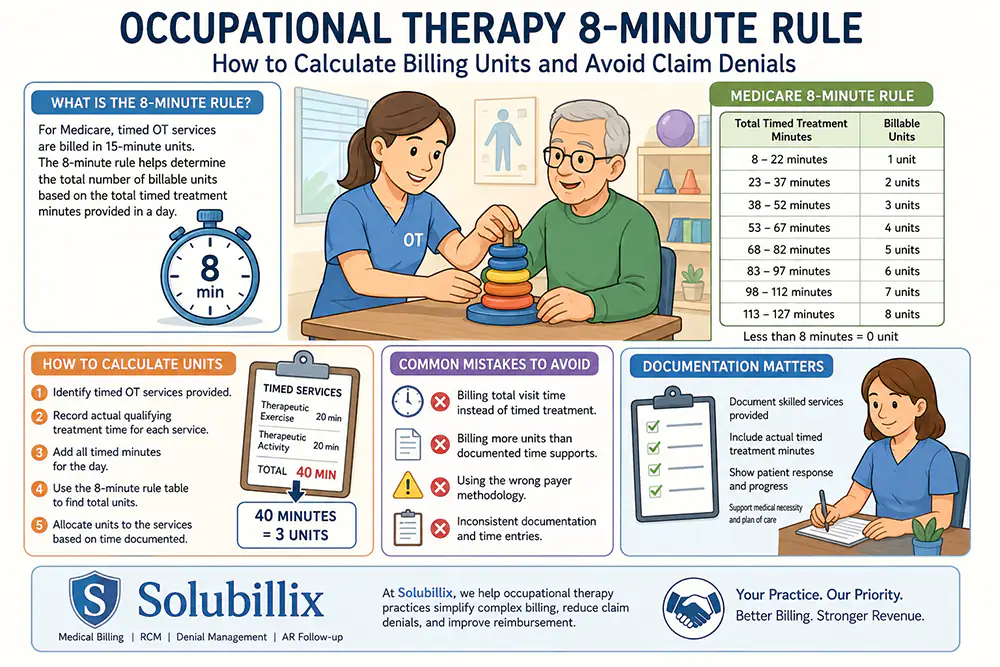
The Medicare 8-minute rule is used to determine the number of billable units for certain timed therapy services.
Many therapy services are reported in 15-minute units. Under the Medicare methodology, the total qualifying timed treatment minutes for the same discipline and date of service are used to determine the total number of units that may be reported.
The basic Medicare calculation is:
| Total Timed Treatment Minutes | Medicare Units |
| 8–22 minutes | 1 unit |
| 23–37 minutes | 2 units |
| 38–52 minutes | 3 units |
| 53–67 minutes | 4 units |
| 68–82 minutes | 5 units |
| 83–97 minutes | 6 units |
| 98–112 minutes | 7 units |
| 113–127 minutes | 8 units |
For example, if an occupational therapist provides 40 minutes of qualifying timed treatment, the total falls within the 38–52 minute range, resulting in 3 Medicare timed units.
If qualifying timed treatment is less than 8 minutes, a timed service generally does not produce a billable unit under the Medicare methodology.
How to Calculate OT Billing Units
The process becomes easier when the billing team follows a consistent sequence.
Step 1: Identify the timed services
First, determine which services provided during the visit are timed services and which are untimed services.
Timed and untimed services should not be treated the same way when calculating units.
Step 2: Document the actual treatment time
The treatment record should accurately reflect the time spent providing qualifying skilled treatment.
CMS distinguishes Timed Code Treatment Minutes from Total Treatment Time. Time spent waiting, resting, toileting, or performing activities that do not qualify as skilled timed treatment should not simply be converted into billable units.
Step 3: Add the qualifying timed minutes
When multiple timed OT services are provided on the same date of service, the qualifying timed minutes are combined to determine the total number of Medicare timed units.
For example:
- 20 minutes of one timed OT service
- 20 minutes of another timed OT service
Total timed treatment = 40 minutes
Under Medicare’s methodology, 40 minutes supports 3 total timed units.
Step 4: Allocate the units correctly
Determining the total number of units is only part of the process.
The units also need to be assigned to the appropriate services based on the treatment documented.
This is an area where billing mistakes frequently occur. CMS explains that each service should be supported by the documented treatment time and that the total number of units cannot simply be assigned to whichever service is most convenient.
Example: Two OT Services During One Visit
Consider this example:
Service A: 20 minutes
Service B: 20 minutes
Total qualifying timed treatment:
20 + 20 = 40 minutes
Forty minutes falls into the Medicare 3-unit range.
However, the claim should still reflect the services actually performed and the documentation supporting those services.
This is why accurate clinical documentation and accurate charge entry need to work together.
What Counts as Timed Treatment?
A common billing mistake is treating the entire time a patient spends at the therapy facility as billable treatment time.
For Medicare, timed treatment generally relates to the period of skilled, direct treatment associated with the timed service.
CMS explains that pre-service and post-service activities generally aren’t included in timed treatment minutes. Time when a patient is waiting for treatment, waiting for equipment, resting, or independently performing an activity also should not automatically be counted as timed treatment.
This distinction is important because total visit time is not necessarily the same as billable timed treatment time.
8-Minute Rule vs. Other Insurance Payers
This is one of the most important points for OT practices:
The Medicare 8-minute rule does not automatically apply to every payer.
AOTA identifies two commonly used approaches for timed-code unit calculation:
- Medicare’s 8-minute rule
- The AMA midpoint or “rule of 8s” methodology
The payer determines which methodology applies.
Therefore, an OT practice should not automatically use Medicare’s calculation for every commercial insurance plan.
Depending on the patient’s coverage, billing requirements may differ for:
- Commercial insurance
- Medicare Advantage
- Medicaid
- Workers’ compensation
- TRICARE
- Other payer programs
Solubillix recommendation: Maintain payer-specific billing guidelines rather than relying on one universal unit-calculation method.
Common OT 8-Minute Rule Billing Mistakes
1. Counting the Entire Visit as Billable Time
A patient may spend 60 minutes at the practice without receiving 60 minutes of qualifying timed treatment.
Billing should be based on the applicable payer’s rules and the treatment time supported by the documentation.
2. Billing Units That Exceed the Documented Minutes
If the clinical record does not support the number of units submitted, the claim may be questioned or denied.
For example, billing four timed units while documenting only 30 minutes of qualifying treatment creates an obvious inconsistency under Medicare’s methodology.
3. Combining Timed and Untimed Minutes Incorrectly
Untimed services are handled differently from timed services.
CMS explains that minutes associated with untimed services are not included when calculating timed-code units.
4. Applying Medicare Rules to Every Payer
A calculation can be correct for traditional Medicare and still be incorrect for another insurance plan.
Always verify the payer’s billing methodology.
5. Inconsistent Treatment Documentation
Consider:
Treatment note: 42 minutes
Charge entry: 60 minutes
Claim: 4 units
Even if the service itself was medically appropriate, the inconsistency creates a billing problem.
The clinical record, charge entry, and claim should be consistent.
6. Ignoring OTA Billing Requirements
When an occupational therapy assistant participates in Medicare services, additional requirements may apply.
CMS has specific rules concerning the CO modifier and the de minimis standard for services furnished by OTAs. Current Medicare guidance includes specific treatment of the final unit when the OT independently provides at least 8 minutes.
This is an important area where OT practices should not rely solely on a basic 8-minute-unit calculation.
Documentation Is the Foundation of Accurate OT Billing
Correct unit calculation starts with good documentation.
A strong OT treatment record should clearly connect:
Patient condition → functional limitation → skilled intervention → treatment time → patient response → progress toward goals
Documentation should support the medical necessity and skilled nature of the services reported.
For timed services, the record should also support the treatment minutes used to determine the units submitted.
This matters because CMS states that the medical record must support the services and units reported on the claim.
How OT Practices Can Reduce 8-Minute Rule Denials
A practical internal review process can prevent many avoidable problems.
Before submitting an OT claim, verify:
- The correct payer methodology was identified.
- Timed and untimed services were distinguished.
- Actual qualifying treatment minutes were documented.
- Total timed minutes were calculated correctly.
- Units are supported by the documented time.
- Units were allocated to the appropriate services.
- The claim agrees with the treatment note.
- Applicable modifiers were reviewed.
- Medical necessity and the plan of care are supported.
- Payer-specific billing requirements were checked.
This type of review is particularly valuable when a practice has multiple therapists, OTAs, locations, or insurance contracts.
Medicare OT Billing in 2026
The 8-minute rule is only one part of Medicare occupational therapy billing.
Practices also need to consider current Medicare requirements involving documentation, medical necessity, applicable modifiers, therapy thresholds, and payment policies.
For 2026, CMS lists the Medicare therapy KX modifier threshold for occupational therapy at $2,480. This is separate from calculating individual timed treatment units.
Medicare also continues to apply a 50% multiple procedure payment reduction to the practice-expense component of applicable therapy services, with the highest practice-expense service generally paid at 100% and subsequent applicable services at 50%.
These rules demonstrate why effective OT billing requires more than simply calculating minutes.
Solubillix: Occupational Therapy Billing Expertise
At Solubillix, we understand that occupational therapy billing is different from general medical billing.
OT practices have to manage the relationship between:
CPT coding + treatment time + documentation + medical necessity + payer requirements + claims + denials + reimbursement
A mistake in one area can affect the entire revenue cycle.
Our goal is to help occupational therapy practices maintain a more organized billing process, identify claim problems, reduce avoidable billing errors, and pursue appropriate reimbursement.
Whether your practice needs help with claim submission, insurance follow-up, denial management, payment posting, accounts receivable, or broader revenue-cycle management, Solubillix is focused on helping healthcare providers protect the revenue they have already earned.
Need Help With Occupational Therapy Billing?
If your OT practice is experiencing recurring denials, inconsistent unit billing, delayed payments, or growing accounts receivable, Solubillix can help evaluate your billing workflow and identify opportunities for improvement.
Contact Solubillix to discuss your occupational therapy medical billing needs.
Frequently Asked Questions
What is the 8-minute rule in occupational therapy?
For Medicare, the 8-minute rule is a methodology used to determine the number of billable units for certain timed therapy services based on qualifying treatment minutes.
How many units can be billed for 30 minutes of OT?
Under the Medicare 8-minute methodology, 30 minutes of qualifying timed treatment falls within the 23–37 minute range, supporting 2 timed units.
How many units are 45 minutes of occupational therapy?
Under the Medicare methodology, 45 minutes falls within the 38–52 minute range, supporting 3 timed units.
Does every insurance company use the Medicare 8-minute rule?
No. Payers may use different methodologies. AOTA notes that the payer determines which time-calculation method applies.
Is the entire OT appointment considered billable treatment time?
No. Total appointment time and qualifying timed treatment time are not necessarily the same. CMS provides specific guidance regarding what time is included in timed treatment minutes.
Can OT billing units be denied because of documentation?
Yes. If the documentation does not adequately support the services or units reported, the claim may be subject to denial or additional review.
Final Takeaway
The Medicare 8-minute rule may look like a simple calculation, but accurate occupational therapy billing requires much more than counting minutes.
A successful billing process connects:
Accurate treatment time → appropriate coding → supporting documentation → correct payer methodology → clean claim submission
For Medicare, understanding the 8-minute rule is an important part of that process. For other payers, OT practices should verify the applicable billing methodology before submitting claims.
At Solubillix, our focus is helping healthcare providers navigate the details of medical billing so they can spend less time dealing with billing problems and more time running their practices.
Solubillix — Medical Billing & Revenue Cycle Support for Healthcare Providers.