
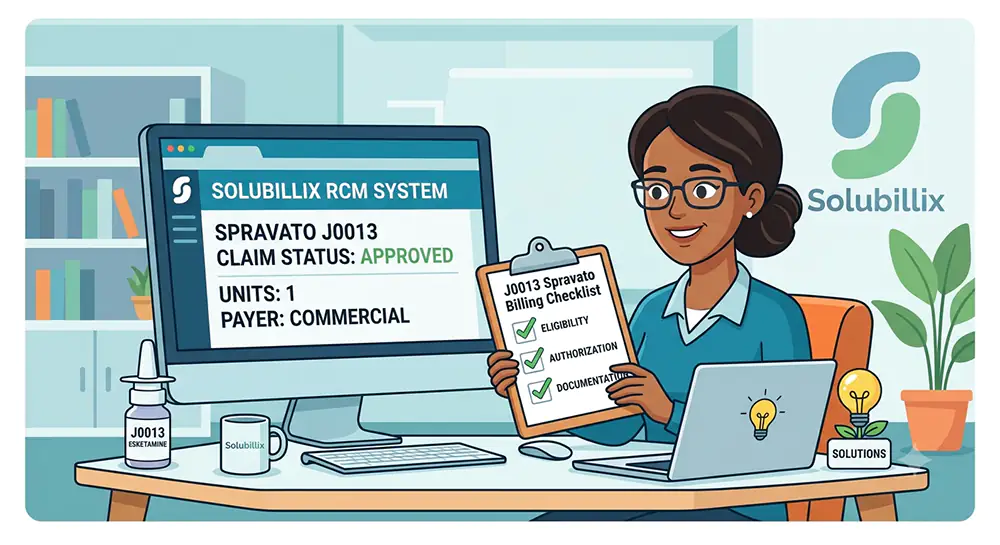
Spravato® (esketamine) billing has become increasingly important for behavioral health practices offering treatment for eligible patients. However, Spravato Buy & Bill reimbursement can be complicated because successful payment depends on more than submitting a drug code.
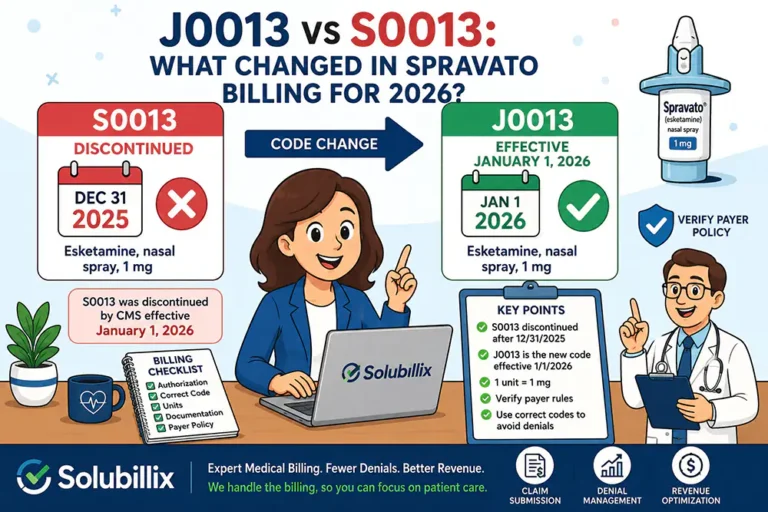
Beginning January 1, 2026, CMS discontinued S0013 and replaced it with J0013, creating an important coding change for practices and billing teams. J0013 represents esketamine nasal spray on a per-milligram basis, while Medicare has separate coding requirements for Spravato services.
For practices using a Buy & Bill model, errors involving the drug code, units, payer requirements, authorization, documentation, or coordination between the drug and professional service claim can result in claim denials, delayed reimbursement, and revenue leakage.
This guide explains common J0013 Spravato billing problems and practical strategies for preventing them.
What Is J0013?
J0013 is the 2026 HCPCS code for esketamine nasal spray, reported per 1 mg.
CMS discontinued S0013 effective January 1, 2026, and J0013 replaced it in the HCPCS code set. However, practices should not assume that every payer handles J0013 identically. Commercial, Medicaid, and other payer policies may differ.
This distinction is particularly important for Buy & Bill practices because the billing team must determine:
- Which drug code the payer requires
- Whether J0013 is payable for that payer
- How many units should be reported
- Whether the drug and administration/service are billed separately
- Whether prior authorization is required
- Whether the payer requires additional documentation
The code change does not mean that every Spravato claim should automatically be billed with J0013.
J0013 vs. Medicare Spravato Billing
One of the most important distinctions for 2026 is the difference between J0013 drug billing and Medicare Spravato service billing.
According to current Spravato reimbursement guidance, J0013 is a Medicare non-payable code for the drug, while Medicare uses G2082 and G2083 to capture the applicable Spravato treatment service for Medicare beneficiaries. Professional service time is handled separately where applicable under the payer’s rules.
CMS’s own esketamine billing article also provides Medicare-specific coding guidance and cautions that its coding guidance does not itself guarantee coverage.
Why this matters
A billing team that treats J0013 as a universal Spravato billing code can create unnecessary denials.
Before submitting a claim, determine:
Payer → Coverage → Required drug code → Units → Service code → Documentation → Claim format
This should be part of the practice’s standard Spravato billing workflow.
10 Common J0013 Spravato Billing Errors
1. Using S0013 After the 2026 Code Change
One of the first errors practices may encounter is continuing to submit the discontinued S0013 code after January 1, 2026.
CMS discontinued S0013 effective January 1, 2026 and replaced it with J0013.
Solution
Update:
- Billing software
- Charge master
- EHR templates
- Clearinghouse claim rules
- Payer-specific billing instructions
- Internal billing cheat sheets
However, do not assume every payer transitioned at exactly the same operational pace. Verify payer-specific instructions before changing a claim workflow.
2. Billing J0013 to Medicare Incorrectly
A common misconception is:
“J0013 is the new Spravato code, so we should bill J0013 to every payer.”
That is not correct.
Current reimbursement guidance identifies J0013 as a Medicare non-payable drug code, while Medicare Spravato services use G2082/G2083 under the applicable Medicare billing rules.
Solution
Build a payer-specific Spravato billing matrix.
For example:
| Payer Type | Billing Review |
| Medicare | Verify applicable G-code/service requirements |
| Commercial | Verify whether J0013 is required/payable |
| Medicaid | Follow state/payer-specific requirements |
| Medicare Advantage | Verify individual plan policy |
| Other payer | Confirm current coding and reimbursement policy |
Never rely on a single universal Spravato billing rule.
3. Incorrect J0013 Units
J0013 is reported based on the amount of esketamine represented by the code’s billing unit.
An incorrect unit calculation can cause:
- Claim rejection
- Medical record mismatch
- Underpayment
- Overpayment
- Drug quantity discrepancy
- Payer audit concerns
Solution
The billing team should reconcile:
Dose administered → Product/package information → HCPCS unit → Claim quantity
The quantity submitted should be supported by the documentation and the payer’s billing requirements.
Do not simply copy the number of nasal spray devices or packages into the units field without confirming how the payer defines the billing unit.
4. Confusing Drug Billing With Administration/Professional Services
Spravato Buy & Bill involves more than the medication itself.
A practice may need to account for:
- Drug acquisition
- Drug billing
- Administration/treatment service
- Patient monitoring
- Evaluation and management services, when separately reportable
- Observation requirements
- Payer-specific claim rules
The drug code and professional services should not automatically be treated as interchangeable.
Solution
Create separate billing checkpoints for:
Drug → Administration/Service → E/M, if applicable → Documentation → Payer rules
For Medicare beneficiaries, review whether the applicable G2082/G2083 requirements apply rather than automatically adding J0013.
5. Missing or Invalid Prior Authorization
Prior authorization is one of the most significant areas of risk for Spravato practices.
A patient may have active insurance but still require authorization before treatment.
Common problems include:
- Authorization not obtained
- Authorization expired
- Incorrect authorization dates
- Wrong provider/facility listed
- Incorrect units or treatment frequency
- Authorization obtained for the wrong product
- Authorization not updated after insurance changes
Solution
Before the first treatment, verify:
- Eligibility
- Benefits
- Medical necessity requirements
- Prior authorization
- Authorization number
- Effective dates
- Approved treatment frequency
- Approved provider/location
- Payer-specific drug requirements
Then perform periodic authorization reviews throughout the treatment course.
6. Diagnosis Does Not Support Medical Necessity
A claim can contain the correct J0013 code and still be denied if the diagnosis and documentation do not support the payer’s coverage requirements.
CMS’s current Medicare esketamine billing guidance identifies diagnosis-code selection in connection with the FDA-approved indication and applicable Medicare coverage rules.
Solution
The diagnosis should be:
- Supported by the medical record
- Consistent with the provider’s assessment
- Appropriate for the treatment being billed
- Consistent with the payer’s coverage policy
The billing team should never select a diagnosis simply because it appears more likely to produce payment.
7. Documentation Does Not Support the Claim
Spravato documentation should support the treatment provided and the services billed.
Depending on the payer and service, documentation may need to establish elements such as:
- Patient diagnosis
- Treatment indication
- Dose administered
- Date of treatment
- Product administered
- Clinical assessment
- Treatment monitoring
- Required observation
- Patient response
- Provider involvement
- Medical necessity
- Disposition/follow-up
SPRAVATO is administered in certified healthcare settings under its REMS requirements, and patients are monitored after administration according to the prescribing requirements.
Solution
Create a Spravato documentation checklist that billing staff can review before submitting the claim.
8. Drug Inventory Does Not Match the Claim
Buy & Bill practices purchase and maintain medication inventory before receiving reimbursement.
That creates a direct connection between:
Inventory → Administration → Documentation → Claim → Payment
If the inventory record shows one amount but the claim reports another, the practice may face reconciliation problems.
Solution
Perform regular reconciliation between:
- Medication inventory
- Purchase invoices
- Lot/expiration records
- Patient administration records
- EHR documentation
- Submitted claims
- Payer payments
This is especially important for expensive or closely monitored medications.
9. Incorrect Modifier or Claim Configuration
Modifiers and claim configuration can create avoidable problems when they do not match the payer’s requirements.
Examples include:
- Incorrect modifier
- Missing required modifier
- Incorrect place of service
- Incorrect provider information
- Incorrect rendering/billing provider
- Drug and service submitted incorrectly
- Duplicate claim submission
Solution
Develop payer-specific claim rules instead of applying one Spravato template to every insurance plan.
A claim should pass a final review for:
Code + Units + Modifier + POS + Provider + Diagnosis + Authorization + Payer
10. Ignoring Payer-Specific Spravato Policies
This is one of the biggest mistakes a billing company or practice can make.
The fact that a code exists does not automatically mean the payer will reimburse it.
CMS itself states that coding guidance does not imply coverage.
Commercial insurers, Medicare Advantage plans, Medicaid programs, and other payers may establish their own requirements.
Solution
Maintain a payer-specific Spravato reference sheet containing:
- Drug code
- Service code
- Authorization requirements
- Diagnosis requirements
- Units
- Modifiers
- Place of service
- Documentation requirements
- Timely filing limit
- Appeal requirements
- Reimbursement methodology
Update the matrix whenever a payer changes its policy.
Common Spravato Claim Denials and Solutions
| Denial Problem | Likely Cause | Billing Solution |
| Invalid procedure/drug code | Incorrect or outdated code | Verify current payer code requirements |
| Authorization denied | Missing/expired authorization | Verify authorization before treatment |
| Medical necessity denial | Diagnosis/documentation insufficient | Review payer criteria and clinical record |
| Incorrect units | Quantity does not match billing unit | Reconcile dose and HCPCS units |
| Non-covered service | Benefit exclusion or payer policy | Verify benefits and coverage |
| Duplicate claim | Same service submitted more than once | Review claim history and corrected claim process |
| Provider not eligible | Enrollment/network issue | Verify provider participation |
| Invalid modifier | Incorrect claim configuration | Review payer-specific modifier rules |
| Timely filing denial | Claim submitted too late | Monitor filing deadlines |
| Drug/service mismatch | Incorrect combination of codes | Review payer billing methodology |
Spravato Buy & Bill: A Better Billing Workflow
A strong Spravato billing process should begin before treatment, not after a claim is denied.
Step 1: Verify eligibility
Confirm that coverage is active on the date of service.
Step 2: Verify benefits
Determine whether Spravato and related services are covered under the patient’s plan.
Step 3: Obtain authorization
Confirm authorization requirements, dates, frequency, and approved provider/location.
Step 4: Confirm coding
Determine the correct drug and service codes for that specific payer.
Step 5: Verify dosage and units
Reconcile the administered dose with the appropriate billing units.
Step 6: Review documentation
Make sure the clinical record supports the treatment and billed services.
Step 7: Submit the claim
Perform a final coding and payer-specific claim review.
Step 8: Monitor adjudication
Track the claim until the payer processes it.
Step 9: Work denials quickly
Identify whether the issue involves:
Coding → Authorization → Medical necessity → Eligibility → Documentation → Payer processing
Step 10: Reconcile payment
Compare the payer’s payment against the expected reimbursement and contract terms.
Why Spravato Buy & Bill Requires Specialized RCM
Spravato billing is different from many routine behavioral health services because the practice may be managing both high-value medication reimbursement and professional healthcare services.
A mistake can therefore affect more than one part of the revenue cycle.
For example:
Incorrect authorization
↓
Treatment performed
↓
Claim submitted
↓
Drug claim denied
↓
Provider absorbs acquisition cost
↓
AR increases
↓
Practice cash flow is affected
That is why Spravato practices benefit from a billing process that addresses the entire cycle rather than simply submitting claims.
How Solubillix Can Help With Spravato Billing
Solubillix provides specialized medical billing and revenue cycle support for behavioral health practices offering Spravato services.
Our Spravato billing support can include:
- Eligibility verification
- Benefits verification
- Prior authorization support
- CPT/HCPCS coding review
- J0013 billing review
- Medicare G-code billing review
- Claim submission
- Claim rejection management
- Denial management
- Insurance follow-up
- Accounts receivable management
- Payment posting
- Underpayment review
- Buy & Bill reconciliation
- Payer-specific billing review
Our goal is to help providers identify billing problems before they become revenue problems.
Final Takeaway
The 2026 transition from S0013 to J0013 makes Spravato billing an important area for behavioral health practices to review. However, simply replacing S0013 with J0013 is not enough.
A successful Spravato billing process requires the practice to coordinate:
Eligibility + Benefits + Authorization + Diagnosis + Documentation + Drug Units + Coding + Claim Submission + Denial Management + AR
For Medicare, practices must also distinguish the J0013 drug code from the applicable Medicare Spravato service coding requirements, including G2082 and G2083.
For commercial and other payers, the practice should verify the payer’s current requirements before submitting claims.
Need Help With Spravato Buy & Bill Billing?
Solubillix helps behavioral health providers manage Spravato billing, coding, authorization, claims, denials, and revenue cycle management.
If your practice is experiencing J0013 denials, authorization problems, incorrect units, delayed reimbursement, or growing Spravato AR, a specialized billing review can help identify where revenue is being lost.
Solubillix — Specialized Medical Billing & RCM Support for Behavioral Health Providers.
Frequently Asked Questions
What is J0013?
J0013 is the 2026 HCPCS code for esketamine nasal spray, reported per 1 mg. CMS discontinued S0013 effective January 1, 2026.
Can J0013 be billed to Medicare?
J0013 is identified as a Medicare non-payable drug code. Medicare Spravato services use applicable G2082/G2083 coding under the Medicare billing rules. Always verify the current CMS/MAC requirements for the specific claim.
Why would a J0013 claim be denied?
Potential causes include incorrect payer-specific coding, invalid units, authorization problems, unsupported medical necessity, incorrect diagnosis, documentation deficiencies, provider/network issues, or claim configuration errors.
Is J0013 the same as S0013?
No. S0013 was discontinued by CMS effective January 1, 2026, and J0013 replaced it in the HCPCS code set.
Should every Spravato payer receive J0013?
No. Coding and reimbursement requirements vary by payer. Commercial and other payers may use J0013, while Medicare has separate service coding requirements. Verify the payer’s current policy before billing.
How can Spravato Buy & Bill practices reduce denials?
The most effective approach is to verify eligibility, benefits, authorization, coding, dosage/units, documentation, and payer requirements before treatment and before claim submission.
Disclaimer: This article is for educational purposes and does not replace current CPT, HCPCS, CMS, Medicare Administrative Contractor, payer, FDA, or plan-specific guidance. Spravato coding and reimbursement requirements can vary by payer and may change over time. Practices should verify current requirements before submitting claims.