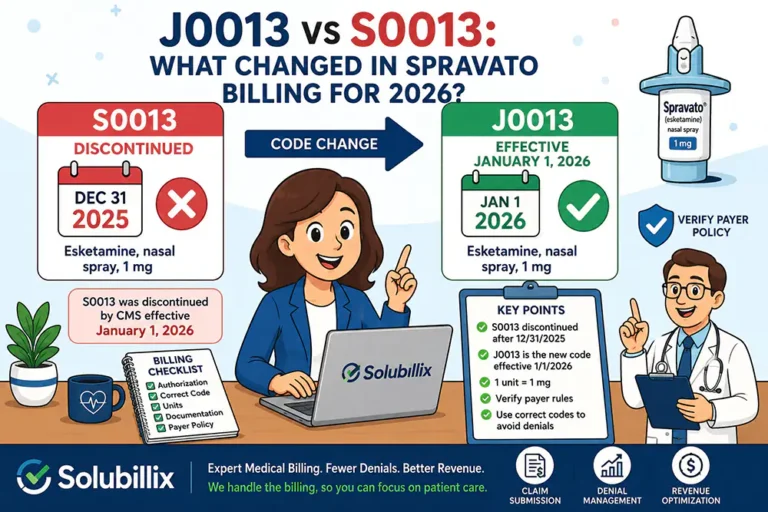

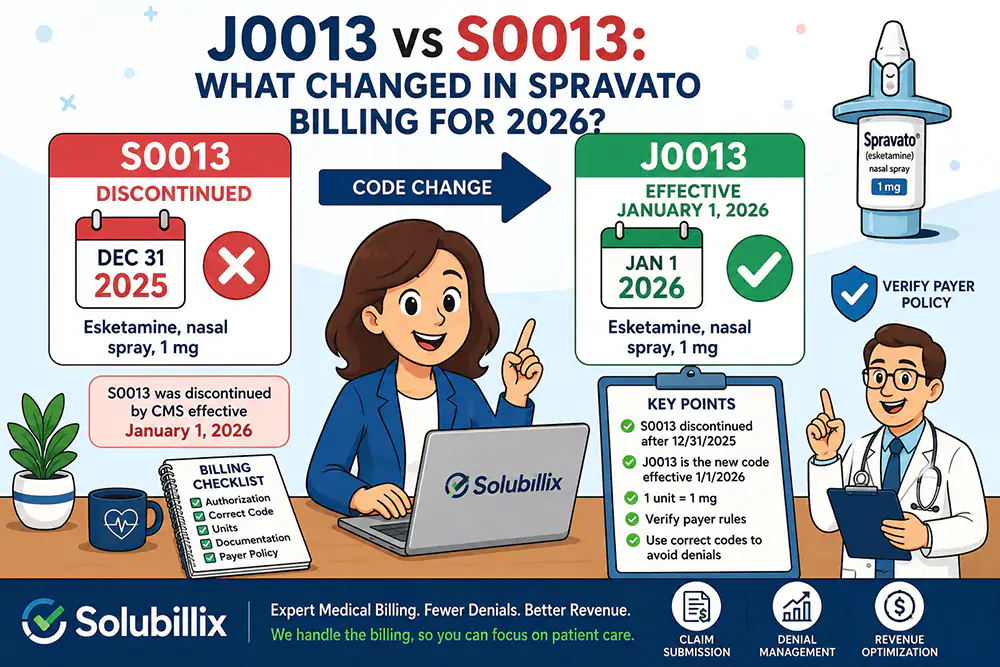
Spravato® (esketamine) billing changed significantly on January 1, 2026, when CMS discontinued HCPCS code S0013 and replaced it with J0013 — Esketamine, nasal spray, 1 mg.
For behavioral health practices providing Spravato treatment, this change is more than a simple code replacement. It can affect claim submission, prior authorizations, payer system configuration, units, reimbursement, and denial management.
The transition has also created payer-specific differences. Some insurers have updated their systems and policies to recognize J0013, while other payer workflows may require additional verification during the transition. The official Spravato HCP coding guidance confirms that S0013 was discontinued by CMS effective January 1, 2026, and J0013 became the replacement drug code.
For practices that depend on timely Spravato reimbursement, understanding the difference between S0013 and J0013 is essential.
At Solubillix, we help healthcare practices navigate complex medical billing, claim submission, denial management, and revenue cycle challenges—including specialized behavioral health billing workflows.
What Is the Difference Between S0013 and J0013?
The most important change is straightforward:
| Code | Description | 2026 Status |
| S0013 | Esketamine, nasal spray, 1 mg | Discontinued by CMS effective January 1, 2026 |
| J0013 | Esketamine, nasal spray, 1 mg | Replacement HCPCS code effective January 1, 2026 |
Although the descriptors are essentially the same, the code identifier changed.
S0013 was a temporary HCPCS code, while J0013 is the replacement J-code established for esketamine nasal spray.
This means practices should not assume that an authorization or billing setup using S0013 will automatically transition to J0013.
Payer systems, authorization records, fee schedules, claim edits, and billing software may all need to reflect the new code.
Why Did S0013 Change to J0013?
CMS periodically updates the HCPCS code set to establish, revise, or discontinue codes used to identify healthcare services, supplies, and drugs.
For 2026, CMS discontinued S0013 and introduced J0013 for esketamine nasal spray.
The change became effective January 1, 2026. Manufacturer coding guidance also identifies J0013 as:
Esketamine, nasal spray, 1 mg.
The practical implication for providers is that the drug line on applicable 2026 claims should be reviewed against the payer’s current billing policy rather than relying on a previous year’s claim configuration.
How Should J0013 Be Reported for Spravato?
J0013 represents esketamine nasal spray in 1 mg increments.
Therefore, the units generally correspond to the total milligrams of esketamine represented by the billed dose, subject to the applicable payer’s billing requirements.
For example:
- 56 mg dose → 56 units of J0013
- 84 mg dose → 84 units of J0013
However, providers should not rely solely on a generic unit formula. The payer’s policy, procurement arrangement, benefit design, and claim instructions should be verified before submission.
The official Spravato coding materials emphasize that coding depends on factors such as the patient’s benefit design, procurement method, and payer reimbursement requirements.
Does J0013 Replace G2082 and G2083?
No.
This is one of the most important distinctions in Spravato billing.
J0013 identifies the drug, while other codes may represent the applicable professional service and observation components depending on the payer and patient.
For Medicare beneficiaries, the coding structure is different. The Spravato manufacturer states that G2082 and G2083 should be used to accurately capture applicable Medicare Spravato services, while J0013 is described as a Medicare non-payable drug code.
Therefore, a billing team should not automatically replace every previous S0013 claim with J0013 without determining:
- The patient’s insurance type
- Whether the claim is being submitted under the medical or pharmacy benefit
- How the medication was obtained
- Whether the provider is using a buy-and-bill arrangement
- The payer’s current Spravato policy
- Whether G2082 or G2083 applies
- Whether a separate E/M or other service code is required
What Happened to Existing S0013 Prior Authorizations?
This is where the 2026 transition can become complicated.
A provider may have obtained an authorization for Spravato using S0013 before the code was discontinued. That authorization does not necessarily mean the payer’s system will automatically recognize J0013 for 2026 dates of service.
Some payers have specifically instructed providers to update or modify authorizations.
For example, Iowa Medicaid guidance states that claims for dates of service through December 31, 2025 should use S0013, while 2026 claims should use J0013. It also instructs providers with existing S0013 authorizations to modify them to J0013 when necessary.
This illustrates an important billing principle:
A code change does not always mean the payer’s authorization record changes automatically.
Before submitting a high-dollar Spravato claim, billing teams should verify whether the authorization has been updated.
Can a 2026 Spravato Claim Still Use S0013?
For CMS coding purposes, S0013 was discontinued effective January 1, 2026.
Therefore, providers should not continue using S0013 for 2026 dates of service simply because it was used successfully in 2025.
However, payer implementation can vary during transitions. The official Spravato HCP guidance notes that some payers may temporarily continue using J3490 (Unclassified drugs) while their systems transition to J0013.
This makes payer verification particularly important.
A billing team should determine the payer’s current requirements before submitting the claim rather than automatically selecting a code based on a prior claim.
Medicare vs. Commercial Spravato Billing in 2026
One of the biggest mistakes providers can make is assuming that all payers process Spravato the same way.
They do not.
Medicare
Medicare has specific coding considerations for Spravato. The manufacturer identifies G2082 and G2083 for applicable Medicare Spravato services and describes J0013 as a Medicare non-payable drug code.
Commercial Insurance
Commercial payers may use J0013 for the drug component, but individual payer policies determine how the medication, professional service, observation, and other applicable services should be reported.
For example, UnitedHealthcare’s 2026 commercial medical drug policy updated its applicable codes by adding J0013 and removing S0013 effective January 1, 2026.
Medicaid
Medicaid requirements can vary by state and managed care organization. Providers should verify the applicable state Medicaid and MCO billing policy.
The Iowa Medicaid 2026 update, for example, specifically requires J0013 for Spravato claims effective January 1, 2026.
Bottom line: Do not use one universal Spravato billing workflow for every payer.
Common Spravato Billing Problems After the S0013-to-J0013 Transition
The code change can create several revenue cycle problems.
1. Using S0013 for a 2026 Date of Service
A billing system may still have S0013 saved as the default drug code.
Submitting the old code for a 2026 claim can result in rejection or incorrect processing.
2. Authorization Still Shows S0013
A patient’s authorization may have been approved under the old code.
The billing team should verify whether the payer requires the authorization to be updated to J0013.
3. Incorrect Units
Because J0013 is reported in 1 mg increments, incorrect unit reporting can create claim discrepancies.
For example, a 56 mg dose and an 84 mg dose should not be reported using the same J0013 unit quantity when J0013 is the applicable drug code.
4. Incorrect Medicare Coding
Applying a commercial J0013 workflow to a Medicare claim without checking the Medicare-specific coding structure can cause billing problems.
5. Ignoring Payer-Specific Rules
Even when CMS has changed the code, payer-specific billing and reimbursement policies still matter.
6. Focusing Only on the Drug Code
A claim can contain the correct drug code and still have problems with authorization, diagnosis, professional services, documentation, or other claim requirements.
2026 Spravato Billing Checklist for Providers
Before submitting a Spravato claim, your billing team should review:
- Date of service
- Insurance type
- Payer-specific Spravato policy
- J0013 vs. S0013 requirements
- Prior authorization
- Authorization code and effective dates
- Dose administered
- J0013 units, when applicable
- Procurement method
- Medical vs. pharmacy benefit
- Applicable E/M or G-code
- Observation requirements
- Diagnosis coding
- NDC requirements, if applicable
- Modifiers, when required
- Documentation supporting the service
- Payer-specific claim submission requirements
A structured pre-submission review can prevent avoidable denials and reduce the amount of rework required after the claim has already been submitted.
How Solubillix Helps With Spravato Medical Billing
Spravato billing requires more than simply selecting a HCPCS code.
A successful revenue cycle process needs coordination between eligibility verification, authorization, coding, claim submission, payment posting, denial management, and payer follow-up.
Solubillix provides medical billing and revenue cycle management support for healthcare practices, helping providers address complex billing workflows and reduce avoidable revenue leakage.
For Spravato practices, our billing approach can include:
- Insurance verification
- Prior authorization support
- Spravato claim submission
- J0013 billing review
- Payer-specific coding research
- Claim rejection analysis
- Denial management
- Underpayment review
- AR follow-up
- Payment posting
- Aging AR management
- Revenue cycle reporting
The goal is simple: help providers spend less time fighting billing problems and more time focusing on patient care.
Final Takeaway: J0013 Is the 2026 Replacement for S0013
The transition from S0013 to J0013 is one of the key Spravato billing changes for 2026.
The core change is:
S0013 → discontinued by CMS effective January 1, 2026
J0013 → replacement HCPCS code for esketamine nasal spray, 1 mg
But successful Spravato billing requires more than changing one code in the billing system.
Providers and billing teams should also review prior authorizations, payer policies, units, procurement arrangements, Medicare-specific requirements, and the applicable professional service codes.
Because payer implementation can differ, always verify the current payer policy before submitting the claim.
At Solubillix, we understand that specialized behavioral health services such as Spravato require specialized billing attention. Our medical billing team helps practices manage complex claims, denials, AR, and payer requirements so providers can build a more reliable revenue cycle.
Need help with Spravato billing or J0013 claim issues? Contact Solubillix to discuss your practice’s medical billing needs.
Frequently Asked Questions
Is S0013 still valid for Spravato billing in 2026?
CMS discontinued S0013 effective January 1, 2026, and replaced it with J0013 for esketamine nasal spray. Payer-specific transition requirements should still be verified.
What is J0013?
J0013 is the 2026 HCPCS code for esketamine, nasal spray, 1 mg.
What happened to S0013?
S0013 was discontinued by CMS effective January 1, 2026, and replaced by J0013.
How many J0013 units are used for Spravato?
When J0013 is the applicable drug code, units generally correspond to the milligrams represented by the dose. For example, 56 mg corresponds to 56 units and 84 mg corresponds to 84 units, subject to payer-specific billing instructions.
Does Medicare use J0013 for Spravato?
Medicare has specific Spravato coding considerations. The manufacturer identifies G2082 and G2083 for applicable Medicare services and describes J0013 as a Medicare non-payable code. Providers should follow current Medicare requirements rather than applying a commercial billing workflow.
Do commercial insurance companies use J0013?
Many commercial payer policies have transitioned from S0013 to J0013, but requirements can vary by payer and plan. UnitedHealthcare, for example, updated its 2026 commercial medical drug policy to add J0013 and remove S0013.
Does an S0013 prior authorization automatically transfer to J0013?
Not necessarily. Some payers may require the authorization to be updated. Providers should confirm this with the payer before submitting 2026 claims.
Can Spravato billing errors cause reimbursement delays?
Yes. Incorrect drug codes, units, authorization information, payer-specific coding, or other claim data can result in rejections, denials, delayed payment, or additional follow-up.
About Solubillix
Solubillix is a U.S.-focused medical billing and revenue cycle management company helping healthcare providers manage billing, claims, denials, accounts receivable, and payer-related challenges.
Solubillix — Turning Medical Billing Into Better Revenue.