
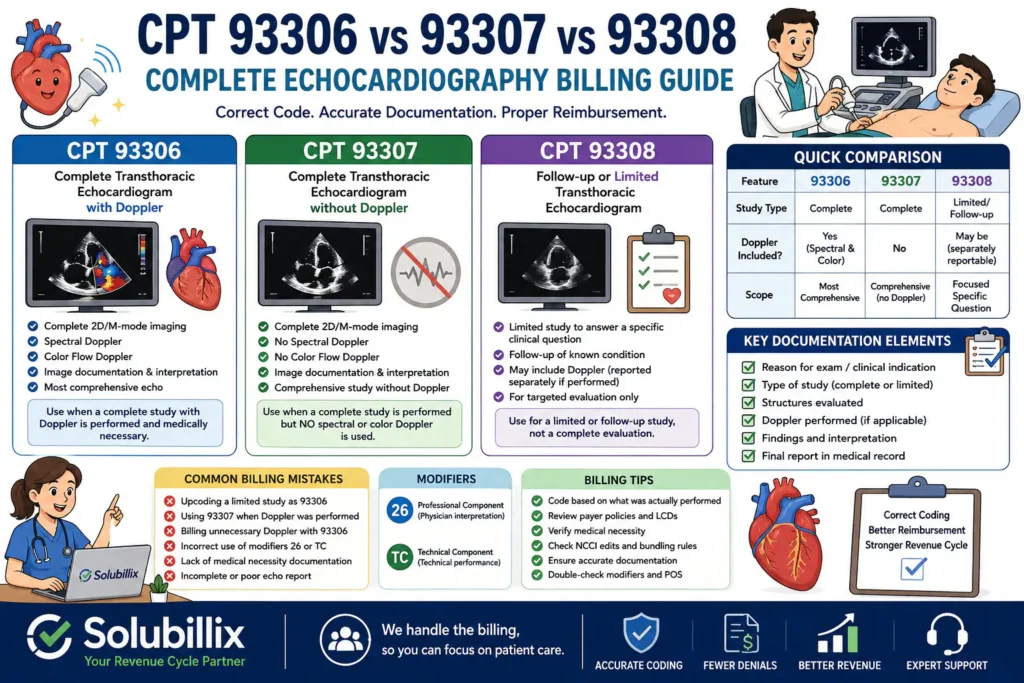
CPT 93306 vs 93307 vs 93308: What’s the Difference?
Confused about CPT 93306, 93307, and 93308? You’re not alone. These transthoracic echocardiography (TTE) codes are commonly used in cardiology billing, but they describe different types of examinations.
The simplest way to remember the difference is:
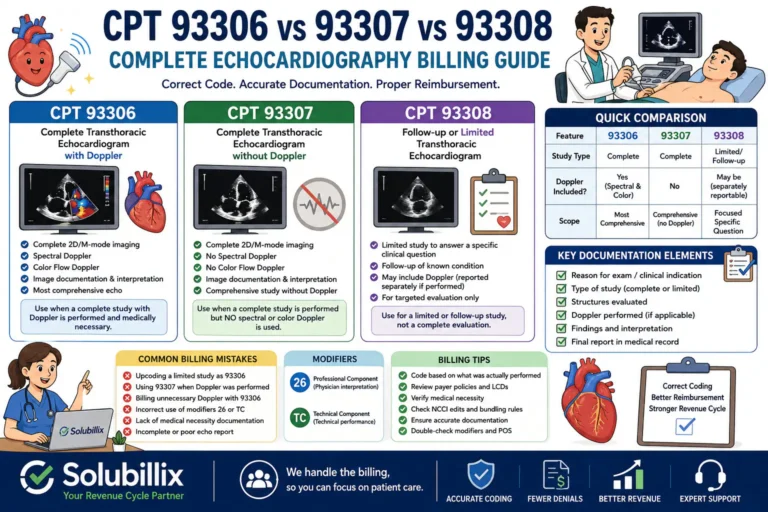
- 93306: Complete transthoracic echocardiogram with Doppler
- 93307: Complete transthoracic echocardiogram without Doppler
- 93308: Limited or follow-up transthoracic echocardiogram
CMS currently lists 93306 as a complete TTE with Doppler, 93307 as a complete TTE without Doppler, and 93308 as a follow-up or limited TTE.
Choosing the wrong code can lead to claim rejections, bundling issues, medical-necessity denials, or unnecessary accounts receivable.
At Solubillix, we help cardiology practices manage complex medical billing, coding, claims, denials, and revenue cycle challenges.
Quick Comparison: 93306 vs 93307 vs 93308
| CPT Code | Study | Doppler | Main Use |
| 93306 | Complete TTE | Spectral + color Doppler | Comprehensive echo |
| 93307 | Complete TTE | No Doppler | Complete echo without Doppler |
| 93308 | Limited/follow-up TTE | Depends on services performed | Focused or follow-up evaluation |
Key takeaway: The biggest differences are complete vs. limited and whether Doppler is included.
CPT 93306: Complete Echocardiogram With Doppler
CPT 93306 is used for a complete transthoracic echocardiogram with Doppler.
The examination includes comprehensive cardiac imaging along with:
- Spectral Doppler
- Color flow Doppler
- Image documentation
- Interpretation of the study
CMS identifies 93306 as “TTE w/doppler complete.”
When Is 93306 Appropriate?
A complete TTE may be performed to evaluate conditions such as:
- Heart murmurs
- Valvular disease
- Cardiomyopathy
- Heart failure
- Ventricular function
- Suspected structural heart disease
- Certain congenital cardiac abnormalities
The specific diagnosis and clinical indication must support medical necessity under the applicable payer policy.
CMS guidance notes that Doppler may provide clinically significant information in conditions such as valvular disease, murmurs, shunts, cardiomyopathy, and certain complications of myocardial infarction.
Important Billing Point
If Doppler is combined with a complete echocardiogram, CMS guidance indicates that 93306 should be used rather than treating the complete study as 93307 and separately adding Doppler codes.
CPT 93307: Complete Echocardiogram Without Doppler
CPT 93307 represents a complete transthoracic echocardiogram without spectral or color Doppler.
CMS describes it as “TTE w/o doppler complete.”
The important point is that the study is still complete. The difference from 93306 is the absence of the Doppler components.
93307 vs 93306
Think of it this way:
93306 = Complete + Doppler
93307 = Complete − Doppler
A billing team should review the actual echocardiography report rather than selecting 93307 simply because Doppler is not prominent in the report.
CPT 93308: Limited or Follow-Up Echocardiogram
CPT 93308 is used for a follow-up or limited transthoracic echocardiogram.
Unlike 93306 and 93307, which describe complete studies, 93308 is intended for a focused examination rather than a comprehensive evaluation.
Examples may include follow-up evaluation of a known condition or assessment of a specific clinical question.
CMS lists 93308 as “TTE F/U or lmtd.”
When Might 93308 Be Appropriate?
Depending on the clinical situation, a limited echo may be used to:
- Reassess a known pericardial effusion
- Follow ventricular function
- Reevaluate a previously identified abnormality
- Answer a specific clinical question
- Perform targeted follow-up imaging
The key is that the documentation must support the limited nature of the examination.
A complete echo should not be reported as 93308 simply because the test was performed quickly or focused on one finding.
93306 vs 93307 vs 93308: Easy Way to Remember
Use this simple three-question approach:
1. Was the echocardiogram complete?
Yes → Consider 93306 or 93307.
2. Was Doppler included in the complete study?
Yes → 93306
No → 93307
3. Was the examination limited or a follow-up study?
Yes → 93308
This simple framework can help billing teams avoid many common coding mistakes.
Can 93306 and 93307 Be Billed Together?
Generally, you should not report both codes simply to capture different portions of the same complete echocardiographic examination.
If the complete TTE includes the Doppler components described by 93306, reporting 93307 plus separate Doppler codes may create an inappropriate coding combination.
CMS guidance specifically states that when Doppler is combined with a complete echocardiogram, 93306 should be used.
Always review current payer policies and NCCI guidance before submitting code combinations.
Can Doppler Be Billed With 93308?
A limited TTE may involve separately reportable Doppler services when they are:
- Actually performed
- Medically necessary
- Properly documented
- Separately reportable under applicable coding and payer rules
CMS recognizes that Doppler may be appropriate with limited examinations in certain clinical circumstances.
However, Doppler should not be added simply to increase reimbursement. The medical record should support the service.
Modifier 26 vs TC for Echocardiography
Echocardiography may involve separate professional and technical components.
Modifier 26 — Professional Component
Modifier 26 may be used when reporting the professional component, such as the physician’s interpretation, when permitted by the code and payer.
Modifier TC — Technical Component
Modifier TC may be used when reporting the technical component when separately reportable.
Whether 26 or TC is appropriate depends on factors such as:
- Who performed the service
- Who owns the equipment
- Place of service
- Billing arrangement
- Payer requirements
Do not automatically append 26 or TC to every echocardiography claim.
Medical Necessity and Documentation
Correct CPT coding is only one part of a successful echocardiography claim.
The documentation should support:
- Reason for the examination
- Clinical indication
- Relevant diagnosis
- Complete vs limited nature of the study
- Imaging performed
- Doppler services, when applicable
- Findings
- Physician interpretation
- Final report
CMS has specifically identified TTE as an area where documentation may be reviewed for medical necessity and correct coding.
A strong documentation trail connects:
Clinical indication → Medical necessity → Examination performed → CPT code → Claim
Common Echocardiography Billing Mistakes
1. Using 93306 for Every Echo
Not every TTE is a complete study with Doppler.
Solution: Match the CPT code to the actual examination.
2. Reporting 93308 for a Complete Study
A limited code should not be used simply because the exam was brief.
Solution: Confirm that the examination was actually limited or follow-up.
3. Using 93307 When Doppler Was Performed
If a complete study includes the Doppler components represented by 93306, 93307 may not accurately describe the service.
Solution: Review the final report before coding.
4. Separately Billing Included Services
Incorrectly unbundling services can result in claim edits or denials.
Solution: Review current NCCI and payer-specific requirements.
5. Ignoring Medical Necessity
Even correctly coded services can be denied when the diagnosis or documentation does not support coverage.
Solution: Verify the clinical indication and payer medical-necessity requirements.
Echocardiography Billing Checklist
Before submitting a claim, review:
- Correct CPT code
- Complete vs limited study
- Doppler performed, if applicable
- Correct diagnosis
- Medical necessity
- Modifier 26 or TC, if applicable
- Place of service
- Physician interpretation
- Final echo report
- Payer policy
- NCCI edits
- Authorization requirements, when applicable
This short review can help prevent avoidable billing errors and unnecessary AR.
How Solubillix Helps Cardiology Practices
Cardiology billing can become complicated when practices are dealing with echocardiography coding, payer requirements, medical-necessity rules, modifiers, claim edits, and denials.
Solubillix provides medical billing and revenue cycle management support for healthcare practices.
Our services can include:
- Cardiology billing
- Echocardiography claim submission
- Coding review
- Insurance verification
- Prior authorization support
- Denial management
- NCCI edit review
- Payment posting
- Underpayment analysis
- AR follow-up
- Revenue cycle reporting
Our goal is to help providers reduce billing errors, improve reimbursement, and spend less time managing claims.
Final Takeaway
The difference between CPT 93306, 93307, and 93308 is easier to understand when you focus on two questions:
Is the echocardiogram complete or limited?
Was Doppler included?
- 93306 = Complete TTE with Doppler
- 93307 = Complete TTE without Doppler
- 93308 = Limited or follow-up TTE
The CPT code should always reflect the service actually performed and documented, while medical necessity and payer-specific requirements must also be considered.
For cardiology practices, accurate echocardiography billing can help reduce avoidable denials, improve clean-claim performance, and strengthen the revenue cycle.
Need help with cardiology or echocardiography billing? Contact Solubillix and let our billing experts help manage the revenue cycle while your team focuses on patient care.
Frequently Asked Questions
What is the difference between 93306 and 93307?
Both represent complete transthoracic echocardiography. 93306 includes Doppler, while 93307 does not include spectral or color Doppler.
What is CPT 93308 used for?
93308 represents a follow-up or limited transthoracic echocardiogram.
Does 93306 include Doppler?
Yes. 93306 represents a complete TTE with Doppler. CMS guidance states that when Doppler is combined with a complete echocardiogram, 93306 should be used.
Can 93306 and 93307 be billed together?
They should not simply be billed together to separately capture components of the same complete study. The claim should accurately represent the services performed and follow applicable payer and NCCI rules.
Can Doppler be billed with 93308?
It may be separately reportable when appropriate, but the Doppler must be performed, medically necessary, documented, and separately reportable under the applicable payer rules.
Can modifier 26 be used with echocardiography?
Modifier 26 may apply when the professional component is separately reportable and payer requirements permit it.
What causes echocardiography claim denials?
Common causes include incorrect CPT selection, insufficient medical necessity, incomplete documentation, inappropriate modifiers, bundling edits, and payer-specific coding requirements.
Solubillix Medical Billing & Revenue Cycle Management Experts
Solubillix is a U.S.-focused medical billing and revenue cycle management company helping healthcare providers manage claims, payer requirements, denials, accounts receivable, and reimbursement challenges.
Solubillix — Expert Medical Billing. Fewer Denials. Better Revenue.