
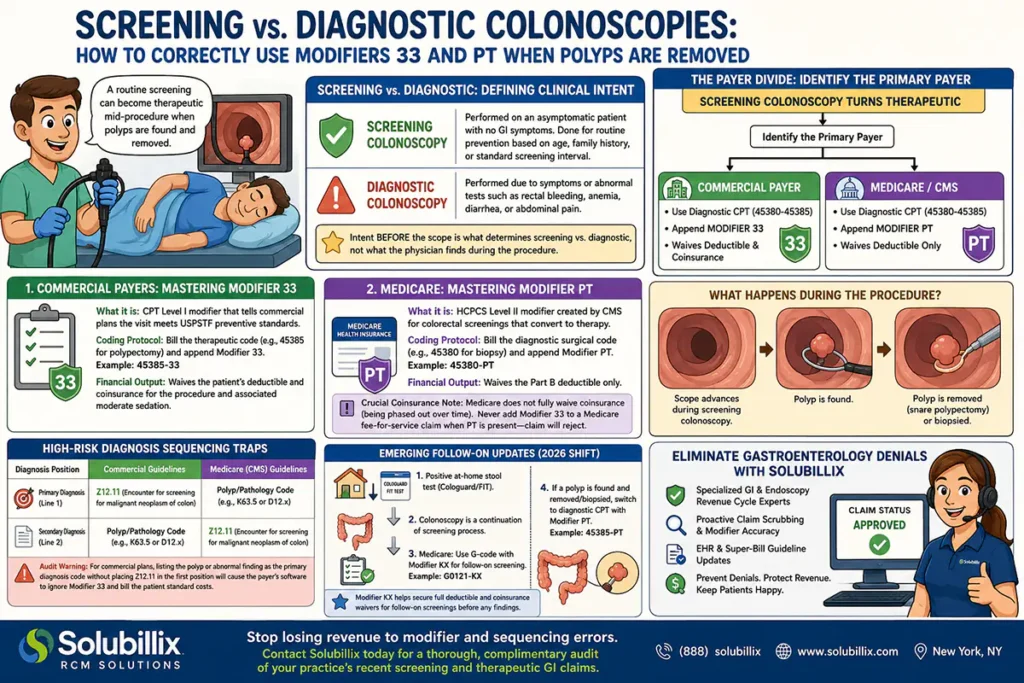
In gastroenterology billing, few scenarios generate as much administrative confusion as a routine screening colonoscopy that transforms into a surgical intervention mid-procedure. Under the Affordable Care Act (ACA), preventive colorectal cancer screenings are protected by “first-dollar coverage,” meaning eligible asymptomatic patients should face zero out-of-pocket deductibles or co-payments.
However, statistics show that the transformation from a “preventive screening” to a “diagnostic or therapeutic” service occurs in roughly 35% to 40% of cases—typically when the endoscopist discovers and removes a polyp or takes a tissue biopsy.
When this surgical conversion happens, the billing department faces a complex problem. If the claim is submitted incorrectly, automated insurance algorithms will classify the procedure as a purely medical intervention, sticking the patient with unexpected cost-sharing and triggering immediate billing disputes.
To protect your gastroenterology practice’s revenue cycle while keeping patient satisfaction high, your billing desk must master the proper application of Modifier 33 and Modifier PT.
Screening vs. Diagnostic: Defining Clinical Intent
Before looking at modifiers, your coding team must understand that the distinction between “screening” and “diagnostic” is dictated entirely by the clinical intent prior to the introduction of the scope, not by what the physician finds during the procedure:
- Screening Colonoscopy: Performed on an asymptomatic patient who lacks gastrointestinal symptoms. The procedure is driven entirely by routine preventive timelines based on the patient’s age, family history, or a standard screening interval (e.g., an average-risk patient aged 45 or older).
- Diagnostic Colonoscopy: Performed as a direct response to active signs, symptoms, or abnormal preceding medical tests. Common triggers include rectal bleeding, iron-deficiency anemia, unexplained chronic diarrhea, or severe abdominal pain.
If a patient meets the criteria for a diagnostic encounter before the procedure begins, it is billed as a medically necessary service from the start, and standard deductible rules apply. The modifier guidelines below apply only when an encounter begins purely as an asymptomatic screening but alters path due to an unexpected finding.
The Payer Divide: Commercial Plans vs. Traditional Medicare
The fundamental mistake made by general medical billers is treating all screening conversions identically. The American Medical Association (AMA) and the Centers for Medicare & Medicaid Services (CMS) have separate code sets and rules for managing this procedural shift.
┌─────────────────────────────────────────┐
│ SCREENING COLONOSCOPY TURNS THERAPEUTIC │
└────────────────────┬────────────────────┘
│
Identify the Primary Payer
│
┌────────────────────────┴────────────────────────┐
▼ COMMERCIAL PAYER ▼ MEDICARE / CMS
┌──────────────────────────────────────────┐ ┌──────────────────────────────────────────┐
│ • Use Diagnostic CPT (45380-45385) │ │ • Use Diagnostic CPT (45380-45385) │
│ • Append MODIFIER 33 │ │ • Append MODIFIER PT │
│ • Waives Deductible & Coinsurance │ │ • Waives Deductible Only │
└──────────────────────────────────────────┘ └──────────────────────────────────────────┘
1. Commercial Payers: Mastering Modifier 33
Modifier 33 (Preventive Services) is a CPT Level I modifier designed by the AMA to communicate to commercial health insurance plans that an encounter meets the preventive standards of the U.S. Preventive Services Task Force (USPSTF).
- The Coding Protocol: If a physician performs a screening colonoscopy on a patient with commercial insurance and removes a polyp via a snare technique, the biller should report the therapeutic code CPT 45385 and append Modifier 33 (i.e., 45385-33).
- The Financial Output: Modifier 33 tells the commercial claims scrubber that the primary purpose of the visit was preventive. This forces the plan to waive the deductible and patient cost-sharing for the surgical procedure and the associated moderate sedation lines.
2. Traditional Medicare: Mastering Modifier PT
Modifier PT (Colorectal Screening Converted to Diagnostic or Therapeutic) is a HCPCS Level II modifier created by CMS specifically for traditional Medicare and certain Medicare Advantage plans. Traditional Medicare handles preventive screening via its own distinct “G-codes” (G0121 for average risk and G0105 for high risk). However, the moment a polyp is discovered, the baseline G-code is discarded.
- The Coding Protocol: If a lesion is found and a biopsy is executed during a Medicare screening, you must bill the appropriate diagnostic surgical code (such as CPT 45380 for a flexible colonoscopy with biopsy) and append Modifier PT (i.e., 45380-PT).
- The Financial Output: Under ACA mandates, the PT modifier signals Medicare to automatically waive the patient’s Part B deductible.
- Crucial Medicare Coinsurance Note: Unlike commercial insurance, Medicare historically did not waive patient coinsurance for converted procedures. CMS has implemented a phased multi-year reduction plan to slowly eliminate patient coinsurance during conversions. Never add Modifier 33 to a traditional Medicare fee-for-service claim when PT is already present, as it will trigger an immediate “invalid modifier combo” rejection.
High-Risk Diagnosis Sequencing Traps
Applying the correct modifier is only half the battle; your code sequencing must match the clinical narrative to survive an insurance audit. Payer guidelines require your diagnosis codes (ICD-10-CM) to clearly show why the surgical CPT code was deployed, while still preserving the screening intent of the visit.
| Diagnosis Position | Commercial Guidelines | Medicare (CMS) Guidelines |
| Primary Diagnosis (Line 1) | Z12.11 (Encounter for screening for malignant neoplasm of colon) | Polyp/Pathology Code (e.g., K63.5 for a colon polyp or D12.x for benign neoplasm) |
| Secondary Diagnosis (Line 2) | Polyp/Pathology Code (e.g., K63.5 or D12.x) | Z12.11 (Encounter for screening for malignant neoplasm of colon) |
Audit Warning: For commercial plans, listing the polyp or abnormal finding as the primary diagnosis code without placing Z12.11 in the first position will cause the payer’s software to completely ignore Modifier 33. The claim will process as a standard medical surgery, passing unexpected costs directly onto the patient’s deductible.
Emerging Follow-On Updates (2026 Shift)
A recent regulatory enhancement clarifies the handling of non-invasive stool-based tests (such as Cologuard or FIT tests). If a patient takes an at-home stool test that returns a positive result, the subsequent colonoscopy is no longer billed as a primary diagnostic test.
Instead, it is legally classified as a continuation of the colorectal cancer screening process. For Medicare beneficiaries, this specific follow-on scenario requires appending the Modifier KX to your screening G-code (e.g., G0121-KX) to secure full deductible and coinsurance waivers. If that follow-on screening then encounters a polyp, the code shifts to the diagnostic surgical line with the PT modifier attached (45385-PT).
Eliminate Gastroenterology Denials with Solubillix
Managing the precise interactions of modifiers 33, PT, and KX requires deep, specialty-specific revenue cycle oversight. Generalist billing teams often default to standard surgical coding without modifiers when polyps are removed, triggering patient complaints, damaging provider-patient relationships, and leading to compliance audits.
At Solubillix, based right here in New York, we specialize in high-complexity GI and endoscopy revenue cycle management. Our dedicated gastroenterology billing experts implement proactive, front-end claim scrubbing rules that verify clinical intents, update EHR super-bills with current guidelines, and cross-reference documentation for proper modifier attachment before claims reach the clearinghouse. We prevent first-pass denials, eliminate balance-billing frustrations for your patients, and capture the maximum legitimate reimbursement your practice deserves.
Stop losing revenue to modifier and sequencing errors. Contact Solubillix today for a thorough, complimentary audit of your practice’s recent screening and therapeutic GI claims.