
For gastroenterology practices, motility clinics, and colorectal surgery centers, neurogastroenterology and pelvic floor diagnostic testing have long been fields riddled with administrative coding friction. For years, reporting complex anorectal physiology evaluations felt like forcing modern, high-definition diagnostic data into outdated, poorly defined categories.
The American Medical Association (AMA) resolved this issue by issuing a complete structural overhaul of anorectal manometry and physiology codes. Long-standing legacy codes have been permanently deleted and replaced with a pair of highly consolidated, comprehensive Category I codes.
If your billing team is still trying to report these services using old procedural lines, your claims are hitting automated payer walls. This in-depth analysis outlines the structural shift, details NCCI edits, clarifies documentation mandates, and provides the exact path to protect your practice’s bottom line.
The Deletion of Legacy Code Structures: Why the System Changed
The historical approach to billing pelvic floor dysfunctions required separating individual, overlapping diagnostic elements. Doctors would piece together multiple distinct lines of code to represent a single clinical encounter. This fragmentation frequently triggered unbundling edits, automated claims scrubbing flags, and duplicate reporting denials from major commercial payers.
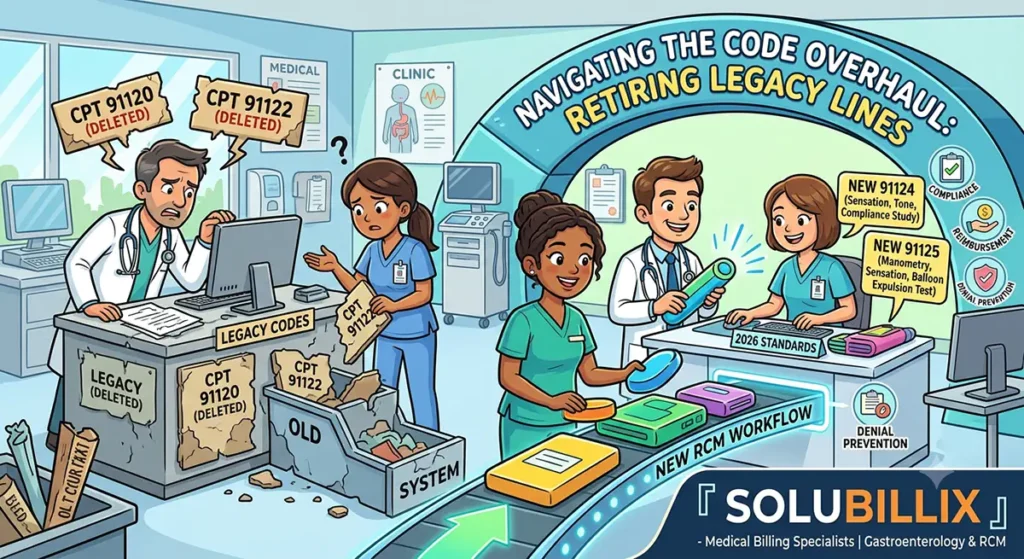
To eliminate this confusion and streamline the processing of medical claims, the AMA permanently retired these long-standing legacy codes:
- CPT 91120 (Rectal sensation test) – DELETED
- CPT 91122 (Anorectal manometry) – DELETED
Attempts to submit claims using 91120 or 91122 will result in immediate, non-negotiable clearinghouse rejections. If your Electronic Health Record (EHR) templates or super-bills have not been updated, your practice is actively leaking revenue through automatic denials.
The Modern Standards: Detailed Breakdown of CPT 91124 and 91125
Instead of picking apart individual testing components, the modernized code set introduces bundled, comprehensive descriptions that reflect contemporary clinical workflows. The new system splits pelvic floor testing into two clearly defined paths based on the technology utilized and the specific clinical intent.
1. CPT 91124: Rectal Sensation, Tone, and Compliance Study
This code specifically quantifies how the rectum responds to internal pressure, as well as how effectively the rectal wall relaxes, stretches, and accommodates stool.
- Clinical Scope: Most commonly utilized when evaluating defecatory disorders, refractory fecal incontinence, severe chronic constipation subtypes, and rectal hypersensitivity or hyposensitivity.
- Required Technology: This code is typically reserved for specialized automated balloon systems, such as a electronic barostat system, which applies computerized phasic or stepwise distensions to measure precise sensory thresholds and resting/evoked tone.
- Documentation Mandate: To satisfy an audit for 91124, the physician’s report must explicitly detail the pressure-volume curves, specific volume thresholds for first sensation, urge to defecate, and maximum tolerated volume.
2. CPT 91125: Anorectal Manometry with Rectal Sensation and Balloon Expulsion Test
This is the new “master code” for comprehensive pelvic floor workups. It completely bundles what used to require multiple lines of coding, serving as a single, all-inclusive procedural line.
- Clinical Scope: It reports a consolidated procedure that captures anal sphincter pressures (resting and squeeze), reflex assessments (such as the presence of the rectoanal inhibitory reflex, or RAIR), rectal sensation testing, and the physical rectal balloon expulsion test.
- The “When Performed” Loophole: The code descriptor explicitly states “with rectal sensation test, and balloon expulsion test, when performed”. This phrase is critical for your billing team. If your clinical team performs the core high-resolution manometry and sensation tracking but skips the physical balloon expulsion due to patient anatomy, active bleeding, severe pain, or clinical directives, CPT 91125 remains the correct code to report. Payers cannot deny the claim for a omitted balloon test if clinical rationale is documented.
Strict Coding Constraints and NCCI Mutual Exclusivity
The primary trap for GI billing departments under these guidelines is the strict implementation of National Correct Coding Initiative (NCCI) parenthetical exclusions. Because the AMA built these codes to prevent historical “double-dipping,” they are heavily guarded by automated payer algorithms.
The Golden Rule of Motility Coding: CPT 91124 and CPT 91125 are completely mutually exclusive. You cannot bill them together for the same patient encounter on the same date of service under any circumstances.
| If you bill this code… | You cannot report it on the same day with… |
| CPT 91124 | 91117 (Colon motility study) or CPT 91125 |
| CPT 91125 | 91117 (Colon motility study) or CPT 91124 |
If a patient transition from a manometry session directly into a barostat compliance study on the same day, your clinical documentation must dictate which primary medical necessity drove the encounter. Splitting the lines across different providers or trying to append Modifier 59 (Distinct Procedural Service) to bypass the NCCI edit will trigger immediate payer audits, manual record reviews, and potential retrospective revenue clawbacks.
Professional vs. Technical Split Formatting
Both 91124 and 91125 carry an “XXX” global period designation, meaning same-day Evaluation and Management (E/M) services can be reported alongside them if a separate, distinct issue is addressed and Modifier 25 is appropriately supported.
Furthermore, if your practice operates an office-based motility lab rather than performing these procedures in a hospital outpatient department (HOPD) or ambulatory surgical center (ASC), your billing team must accurately execute the technical/professional split:
- Modifier 26 (Professional Component): Appended when your gastroenterologist interprets the graphical data, analyzes the wave metrics, and drafts the final diagnostic report, but does not own the physical testing equipment or the clinical space.
- Modifier TC (Technical Component): Appended if your entity owns the diagnostic machinery, provides the physical clinical space, and employs the technician performing the test, but the interpretation is completed by an outside specialist.
- Global Billing (No Modifiers): Applied only when your practice owns the device and your physician provides the formal interpretation within an office-based setting. Missing this distinction leads to over-billing or under-billing, both of which carrying heavy financial penalties during compliance checks.
Protect Your GI Revenue Cycle with Solubillix
Regulatory updates shift rapidly, and generalist billing companies or overwhelmed in-house teams often miss the technical nuances of specialized code overhauls. A single month of submitting deleted legacy codes or unbundled manometry sequences can cause thousands of dollars in clean claim revenue to suddenly vanish, choking your clinic’s cash flow.
At Solubillix, based right here in New York, we specialize in high-complexity specialty billing and revenue cycle management. Our dedicated Gastroenterology revenue cycle managers ensure that your operational workflows, electronic health record templates, and coding structures seamlessly align with current guidelines. We implement rigid, custom claim-scrubbing parameters that eliminate denials before they can form, maximizing your reimbursements and allowing your clinical staff to focus entirely on patient outcomes.
Stop guessing on complex motility claims and losing revenue to outdated codes. Contact Solubillix today for a transparent, comprehensive evaluation of your practice’s recent GI billing performance.