
Protecting TMS Revenue After Insurance Recoupments, Post-Payment Denials, and Medical Necessity Disputes
By Solubillix – Behavioral Health Medical Billing & Revenue Cycle Management Experts
Transcranial Magnetic Stimulation (TMS) therapy has become an important treatment option for patients with treatment-resistant depression and other behavioral health conditions. However, while TMS provides significant clinical value, many psychiatric practices face complex reimbursement challenges from insurance companies.
One of the most frustrating challenges is the retroactive TMS denial.
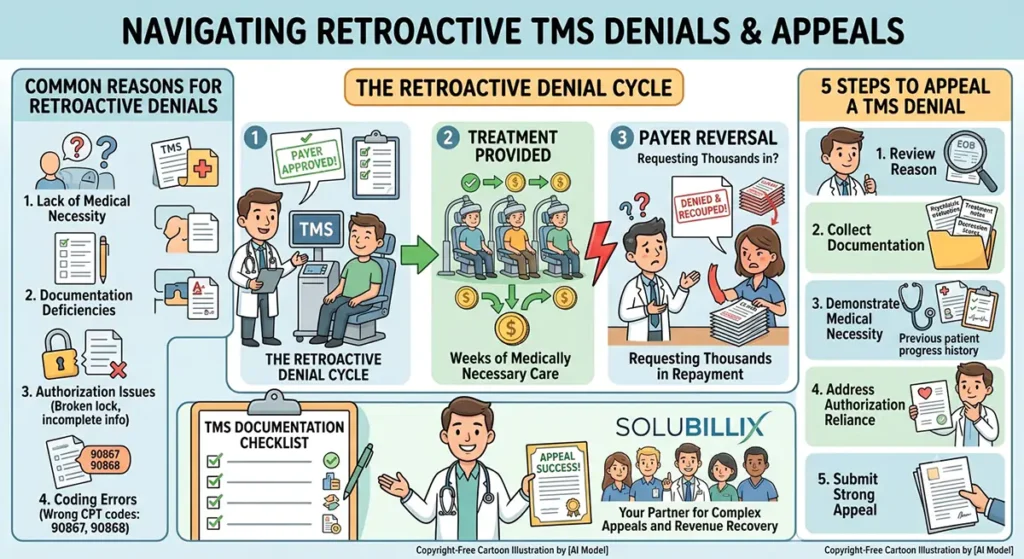
A retroactive denial occurs when an insurance payer:
- Previously approved the treatment,
- Allowed and paid claims,
- Then later reverses payment and requests repayment.
This situation can create significant financial stress for providers because TMS treatment plans often involve multiple sessions over several weeks. A payer recoupment involving dozens of sessions can result in thousands of dollars in unexpected revenue loss.
Common reasons insurance companies issue retroactive TMS denials include:
- Alleged lack of medical necessity
- Documentation deficiencies
- Authorization issues
- Incorrect coding
- Missing progress notes
- Failure to meet payer-specific criteria
- Incorrect patient eligibility interpretation
The good news is that retroactive TMS denials can often be challenged successfully when providers submit a strong, evidence-based appeal.
At Solubillix, we help behavioral health providers navigate complex denial situations, strengthen appeals, and recover revenue that may otherwise be lost.
Understanding Retroactive TMS Denials
What Is a Retroactive TMS Denial?
A retroactive TMS denial happens when a payer changes its decision after services have already been provided.
For example:
- A psychiatrist submits a prior authorization request for TMS therapy.
- The insurance company approves the treatment course.
- The patient completes multiple TMS sessions.
- Claims are submitted and paid.
- Months later, the payer performs a review and denies the claims.
The payer may then:
- Reverse previous payments
- Issue a recoupment notice
- Request repayment
- Offset future payments
This creates a serious revenue cycle problem for practices that provided care based on payer approval.
Why Insurance Companies Issue Retroactive TMS Denials
1. Medical Necessity Disputes
Medical necessity is one of the most common reasons for TMS denials.
The payer may argue that:
- The patient did not meet TMS eligibility criteria
- Previous treatments were insufficient
- Documentation did not demonstrate treatment resistance
- Clinical improvement was not adequately documented
To defend against this denial, providers must show that TMS treatment was clinically appropriate based on the patient’s condition and treatment history.
2. Documentation Does Not Support TMS Treatment
Insurance companies closely review TMS documentation.
Common documentation problems include:
- Missing psychiatric evaluation
- Lack of depression severity scores
- No treatment history
- Missing medication trials
- Incomplete progress notes
- Poor response tracking
Even when treatment is clinically appropriate, weak documentation can make an appeal difficult.
3. Authorization Problems
A common misconception is:
“If insurance approved TMS, payment is guaranteed.”
Unfortunately, authorization does not always prevent future review.
A payer may later claim:
- Authorization was based on incomplete information
- Services exceeded approved sessions
- Documentation did not match authorization requirements
- Authorization criteria were not met
A strong appeal must demonstrate that the provider followed payer requirements in good faith.
4. Coding Errors
Incorrect coding can trigger denials and audits.
Common TMS billing codes include:
- CPT 90867 – Initial application of TMS treatment
- CPT 90868 – Subsequent delivery of TMS treatment
- CPT 90869 – Subsequent motor threshold determination
Incorrect reporting, missing documentation, or diagnosis mismatch can create reimbursement issues.
Step-by-Step Process to Appeal a Retroactive TMS Denial
Step 1: Review the Denial Reason Carefully
Before writing an appeal, understand exactly why the payer denied the claim.
Review:
- Explanation of Benefits (EOB)
- Denial codes
- Medical review findings
- Recoupment letter
- Authorization records
Do not submit a generic appeal.
The appeal should directly address the payer’s stated reason.
Step 2: Collect Complete TMS Documentation
A successful appeal depends on strong supporting evidence.
Gather:
Patient Clinical Records
Include:
- Psychiatric evaluation
- Diagnosis documentation
- Symptom severity
- Treatment history
- Medication failures
- Previous therapy attempts
TMS Treatment Records
Include:
- Treatment dates
- Number of sessions
- Treatment parameters
- Motor threshold documentation
- Treatment response tracking
- Provider notes
Insurance Records
Include:
- Authorization approval
- Authorization number
- Approval dates
- Correspondence with payer
- Previous paid claims
Step 3: Demonstrate Medical Necessity
A strong appeal should explain:
Why TMS Was Appropriate
Example:
“The patient demonstrated persistent depressive symptoms despite adequate trials of multiple antidepressant medications and psychotherapy interventions. Based on clinical evaluation and treatment history, TMS therapy was medically appropriate.”
Why Alternative Treatments Were Insufficient
Explain:
- Previous medications attempted
- Medication intolerance
- Lack of adequate response
- Functional impairment
Why Continued Treatment Was Necessary
For continuation requests, explain:
- Patient response
- Clinical progress
- Remaining symptoms
- Treatment goals
Step 4: Address Authorization and Good-Faith Reliance
If the payer approved treatment before reversing payment, highlight this in your appeal.
Example:
“The provider initiated treatment after receiving payer authorization and delivered services according to the approved treatment plan. The provider relied on the authorization provided by the payer when administering medically necessary care.”
This demonstrates:
- Provider compliance
- Good-faith participation
- Reasonable reliance on payer approval
Step 5: Write a Strong TMS Appeal Letter
A successful appeal should include:
Introduction
Identify:
- Patient information
- Claim numbers
- Dates of service
- Denial reason
Clinical Summary
Explain:
- Diagnosis
- Treatment history
- Reason TMS was selected
Medical Necessity Argument
Describe:
- Why treatment was appropriate
- How documentation supports care
Request for Reconsideration
Clearly request:
- Reversal of denial
- Reprocessing of claims
- Cancellation of recoupment
Common Mistakes That Weaken TMS Appeals
Mistake #1: Submitting a Generic Appeal
A template letter without patient-specific details usually has limited success.
Each appeal should connect documentation to the denial reason.
Mistake #2: Ignoring Payer Guidelines
Different insurance companies may have different TMS requirements.
Some require:
- Specific depression rating scales
- Medication trial documentation
- Psychiatric evaluations
- Treatment response monitoring
Mistake #3: Missing Appeal Deadlines
Insurance companies typically provide a limited timeframe for appeals.
Missing deadlines can result in:
- Appeal rejection
- Lost reconsideration rights
Mistake #4: Not Including Supporting Records
An appeal without documentation is only an argument.
Supporting evidence strengthens the provider’s position.
TMS Documentation Checklist for Strong Appeals
Before submitting a TMS appeal, verify:
✅ Psychiatric evaluation completed
✅ Diagnosis clearly documented
✅ Treatment-resistant history included
✅ Previous medication trials documented
✅ Medical necessity explained
✅ TMS authorization records attached
✅ Treatment notes included
✅ Patient response documented
✅ Provider signature completed
✅ Appeal submitted within deadline
How Behavioral Health Practices Can Prevent Future TMS Denials
1. Verify Insurance Requirements Before Treatment
Before starting TMS:
- Confirm benefits
- Obtain authorization
- Review payer criteria
- Document approval details
2. Maintain Complete Clinical Documentation
Strong documentation protects providers during:
- Claim review
- Appeals
- Audits
- Recoupment disputes
3. Monitor Authorization Limits
Track:
- Approved sessions
- Used sessions
- Remaining sessions
- Authorization expiration dates
4. Perform Regular Billing Audits
Routine audits identify:
- Coding errors
- Documentation gaps
- Authorization issues
- Revenue risks
How Solubillix Helps TMS Providers Protect Revenue
TMS billing requires specialized knowledge of:
- Behavioral health coding
- Insurance authorization requirements
- Medical necessity documentation
- Denial management
- Appeals processes
At Solubillix, we support psychiatric practices by providing:
✔ TMS billing expertise
✔ Prior authorization support
✔ Denial analysis
✔ Appeal preparation assistance
✔ Insurance follow-up
✔ Revenue cycle optimization
Our goal is to help providers reduce administrative burden and maximize reimbursement for the valuable care they provide.
Frequently Asked Questions About Retroactive TMS Denials
Can a payer deny TMS after approving authorization?
Yes. Some payers may conduct retrospective reviews and deny claims even after authorization if they determine requirements were not met.
How do you appeal a TMS denial?
A successful appeal requires reviewing the denial reason, gathering documentation, demonstrating medical necessity, and submitting a detailed reconsideration request.
What documents are needed for a TMS appeal?
Common documents include psychiatric evaluations, treatment history, authorization records, TMS treatment notes, progress documentation, and claim information.
Why are TMS claims denied?
Common reasons include medical necessity concerns, documentation gaps, authorization issues, coding errors, and payer guideline requirements.
How can providers prevent TMS denials?
Providers can reduce denials by verifying requirements before treatment, maintaining detailed documentation, monitoring authorizations, and conducting regular billing reviews.
Conclusion: Protect Your TMS Revenue With Proper Documentation and Appeals
Retroactive TMS denials can create significant financial challenges for behavioral health practices, but they are not always final decisions.
A well-prepared appeal supported by complete documentation, medical necessity justification, and authorization records can significantly improve the chance of recovering lost reimbursement.
The key is proactive revenue cycle management.
By partnering with an experienced medical billing company like Solubillix, TMS providers can focus on patient care while experienced billing specialists handle complex payer requirements, denials, and reimbursement challenges.
Solubillix — Helping Behavioral Health Providers Reduce Denials and Maximize Revenue.
About Solubillix
Solubillix is a US-based medical billing and revenue cycle management company specializing in behavioral health billing, TMS billing, psychiatry billing, denial management, and insurance follow-up services. We help healthcare providers improve collections, reduce administrative challenges, and achieve stronger financial performance.