
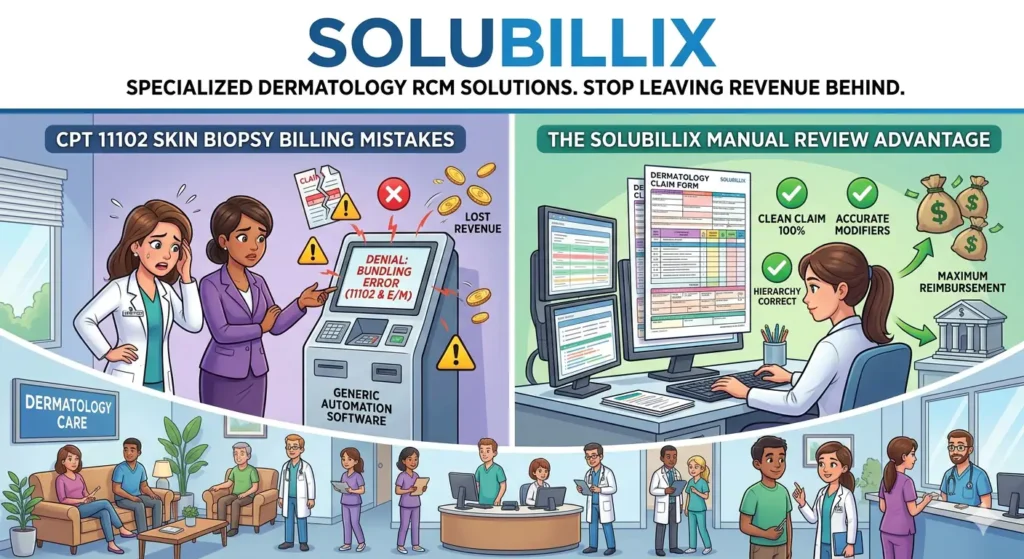
Skin biopsies are among the most frequently performed procedures in a busy dermatology practice. Because they are so common, it is easy for clinical and administrative teams to treat them as routine line items. However, since the American Medical Association (AMA) overhauled the skin biopsy coding structure, reporting a tangential skin biopsy under CPT 11102 has become a major source of claim denials and lost revenue.
Many dermatology practices rely on broad billing automation or generalized clearinghouse software to scrub their claims. Unfortunately, rigid automated filters frequently miss the subtle coding rules and documentation nuances required for complex specialty procedures, leading to rejected claims and delayed cash flow.
At Solubillix, our New York-based billing specialists eliminate this risk. By utilizing dedicated, manual claim reviews instead of automated guessing software, we ensure your dermatology practice is fully, accurately, and legally reimbursed for every procedure.
Below is our expert analysis of the most critical CPT 11102 billing mistakes dermatology practices make and how our manual intervention process fixes them.
The Base Rule: Understanding CPT 11102 and +11103
To avoid costly billing errors, our audit team reminds practices that skin biopsy codes are defined strictly by the technique used, not just the number of lesions.
- CPT 11102: Tangential biopsy of skin (e.g., shave, scoop, saucerization, or superficial technique); single or first lesion.
- CPT +11103: Tangential biopsy of skin; each additional lesion (Must be listed separately in addition to the code for the primary procedure).
3 Critical CPT 11102 Mistakes Damaging Your Revenue Cycle
1. Confusing a Tangential Biopsy (11102) with a Shave Removal (11400–11446)
This is the single most common error our team uncovers during practice audits. While a tangential biopsy and a shave removal look clinically identical on paper—both involve a superficial horizontal slice of the skin—their billing codes depend entirely on clinical intent.
- The Mistake: Billing CPT 11102 when the dermatologist’s true intention was to completely remove and treat the lesion.
- The Solubillix Resolution: If the provider removes a lesion entirely to treat it, it is a removal or excision—not a biopsy—even if the tissue is sent to a pathology lab. CPT 11102 should only be reported when a small sample of the tissue is taken purely for diagnostic purposes to determine future treatment. Solubillix’s manual chart audits cross-reference provider notes with pathology orders to ensure correct intent-based coding before submission, saving your practice from costly post-payment audit takebacks.
2. Failing to Follow the Multiple-Biopsy Hierarchy
Dermatologists often perform multiple biopsies using different techniques during a single patient encounter (e.g., one punch biopsy and one tangential shave biopsy).
- The Mistake: Automatically reporting CPT 11102 as the primary code just because it was the first procedure performed chronologically.
- The Solubillix Resolution: You can only bill one primary biopsy code per daily claim form. Primary codes are ranked by structural depth and complexity: Incisional (11106) > Punch (11104) > Tangential (11102). If you perform a punch biopsy and a tangential biopsy on the same day, the punch biopsy (CPT 11104) becomes your primary code. The tangential biopsy must be downgraded and billed using the add-on code CPT +11103, not CPT 11102. Automated systems frequently missequence these, resulting in a total denial of the secondary service.
3. Misapplying Modifier 25 on Same-Day Evaluation and Management (E/M) Visits
When a patient present for a general skin check or a separate issue (like severe eczema) and the dermatologist discovers a suspicious lesion requiring an immediate biopsy, an E/M code is billed alongside the procedure.
- The Mistake: Appending Modifier 25 to the E/M code without documenting a “significant, separately identifiable” service, resulting in immediate bundling denials by major payers.
- The Solubillix Resolution: If the entire focus of the visit was simply to look at the suspicious lesion and immediately biopsy it, you cannot bill an E/M code. To legally bypass the global surgery edit, your documentation must clearly separate the evaluation of the broader condition from the biopsy procedure itself. Our specialists manually review the clinical narrative to ensure Modifier 25 is fully supported before the claim leaves our hands.
Our Proactive Documentation Checklist for Clean Claims
To safeguard your dermatology practice against insurance payer audits, our Solubillix team recommends verifying that your clinical charts explicitly capture these four elements:
- The Specific Technique: Use explicit phrasing such as “tangential,” “shave,” or “saucerization.”
- Anatomical Location: Clearly identify the unique physical site of each individual lesion.
- Diagnostic Intent: Explicitly state that the sample was taken to establish a diagnosis, not for therapeutic removal.
- Distinct E/M Notes: Maintain a completely separate paragraph outlining the history, exam, and medical decision-making for the E/M visit when using Modifier 25.
Partner with Solubillix to Secure Your Dermatology Revenue
Because dermatology clinics manage hundreds of minor procedures every single week, automated billing filters and standard EHR software frequently overlook the clinical context of a provider’s note. This leads to massive downcoding, expensive denials, and lost revenue for your practice.
At Solubillix, we do things differently. We are not an AI-based or fully automated platform that treats your hard work like numbers in an algorithm. Our specialized revenue cycle management team manually reviews your documentation, verifies correct modifier application, and structures complex multi-lesion hierarchies perfectly to match strict payer guidelines. We take the administrative burden off your shoulders so you can focus entirely on delivering exceptional patient care.
Stop Leaving Your Dermatology Revenue to Automation
Is your practice struggling with code bundling rejections or uncollected procedure revenues? Let Solubillix perform a meticulous, manual analysis of your revenue cycle. [Schedule Your Free Solubillix Revenue Cycle Analysis Today]