
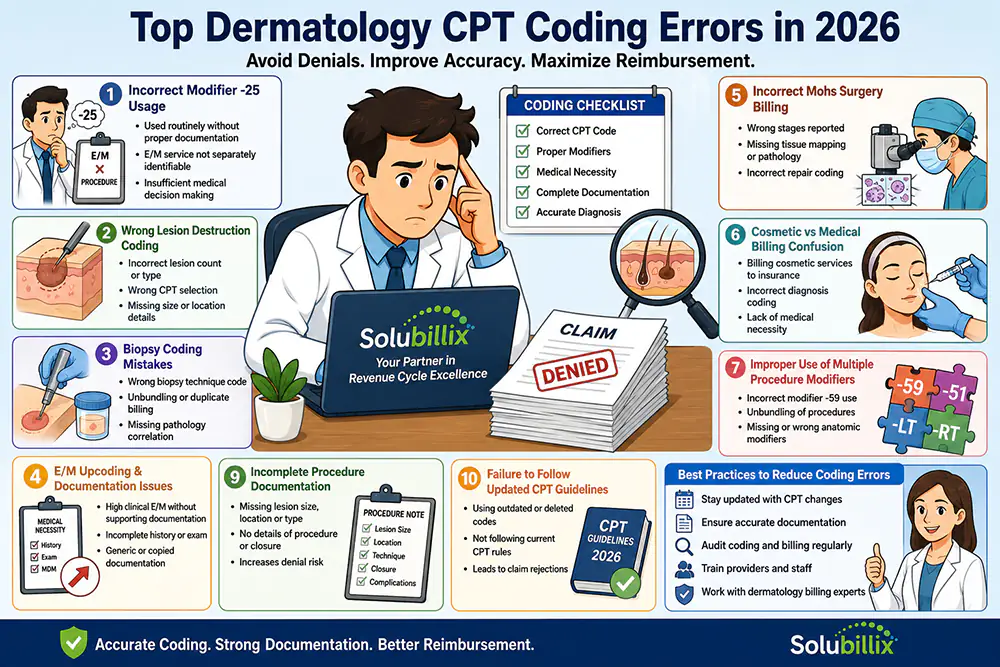
Common Billing Mistakes That Are Increasing Denials for Dermatology Practices
Dermatology billing in 2026 has become increasingly complex as insurance companies apply stricter coding reviews, tighter documentation standards, and more aggressive claim audits. Even experienced dermatology practices are seeing higher denial rates due to CPT coding mistakes, modifier errors, and medical necessity issues.
From lesion removals and biopsies to Mohs surgery and E/M services, dermatology claims are now under greater payer scrutiny than ever before.
At Solubillix, we help dermatology providers identify coding weaknesses, reduce denials, strengthen compliance, and improve reimbursement accuracy through specialized dermatology billing solutions.
Understanding the most common dermatology CPT coding errors in 2026 is essential for protecting revenue and maintaining clean claims.
Why Dermatology Coding Errors Are Increasing
Dermatology combines medical, surgical, and cosmetic services within one specialty. Because of this complexity, coding errors frequently occur when practices:
- Use incorrect CPT codes
- Misapply modifiers
- Lack proper documentation
- Bill medically unnecessary services
- Confuse cosmetic and medical procedures
- Under-document procedural details
Insurance companies are now carefully reviewing dermatology claims for:
- Coding accuracy
- Documentation consistency
- Procedure-to-diagnosis relationships
- Modifier justification
- Medical necessity compliance
Even small coding mistakes can result in:
- Claim denials
- Downcoding
- Payment delays
- Refund requests
- Audit exposure
1. Incorrect Modifier -25 Usage
Modifier -25 remains one of the most denied modifiers in dermatology billing.
This modifier is used when a significant, separately identifiable E/M service is performed on the same day as a procedure. However, many practices append modifier -25 routinely without sufficient supporting documentation.
Common Mistakes
- Billing modifier -25 automatically with procedures
- Missing separate medical decision-making documentation
- Insufficient history or examination details
- Billing routine pre-procedure evaluation as E/M
Why Payers Deny These Claims
Insurance companies frequently determine that the E/M service was part of the procedure itself and not separately billable.
Best Practice
Documentation must clearly show:
- Separate patient concerns
- Independent physician work
- Additional medical decision-making
- Distinct treatment planning
2. Wrong Lesion Destruction Coding
Incorrect lesion destruction coding is one of the most frequent CPT errors in dermatology.
Practices often confuse:
- Benign lesion destruction codes
- Premalignant lesion codes
- Malignant lesion treatment codes
Common Coding Errors
- Incorrect lesion counts
- Wrong diagnosis linkage
- Improper CPT selection
- Missing lesion size documentation
- Incorrect anatomical reporting
Because reimbursement varies significantly between lesion categories, payers carefully review these claims.
Documentation Requirements
Providers should document:
- Lesion type
- Anatomical location
- Number of lesions treated
- Treatment method
- Medical necessity
3. Biopsy Coding Mistakes
Skin biopsy claims are heavily audited in 2026 due to high utilization across dermatology practices.
Frequent Biopsy Errors
- Billing multiple biopsy codes incorrectly
- Unbundling biopsy procedures
- Missing pathology correlation
- Incorrect specimen documentation
- Duplicate billing
Many providers also fail to distinguish between:
- Tangential biopsy
- Punch biopsy
- Incisional biopsy
Using the wrong biopsy CPT code can lead to immediate claim denials.
Best Practice
Operative notes should clearly identify:
- Biopsy technique
- Lesion location
- Number of specimens
- Clinical indication
- Pathology follow-up
4. E/M Upcoding and Documentation Deficiencies
Evaluation and Management services continue to be a major payer focus area in dermatology.
Insurance companies are carefully reviewing:
- High-level E/M frequency
- Medical decision-making complexity
- Time-based billing support
- Documentation consistency
Common E/M Coding Problems
- Billing higher-level visits without support
- Incomplete histories
- Generic charting templates
- Repetitive documentation
- Insufficient assessment details
Payers expect documentation to accurately reflect the complexity of the patient encounter.
5. Incorrect Mohs Surgery Billing
Mohs micrographic surgery requires highly detailed documentation and accurate CPT selection.
Common Mohs Billing Errors
- Incorrect stage reporting
- Missing tissue mapping
- Improper repair coding
- Billing reconstruction incorrectly
- Lack of pathology support
Because Mohs surgery carries high reimbursement values, even minor documentation gaps may trigger audits.
Required Documentation
Providers should include:
- Tumor location
- Surgical stages
- Histological findings
- Margin evaluation
- Reconstruction details
- Operative complexity
6. Cosmetic vs Medical Billing Confusion
One of the most serious compliance issues in dermatology involves improper billing of cosmetic procedures to insurance carriers.
Frequently Misbilled Services
- Botox injections
- Laser treatments
- Chemical peels
- Cosmetic lesion removal
- Scar treatments
- Skin rejuvenation procedures
Common Problems
- Incorrect diagnosis coding
- Missing medical necessity
- Billing cosmetic services as medical
- Improper use of inflammatory diagnoses
Insurance companies aggressively review claims that blur the line between cosmetic and medically necessary treatment.
7. Improper Use of Multiple Procedure Modifiers
Dermatology practices frequently perform multiple procedures during a single encounter, increasing the risk of modifier-related coding errors.
Common Modifier Issues
- Incorrect modifier -59 usage
- Improper procedural unbundling
- Missing anatomical modifiers
- Incorrect sequencing of CPT codes
Improper modifier use can result in:
- Bundled claim denials
- Reduced reimbursement
- Audit flags
- Payment recoupments
8. Missing Medical Necessity Documentation
One of the biggest reasons dermatology claims are denied in 2026 is insufficient medical necessity support.
Even correctly coded services may be denied if documentation does not explain:
- Why the procedure was necessary
- Symptoms affecting the patient
- Failed conservative treatments
- Clinical progression
- Risk factors
High-Risk Areas
- Skin tag removal
- Benign lesion excisions
- Repeat procedures
- Cosmetic-related diagnoses
- Frequent follow-up visits
Medical necessity must always be clearly supported within the patient record.
9. Incomplete Procedure Documentation
Many dermatology denials occur because procedural notes lack critical information.
Missing Documentation Often Includes
- Lesion measurements
- Procedure technique
- Anatomical location
- Closure method
- Number of lesions treated
- Complications or findings
Incomplete documentation creates both reimbursement and compliance risks.
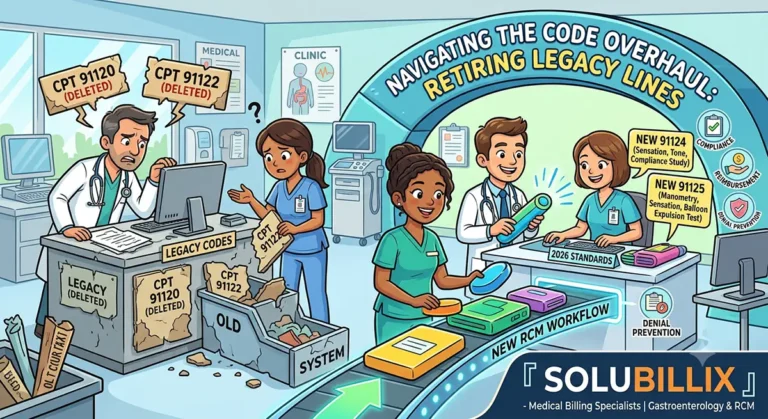
10. Failure to Follow Updated CPT Guidelines
CPT coding changes continue to evolve every year, and dermatology practices that fail to stay updated face growing billing challenges.
Common issues include:
- Using deleted CPT codes
- Applying outdated coding rules
- Incorrect category selection
- Missing payer-specific requirements
Regular coding education is essential for maintaining claim accuracy.
How Dermatology Practices Can Reduce Coding Errors
Perform Routine Internal Audits
Internal audits help identify:
- Coding inconsistencies
- Modifier misuse
- Documentation gaps
- Overcoding risks
- Repeated denial patterns
Proactive auditing reduces long-term financial exposure.
Strengthen Clinical Documentation
Documentation should:
- Match billed services
- Support medical necessity
- Include lesion details
- Explain physician decision-making
- Justify modifiers and procedures
Detailed charting remains critical for successful dermatology billing.
Train Providers and Billing Staff
Ongoing education helps practices stay updated on:
- CPT coding changes
- Modifier requirements
- Documentation expectations
- Dermatology compliance rules
- Payer-specific billing edits
Proper training reduces costly claim errors.
Work With Dermatology Billing Specialists
Dermatology billing requires specialty-specific expertise that many general billing companies cannot provide.
At Solubillix, we help dermatology practices improve coding accuracy, reduce denials, optimize reimbursement, strengthen compliance, and streamline revenue cycle management through customized dermatology billing solutions.
Our team understands the complexities of:
- Procedural dermatology coding
- Mohs surgery billing
- Modifier compliance
- Biopsy documentation
- Cosmetic billing regulations
- Insurance audit prevention
Final Thoughts
Dermatology CPT coding errors are becoming more costly in 2026 as insurance companies increase claim reviews and tighten compliance standards.
Practices that continue using outdated coding workflows or weak documentation processes may experience:
- Higher denial rates
- Delayed reimbursements
- Revenue leakage
- Audit exposure
- Compliance penalties
However, dermatology providers that prioritize coding accuracy, documentation quality, internal auditing, and specialty-focused billing support can significantly improve financial performance and reduce payer-related risks.
In today’s healthcare environment, accurate dermatology coding is no longer optional — it is essential for long-term practice success.
That is why many providers trust Solubillix for expert dermatology billing services and revenue cycle management support.