
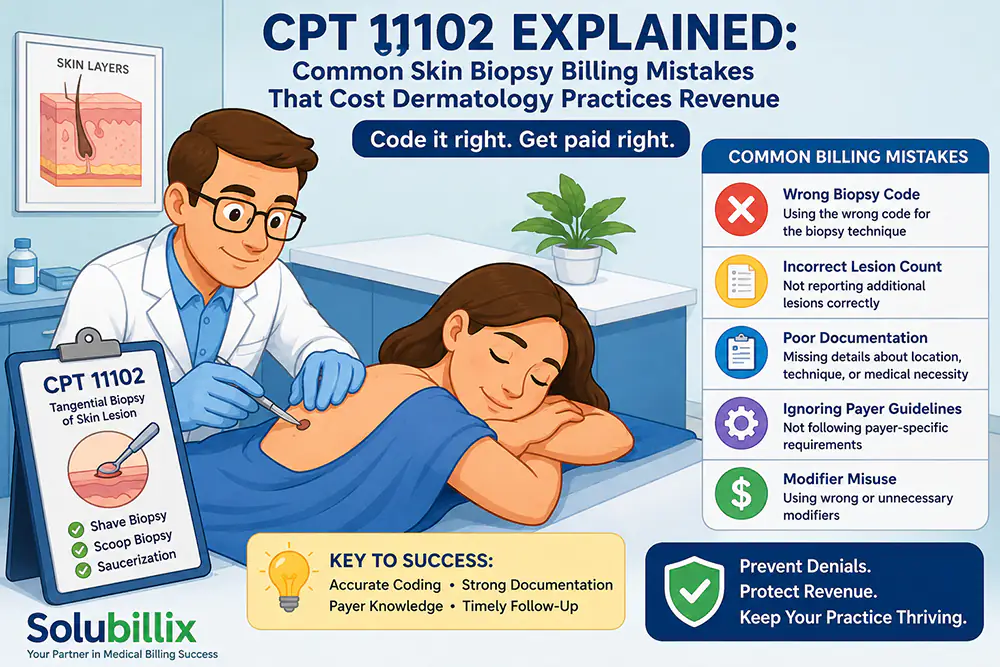
Dermatology practices perform skin biopsies every day to diagnose suspicious lesions, inflammatory skin conditions, and potential skin cancers. While these procedures are common, billing errors related to CPT 11102 can quietly reduce reimbursement and create avoidable claim denials.
Many dermatology providers focus on delivering accurate diagnoses and timely patient care, but coding and billing details can become a hidden source of revenue loss. Incorrect coding selection, incomplete documentation, and misunderstanding add-on biopsy codes often lead to payment delays or denials.
At Solubillix, we frequently see dermatology practices facing these preventable billing challenges. Understanding CPT 11102 and applying accurate billing practices can help protect revenue and improve claim acceptance rates.
What Is CPT 11102?
CPT 11102 describes a tangential biopsy of a single skin lesion. Tangential biopsy techniques may include:
- Shave biopsy
- Scoop biopsy
- Saucerization
The procedure involves removing a superficial portion of the lesion for diagnostic evaluation.
CPT 11102 applies to the first lesion biopsied using the tangential technique. When additional tangential biopsies are performed during the same encounter, add-on coding may apply depending on the number of lesions and procedural details.
Accurate code selection matters because biopsy coding is based on technique and lesion count, not solely diagnosis.
Who Can Bill CPT 11102?
CPT 11102 may be billed by qualified healthcare professionals performing medically necessary dermatologic procedures within their scope of practice.
This commonly includes:
- Dermatologists
- Dermatology specialists
- Qualified physicians
- Certain advanced practice providers when permitted by payer policy and supervision requirements
Coverage and reimbursement policies may vary by payer, making payer-specific verification an important part of claim preparation.
Common CPT 11102 Billing Mistakes
Dermatology practices often lose revenue due to billing mistakes that appear minor but have major reimbursement consequences.
1. Confusing Biopsy Technique Codes
One of the most common errors is choosing the wrong biopsy code.
Skin biopsy CPT codes are categorized by technique. CPT 11102 specifically represents tangential biopsy. Punch and incisional biopsies have separate coding families.
Selecting a code based only on diagnosis rather than procedural method can trigger denials or payer audits.
2. Billing Incorrect Lesion Counts
CPT 11102 represents the initial tangential biopsy lesion.
When multiple lesions are biopsied, proper add-on coding becomes essential. Billing only the primary code when additional lesions were treated may lead to underpayment, while reporting lesion counts inaccurately may trigger payer scrutiny.
Documentation must clearly support the number of lesions biopsied.
3. Incomplete Procedure Documentation
Documentation gaps are another frequent denial source.
Payers typically expect records to support:
- Medical necessity
- Lesion location
- Biopsy technique used
- Clinical rationale
- Procedure details
- Pathology relevance when applicable
Incomplete charting may cause claim rejection even when the procedure was medically appropriate.
4. Ignoring Payer-Specific Requirements
Although CPT coding standards provide procedural definitions, payers may apply their own policies regarding medical necessity, diagnosis support, frequency limitations, and modifier requirements.
Failing to review payer guidance can create avoidable reimbursement problems.
5. Modifier Misuse
Modifier errors can create claim delays and payment complications.
Depending on the clinical scenario, modifiers may be necessary to indicate distinct procedural services or separate encounters. However, modifiers should only be reported when fully supported by documentation and payer policy.
Automatic or routine modifier use without supporting medical records may increase audit risk.
Documentation Requirements for CPT 11102
Strong documentation supports both medical necessity and reimbursement.
Clinical records should generally include:
- Patient presentation and symptoms
- Lesion description and location
- Reason biopsy was medically necessary
- Tangential biopsy technique performed
- Number of lesions biopsied
- Procedure notes
- Provider assessment and treatment plan
Clear and organized documentation helps reduce denials and strengthens claim defensibility during payer review.
Understanding AMA and CMS Guidance
Coding guidance evolves, making continued education essential.
The American Medical Association (AMA) maintains CPT code definitions and procedural descriptions used for reporting services. Providers should apply CPT coding according to the documented biopsy technique and procedural details.
CMS and payer policies may influence coverage decisions, medical necessity standards, and reimbursement requirements. Because Medicare Administrative Contractors and commercial insurers may maintain separate policies, dermatology practices should verify current payer rules before claim submission.
Practices should rely on updated coding resources and payer guidance to support accurate reporting.
How Dermatology Practices Can Prevent CPT 11102 Denials
Reducing denials requires both clinical and billing alignment.
Effective strategies include:
Verify Documentation Before Submission
Billing teams should confirm that the procedure note supports the selected biopsy code.
Train Staff on Biopsy Coding Updates
Ongoing education helps reduce coding confusion and keeps teams current on billing changes.
Monitor Denial Trends
Repeated denial patterns often reveal workflow gaps that can be corrected.
Perform Internal Audits
Periodic coding reviews help identify missed revenue and compliance risks.
Use Specialty-Focused Billing Support
Dermatology billing involves specialty-specific coding knowledge. Experienced billing teams can help practices improve clean claim rates and reduce revenue leakage.
Frequently Asked Questions
Is CPT 11102 used for every skin biopsy?
No. CPT 11102 applies specifically to tangential biopsy of the first skin lesion. Other biopsy techniques require different CPT codes.
Does pathology billing replace CPT 11102?
No. Pathology services and procedural biopsy billing are separate services when appropriately performed and documented.
Can CPT 11102 be denied?
Yes. Denials may occur because of incorrect coding, insufficient documentation, payer policy issues, or unsupported medical necessity.
Final Thoughts
Skin biopsies are routine procedures in dermatology, but routine procedures can still create significant revenue loss when billing errors occur. CPT 11102 requires careful attention to biopsy technique, lesion count, documentation quality, and payer-specific requirements.
Practices that strengthen coding accuracy and denial prevention strategies often see improved reimbursement and cleaner claim performance.
Solubillix helps dermatology providers navigate specialty billing challenges with a focus on coding accuracy, denial reduction, and revenue cycle efficiency. Accurate skin biopsy billing is not only about compliance—it is also about protecting the financial health of your practice.